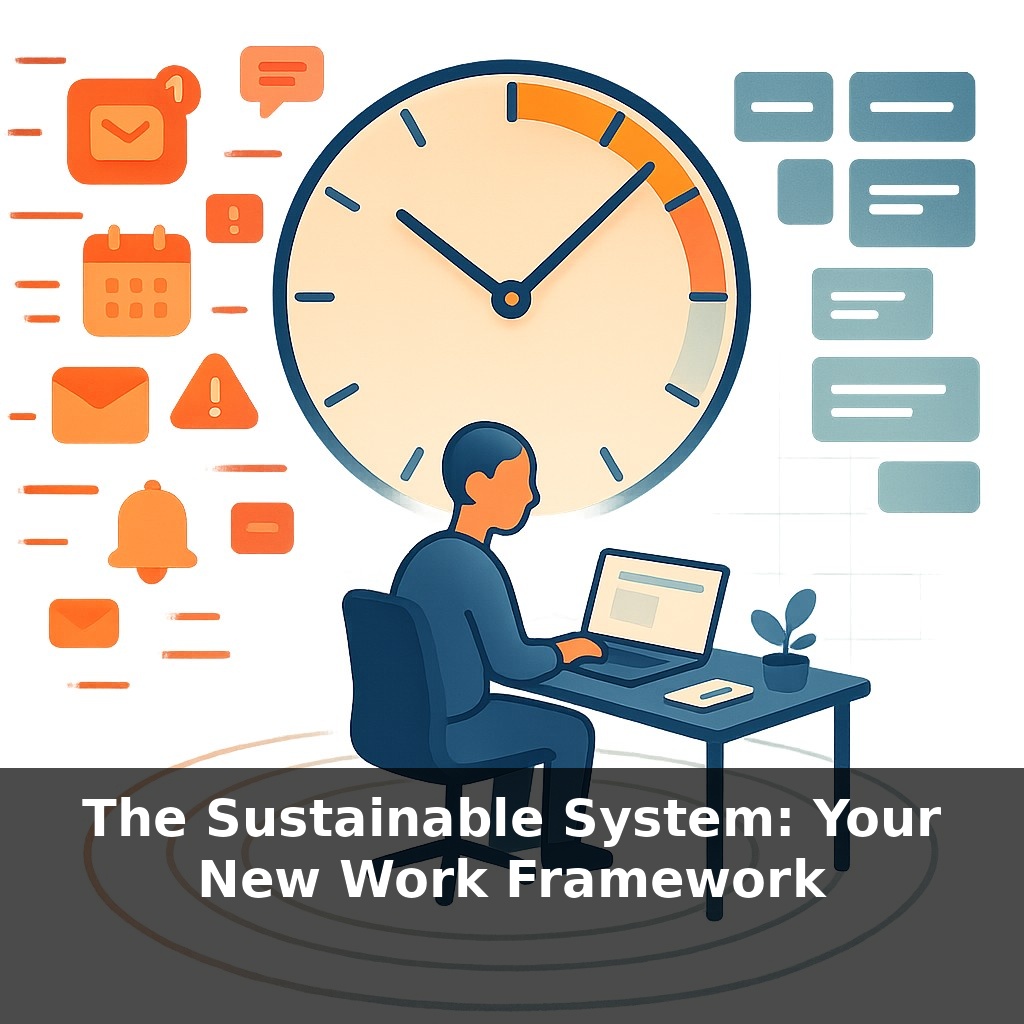
Your body can sustain intense focus for about an hour and a half—yet most workdays are chopped into tiny, frantic fragments. Picture yourself racing between pings, meetings, and “urgent” tasks… and still closing your laptop drained, with the real work untouched.
You’ve probably tried to “fix” your workday with tricks: a new app, a stricter to‑do list, maybe even time blocking. They help for a week, then the chaos seeps back in. That’s not a willpower problem; it’s a system problem.
Research shows the people who sustain high performance don’t just work harder in short bursts—they structure the *entire* ecosystem around their work: when they tackle deep tasks, how they rest, what they say no to, and how much control they have over their schedule.
Think of it less like optimizing a single day and more like designing a sustainable, week‑long “operating system” for yourself. The goal isn’t to squeeze more hours out of you; it’s to line up your workload, energy, and autonomy so that good days stop feeling accidental and start becoming the default.
Most people try to “fix” their workday at the surface level: rearrange meetings, install a website blocker, switch note apps. It’s like rearranging icons on your phone while the battery keeps dying. A sustainable system goes deeper: *which* work earns a prime slot, *how* you move between modes, and *where* recovery lives on your calendar, not just in your evenings. It also zooms out from “today” to patterns across your week—your natural energy waves, your recurring drains, your non‑negotiables. Instead of chasing an ideal day, you’re designing repeatable conditions that make good days easier to hit and harder to break.
Most “productivity advice” jumps straight to tactics: use 90‑minute blocks, take 5‑minute breaks, walk every 30 minutes. Those are useful, but they only work when they’re part of a bigger pattern that actually fits your life. A sustainable system is less about copying best practices and more about assembling four ingredients into something that runs almost on autopilot:
1) **Load** – what you take on and when. 2) **Recovery** – how your brain and body come back online. 3) **Autonomy** – how much control you have over the first two. 4) **Meaning** – why any of this is worth doing.
Research is clear: if even one of these is chronically out of whack, you pay for it in exhaustion, cynicism, or quiet disengagement. But when they’re *intentionally* balanced, several things happen: you can push hard without crashing, you get more done in fewer hours, and “off” time stops feeling like numbing out and starts feeling restorative.
Practically, this means designing *modes* instead of improvising all day. For knowledge work, three modes cover most of what matters:
- **Deep work mode:** high‑stakes thinking, protected from interruptions. - **Light work mode:** email, admin, quick coordination. - **Recovery mode:** micro‑breaks, movement, real psychological detachment.
Each mode has its own rules: length, environment, tools, and boundaries. A 90‑minute deep work block might mean one goal, one document, phone in another room. A 25‑minute light work sprint might mean blasting through a queue with a timer. Recovery might mean a 10‑minute walk without your phone or a stretch plus water, not scrolling.
The key is *sequencing* these modes in a way your brain likes. Stack two or three cycles, then insert a longer reset. Protect your best‑quality hours for work that actually moves the needle, and demote shallow tasks to your natural slumps.
Think of it like configuring a piece of software: default settings for how long you run a process, how often you clear cache, when you shut down background apps. Once set, you don’t negotiate with yourself every hour—you just follow the modes you designed.
Think of these modes as presets you’re “programming” into your week. Instead of asking, “What should I do now?” you’re choosing among a few well‑designed options.
Example: A marketing lead notices her sharpest thinking happens mid‑morning. She blocks 9:30–11:00 as a recurring deep‑work window for campaign strategy, moves status meetings to afternoons, and batches Slack/email into two 20‑minute light‑work sprints. Between cycles, she takes 7‑minute movement breaks: refill water, stretch, one lap outside.
Or a developer in a noisy open office negotiates a small autonomy win: three “headphone hours” each day when coworkers know not to tap him. He stacks code reviews (light work) after lunch, when his energy dips, and adds a short walk after his last call to mark the psychological switch from work to personal time.
A bit like configuring a smart home system—once you set scenes for “focus,” “admin,” and “off,” your environment nudges you into the right mode instead of you relying on sheer willpower all day.
A sustainable system also changes how you *plan* your career. Instead of chasing every promotion, you weigh each move against your capacity: “Can my current system stretch to hold this, or do I need to re‑engineer it first?” That mindset makes you pick roles, managers, and companies that respect bandwidth. Think like a long‑term investor rebalancing a portfolio: you periodically shift how much “risk” you take on in projects, learning, and rest so you don’t overexpose any part of your life.
When you treat your setup as a living draft, every week becomes a small experiment: swap one meeting, shift one block, add one cleaner shutdown. Over time, these tweaks compound like steady deposits in a retirement account—quietly growing your capacity, options, and confidence until “sustainable” isn’t a goal anymore, it’s just how you work.
Start with this tiny habit: When you open your laptop to start work, whisper to yourself, “What’s my minimum today?” and pick just ONE sustainable move for your system—like moving a recurring task from your to‑do list into a weekly block on your calendar. When you feel that familiar urge to overhaul everything at once, pause and instead adjust ONE friction point, like shortening a meeting by 10 minutes or deleting a low‑impact recurring task. Before you close your laptop, jot a single sentence in your “Sustainable System” doc: “One thing that felt easy today was ______,” so you’re slowly training your system around what’s actually sustainable, not ideal.