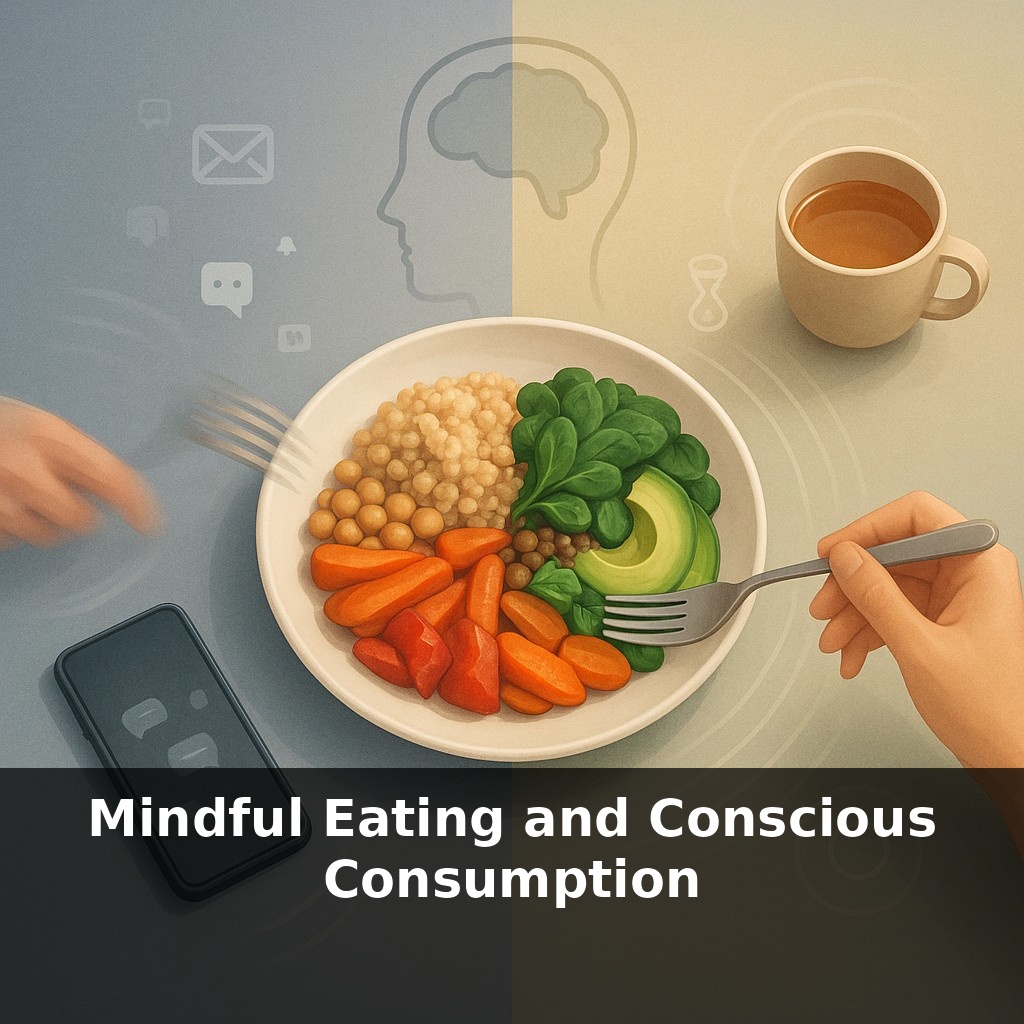
Right now, the average American meal is over in about 10 minutes—shorter than most playlists’ first song. Yet your brain needs far longer to even register fullness. In this episode, we’ll step into that gap between “first bite” and “I’m done” and explore what’s actually happening there.
Most of us eat on autopilot: scrolling, answering emails, finishing “just one more thing” while our fork keeps moving. Then the plate is empty and we’re not totally sure when we crossed from “hungry” to “stuffed.” In this episode, we’re going to slow that blur down and zoom in—not to judge your food choices, but to understand what’s actually driving them.
New research shows that how you eat can reshape what your brain expects from food: its pleasure, its comfort, even its role as stress relief. Mindful eating isn’t about tiny portions or moral perfection; it’s about upgrading your internal “operating system” so hunger, satisfaction, and choice become clearer signals instead of static.
We’ll look at why stress hijacks your appetite, how awareness changes cravings over time, and how your plate connects to bigger issues like waste and sustainability.
So in this episode, we’ll treat your meals like a live “data stream” instead of a blur you only evaluate afterward. We’re going to look at three layers: what’s happening in your body before, during, and after you eat; what’s happening in your mind—especially around cravings, guilt, or “I’ve already blown it”; and what’s happening in your environment, from portion sizes to how much ends up in the trash. Think of it as debugging a program: we’re not blaming the user, we’re tracing the code that leads from the first bite to the final decision.
When researchers put people in scanners and show them food cues, one pattern keeps popping up: the more rushed and distracted someone typically eats, the louder the brain’s “reward” centers shout in response to hyper-palatable foods. Over time, that wiring starts to prefer intensity over subtlety—big hits of sugar, salt, and fat over quieter signals like gentle fullness or stable energy.
Mindful-eating training nudges that system in a different direction. Several trials, including an NIH-funded MB‑EAT program, find that as people practice paying close attention to the first bites, the brain’s response to “trigger foods” becomes less explosive, while sensitivity to internal signals—like the relief of genuine hunger easing—gets stronger. Participants often report that the same food tastes different: sometimes better, sometimes oddly flat. That shift is data, not failure. It means your brain is recalibrating what counts as rewarding.
Physiologically, slowing down changes the timeline. Mechanical chewing, taste, and stomach stretch all send signals upward, but hormones like GLP‑1 and peptide YY that say “that’s enough” need time to peak. When you double meal length, you’re not just dragging things out—you’re allowing those hormones to join the conversation. That’s one reason a simple speed reduction can cut intake by about 10 % without feeling deprived.
There’s also the stress piece. Eating in a keyed‑up state keeps cortisol elevated, which pushes the body toward storing more and craving faster energy. Studies of mindful-eating programs show not only fewer binge episodes and modest weight shifts, but also smoother blood sugar curves and lower cortisol. In practice, that can look like fewer “I lost control at 9 p.m.” episodes and more evenings that just… pass without a food battle.
Zooming out, conscious consumption extends past your plate to your fridge and trash can. When households bring the same awareness to buying and portioning—asking “Will someone actually want this, in this amount, at a specific time?”—food waste drops sharply. The NRDC’s data suggest reductions of up to 25 % when people plan with realistic appetites in mind.
Listening closely during meals is like switching your phone from blaring notifications to a well‑tuned settings panel: you’re still getting signals, but now you can see which alerts matter, which can be dismissed, and which suggest a deeper change is needed.
Think of a typical Tuesday lunch you barely remember afterward. Now replay it with one tweak: for the first three minutes, you do nothing but notice tiny details—temperature, first scent, how the first bite breaks apart. Many MB‑EAT participants start there, with a single “micro‑window” of attention inside an otherwise normal meal, and still report calmer evenings and fewer “how did I finish the bag?” moments weeks later.
Or take grocery shopping. One client I worked with set a rule: only buy fresh items she could name a specific meal and day for. That single filter quietly shrank her cart, cut her trash, and revealed an unexpected pattern—she routinely overbought “healthy” foods as a way to feel virtuous, then threw them out.
For some people, the real leverage point isn’t dinner at all but the “in‑between” bites: the crusts eaten while cleaning up kids’ plates, the handful of nuts grabbed while cooking. Tracking only those mindless fragments for a week often exposes an invisible extra “meal” hiding in plain sight.
As this awareness deepens, daily routines quietly reconfigure. Cafeterias might swap blaring TVs for calmer spaces; apps could nudge you when your usual pace jumps, like a fitness tracker noticing a sudden sprint. Families start syncing meals the way they sync calendars, treating shared attention as a resource to budget. Over time, personal patterns aggregate: if whole neighborhoods normalize slower, more intentional eating, supply chains adapt, pricing shifts, and “default” options look very different for the next generation.
Your challenge this week: once a day, pick one ordinary snack and treat it like a “beta test.” Before the first bite, decide: stop at three slow bites, then re‑check—do you still truly want more, or is the urge fading? Log only that decision point. After seven days, review: when does “more” actually add pleasure, and when is it just habit?