Right now, millions of people climb into bed exhausted—and then feel their brains slam the gas pedal. One person replays work emails; another plans next week’s budget; another scrolls through “just one more” video. All of them are tired. None of them are actually winding down.
Most people think better sleep starts when they turn off the light. Biologically, it starts at least an hour earlier. Your nervous system is still carrying “tabs” from the day: that awkward comment, the unresolved email, the mental to‑do list that keeps auto-refreshing like a browser stuck on reload. By the time you’re horizontal, your body is buzzing with unfinished business.
Mindfulness gives those tabs somewhere to land. Not as another task, but as a series of gentle “signposts” your brain learns to recognize as the shift from doing to settling. Over time, a few simple cues—a slower breath, a familiar notebook, a certain way you move through your space—become like a dimmer switch for your internal intensity.
This isn’t about perfection. It’s about creating just enough predictability that, each night, your mind doesn’t have to renegotiate whether it’s allowed to rest.
So tonight’s routine isn’t just about feeling calm—it’s about training your brain’s internal clock. Every repeated cue you add—lower light, slower speech, moving more slowly through your space—becomes data your body uses to time hormone release, temperature shifts, and the transition into deeper stages of sleep. Think of it as updating the “firmware” that runs in the background of your day. You’re not forcing yourself to sleep; you’re creating conditions where sleep becomes the default, not the exception, even after evenings that feel hectic or emotionally charged.
Here’s where the routine gets concrete. Think of this as designing a short “evening sequence” that your body can learn, step by step.
Start by picking a consistent *start time* rather than a specific bedtime. For example: “At 10:15, I begin my wind‑down, no matter what.” Your actual lights‑out might move a little, but the brain pays more attention to when the slowing *starts* than to when you finally close your eyes. Research in students and shift workers shows that this kind of regularity predicts performance and mood more strongly than total hours alone.
Next, strip away one big source of confusion: bright, close‑up screens. Two hours might sound unrealistic; begin with 30–45 minutes. That doesn’t mean you have to sit in silence. It means anything with strong blue light or rapid, novel content (phones, laptops, tablets) goes away. Many people find that when the default option disappears, a different part of the evening becomes available: conversations, stretching, even just staring out a window and letting the mind decelerate.
Into that cleared space, you add a few low‑effort practices that directly nudge arousal downward. Slow diaphragmatic breathing—say, inhaling to a count of 4 and exhaling to a count of 6 for five minutes—can lower heart rate within one session. A brief body scan, moving attention from toes to head, converts vague tension into specific sensations your system can actually process. A 3‑line gratitude note (“Today I appreciated…”) helps redirect the problem‑seeking bias that tends to dominate at night.
These pieces work best when they’re linked together in the same order. Over a week or two, your brain starts recognizing the sequence: dimmer lights, slower breath, pen on paper. Athletes don’t rely on willpower to perform; they lean on rituals that make the desired state more likely to appear on cue. You’re doing the same thing with rest: reducing friction, lowering noise, and letting your biology do work it’s already wired to do—once you stop asking it to sprint right up until the moment you expect it to drift.
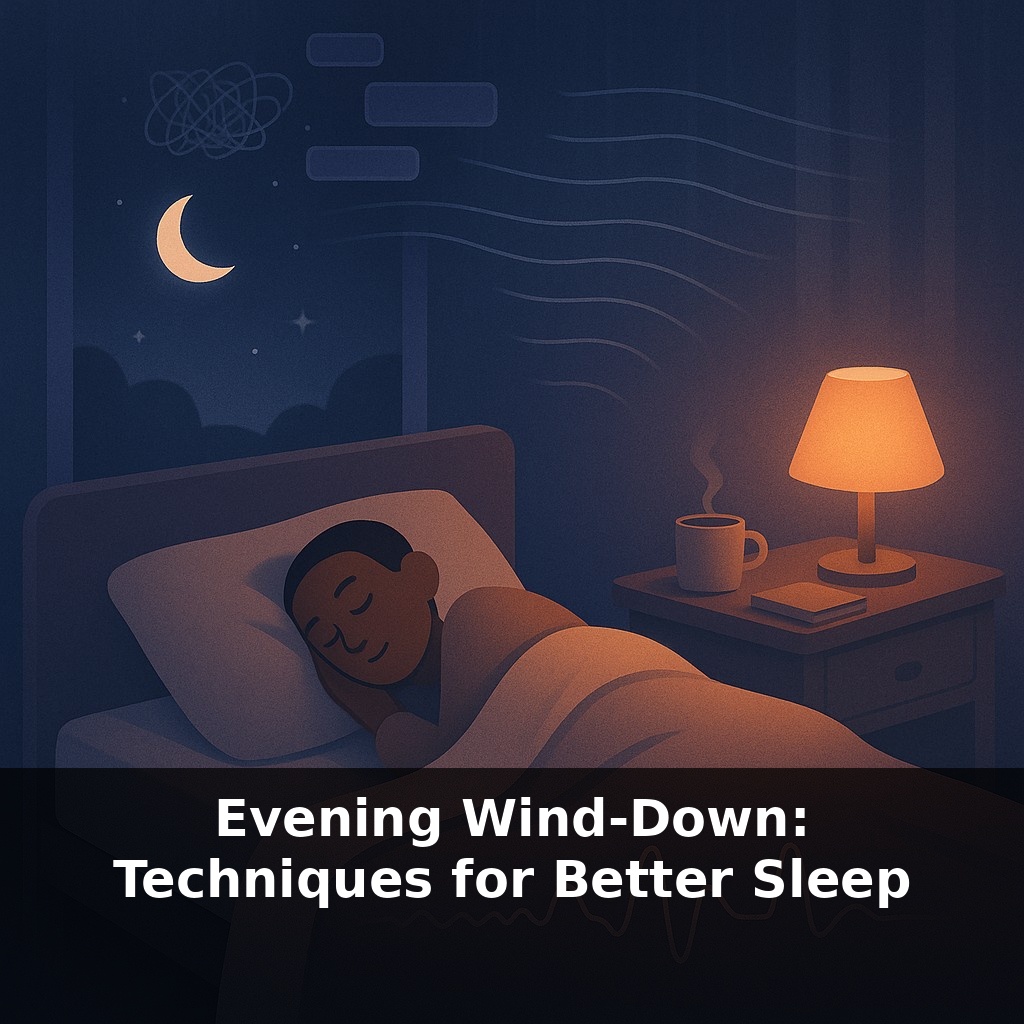
Think of two people at 10:15 p.m. One drops onto the couch, phone in hand, auto‑plays three episodes, then shuffles to bed when they can’t keep their eyes open. The other flips their phone to airplane mode, sets it across the room, turns on a warm lamp, and pulls out a notebook. Same day, same level of exhaustion—completely different “evening trajectory” once that first move is made.
Small choices like that first move are what reshape your evenings. Some people find it helps to anchor the sequence to existing habits: brushing your teeth becomes the trigger for three slow breaths at the sink; clicking off the kitchen light flows into filling a water bottle and writing one line about something that went right. Others pair routines with locations: the end of the bed is only for a brief stretch and body scan; the desk is only for jotting down next‑day tasks so they don’t leak into the night.
Your routine can be minimal but still precise. One musician I worked with used a three‑step pattern before late gigs: hot shower, ten quiet breaths with a hand on the chest, then noting the “top three” concerns on paper. Over a month, they noticed fewer 3 a.m. wide‑awake stretches and—more interestingly—less dread about going to bed on performance nights. Another person with an unpredictable work schedule focused just on *sequence* when the *time* couldn’t be fixed: tea, stretch, two minutes of breathing, page of reading. The clock varied by over an hour, but the predictability of those steps still softened the edge off their nights.
Your own version might be as simple as “dim, sit, breathe, jot, read.” The power isn’t in complexity; it’s in repeating the same short series often enough that your mind starts to recognize it as a familiar on‑ramp, even on days that feel anything but calm.
In a few years, your pre‑bed choices might be quietly synced with your health data. A wearable could notice you’re overstimulated—racing pulse, shallow breaths—and nudge your headphones to offer slower guidance, like a coach calling a time‑out when the game gets frantic. At scale, these “evening coaches” could shift from a private habit to infrastructure, the way traffic lights organize busy streets so thousands of separate journeys run more smoothly.
You don’t have to get this perfect; you just have to get it repeatable. Over time, your evening choices can ripple outward: fewer late‑night arguments, clearer mornings, a little more bandwidth for the people you care about. Your challenge this week: treat your last waking hour like prime real estate—and notice what you’ve quietly been building there.