Around mid-afternoon, your brain quietly hits “low power mode.” Studies show reaction speed can drop noticeably after lunch—yet that’s when many of us schedule our most demanding work. So here’s the puzzle: what if the most productive thing you did then took under two minutes?
That tiny window after lunch, when your cursor hovers and your mind quietly drifts, isn’t laziness—it’s biology nudging you toward a reset. Instead of muscling through with more caffeine or tab-hopping, you can use that same few minutes to deliberately reboot your attention. Research on “micro” mindfulness breaks shows that even 60–180 seconds of intentional practice can shift your brain from scattered to steady. This isn’t about becoming serene or spiritual at your desk; it’s about training a quick mental pit stop, like a Formula 1 team swapping tires in seconds so the car can keep racing cleanly. In this episode, we’ll look at midday as a strategic checkpoint: when to pause, which simple techniques work best in real workplaces, and how to integrate them without announcing to your colleagues that you’ve suddenly become “the mindfulness person.”
Think of this midday reset as maintenance, not magic. The goal isn’t to feel blissed out—it’s to clear just enough “mental dust” so your brain can grip the next task. Research shows these short pauses can nudge attention networks back online and dial down stress signals that quietly build all morning. Instead of treating lunch as a hard line between “before” and “after,” we’re zooming in on the messy middle: the five minutes between meetings, the 90 seconds waiting for a file to load. Those tiny in-between moments are perfect real estate for practices that keep you present instead of drifting into autopilot.
If mornings are about ramping up and evenings are about winding down, midday is when your mental gears tend to grind. That’s exactly where these brief, intentional practices fit—not as a separate “wellness activity,” but as a way of steering how your brain shifts between tasks.
One useful way to look at midday mindfulness is through what’s happening under the hood: your brain toggles between the task-positive network (TPN), which helps you focus, and the default mode network (DMN), which jumps to daydreaming, self-talk, and rumination. After a long stretch of decisions, emails, and meetings, the DMN starts hijacking more time. You notice it as mind-wandering in a meeting, rereading the same sentence, or doom-scrolling between tasks.
Brief practices act like a deliberate toggle. In 60–180 seconds, you’re not trying to become calm; you’re practicing the skill of “coming back” on purpose. That repetition—notice, shift, refocus—is what seems to strengthen the TPN and quiet the DMN, according to imaging studies. Over days and weeks, you’re not just surviving afternoons; you’re actually retraining how quickly you can recover your attention after a distraction.
This is where techniques differ. A 5-sense check-in—silently naming one thing you can see, feel, hear, smell, and taste—anchors you in the environment and is excellent when you’re mentally scattered. Box-breathing (inhale, hold, exhale, hold for equal counts) leans more on the body; those measured exhales can nudge heart-rate variability up within a couple of minutes, signaling your nervous system that it’s safe to stand down a notch. Very short “micro-meditations”—like following 10 breaths, or watching the sensation of your feet on the floor—blend both: a mild physical settling plus a mental refocus.
Context matters too. In knowledge work, the post-lunch window often involves switching between tasks: updating a brief, then jumping into a call, then answering chat messages. Each switch has a “cognitive tax.” Dropping a 90-second practice right before a demanding block—drafting, coding, presenting—essentially pays that tax up front, so fewer costs show up as errors or rework later.
All of this only helps if it’s frictionless. The most effective midday practices are the ones you can do: - Without closing your eyes, if that feels awkward - Without any apps, timers, or special spaces - Without anyone else needing to participate
The goal isn’t to create a perfect routine; it’s to seed tiny, repeatable cues into the messy reality of your day, so coming back to the present becomes less of a rescue maneuver and more of a habit.
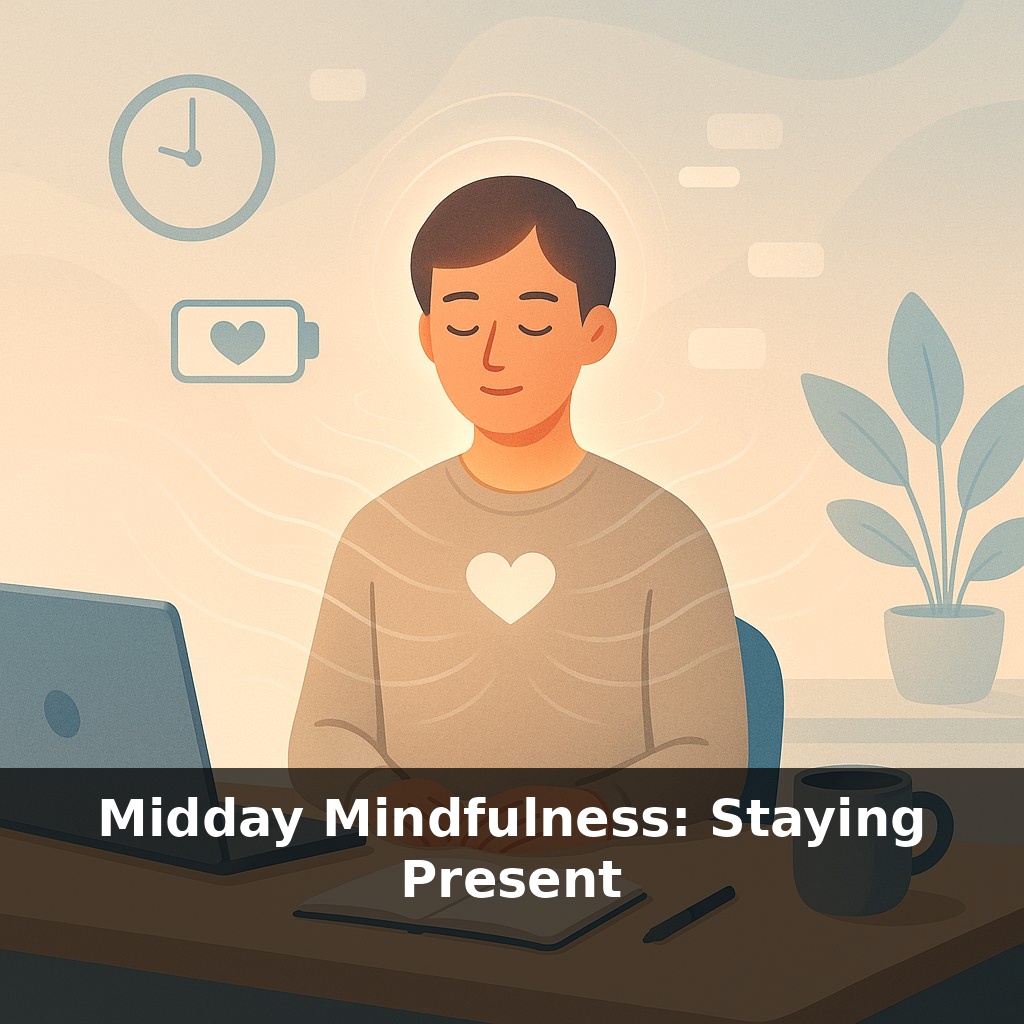
A simple way to see this in action is to look at how different people “plug in” midday. A software engineer in back‑to‑back stand‑ups might quietly use the 30 seconds while a deploy runs to do a 5-sense scan, not to relax, but to notice whether her shoulders have crept toward her ears and deliberately let them drop. A nurse charting between patients might take three slow breaths at the computer, feeling the rise and fall under her scrubs before clicking into the next record. A salesperson who lives in their calendar might block a recurring 3‑minute “reset” right after their most draining daily call, using it to stand, feel their feet, and take ten counted exhales before opening email again.
Organizations can scaffold this too: a team agreement that the first minute of key meetings is silent arrival, or an automated “breathe” nudge paired with scheduled reports. Done consistently, these tiny acts become less like extra tasks and more like how you naturally switch mental gears.
Soon, midday mindfulness may be less about willpower and more about design. Office lighting, meeting lengths, even software prompts could be tuned like stadium lights—bright for sprints, dimmer for recovery. Leaders might be rated not just on output, but on how sustainably their teams can focus by 2 p.m. And as wearables quietly learn your afternoon “signature,” the nudge to pause could feel less like a wellness tip and more like having a skilled coach timing your substitutions.
Midday mindfulness isn’t another task on your list; it’s a way of quietly editing how your day unfolds. Over time, those 90‑second pauses can change which meetings you say yes to, how you recover from bad news, even how you walk into your evening. Your challenge this week: treat one midday pause like a software update—small patch, different operating system.