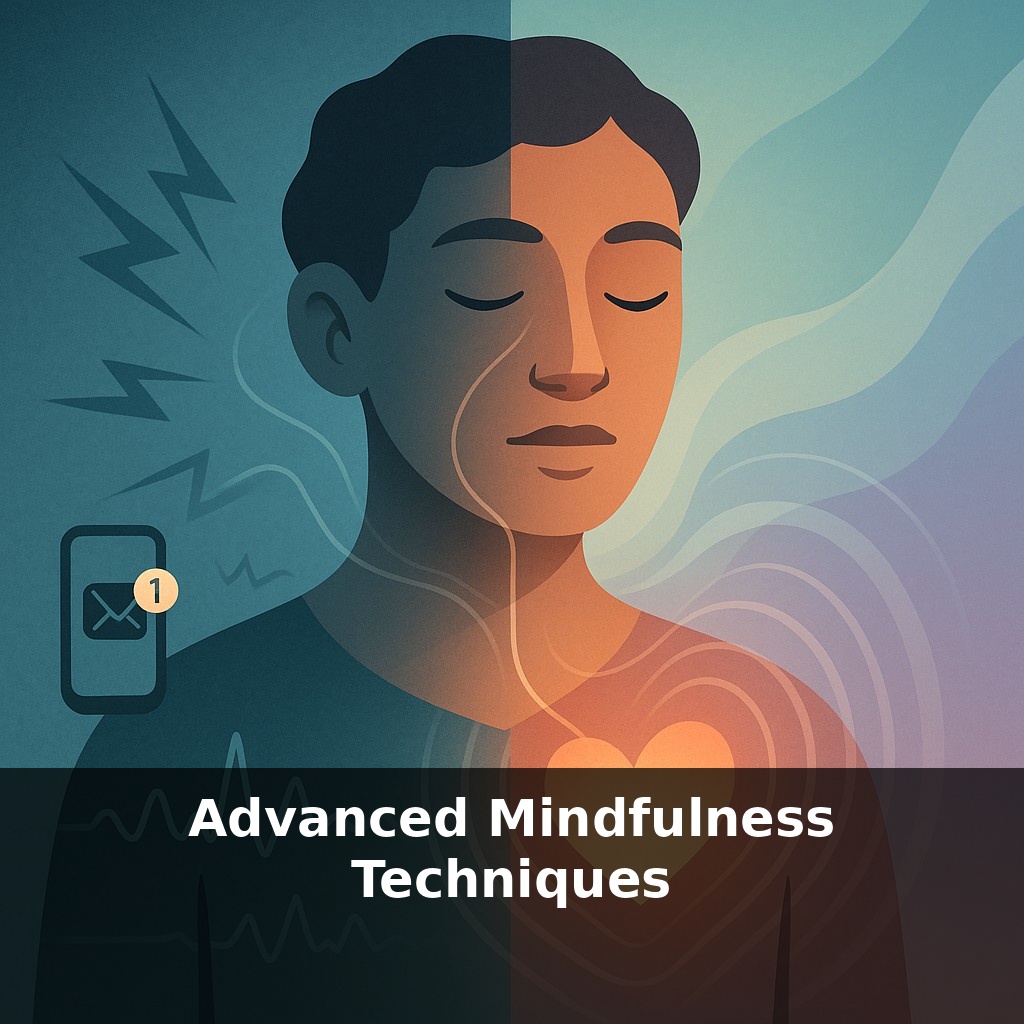
Maya’s phone buzzes: an email from her boss, sharper than it needs to be. Her chest locks, jaw tightens, breath loud in her ears. She finds her inhale, her exhale… but the sting and shutdown stay. When the breath isn’t enough, how do you retrain your heart and body’s reflex?
Maya does what she was taught: notices her breath, labels “tightness,” “heat,” and waits. The wave passes, but later that night she’s replaying the email, rehearsing comebacks, feeling her pulse in her temples. Basic mindfulness helped her not explode; it didn’t help her feel genuinely okay. This is where advanced practice comes in—not “fancier,” just more targeted.
Two upgrades matter most: practices that warm the emotional tone (like directed goodwill toward yourself and others), and practices that sharpen how you inhabit your body from the inside. A nurse debriefing after a traumatic shift, a parent stuck in nightly conflict with a teen, a manager giving hard feedback every week—these situations call for skills that can steady physiology and soften attitude in real time, not only after the fact. That’s what we’ll train next.
In clinical settings, these upgrades are now used less as “spiritual extras” and more as targeted tools. An oncologist team in Wisconsin opens weekly meetings with three minutes of silent goodwill for the most distressed patient on their list; staff burnout scores have quietly fallen. A tech lead in Denver bookends code reviews with a 60‑second body-scan, noticing shoulders, jaw, gut, before speaking. Parents in a pediatric pain program coach their kids to feel the whole body during flares, not just the pain zone, cutting ER visits over a semester. You’ll learn to adapt tactics like these to your own life.
Neuroscientists now see something meditators have claimed for centuries: once attention is reasonably steady on the breath, shifting into loving‑kindness and refined body‑awareness doesn’t just feel different—it lights up partially different circuitry. Think of this as expanding your training zone so you’re not only calmer in neutral moments, but less hijacked in emotionally loaded ones.
Loving‑kindness first. In Barbara Fredrickson’s 2008 trial, people didn’t start by beaming compassion at difficult coworkers. They began with someone easy: a mentor, a grandchild, even a pet. The phrases were simple—variations of “may you be safe, healthy, at ease”—but participants were coached to *quietly invite the feeling* the words pointed to. Over six weeks, that 9% bump in daily positive emotion wasn’t just “more smiles”; it predicted higher scores in resilience and social support months later.
Applied to Maya’s world: after reading the harsh email, she might pause for 90 seconds, picture a colleague she genuinely likes, and repeat her chosen phrases with a slight softening of the eyes and chest. Only then does she respond to the message. She’s not forcing forgiveness; she’s priming her emotional baseline upward before engaging.
On the body side, the data are just as concrete. The Mass General study didn’t use exotic techniques; participants slowly swept attention from crown to toes, noting pressure, temperature, subtle pulsing. Ten to 20 minutes, most days, for eight weeks—and systolic blood pressure edged down by several points. In the Marine M‑FIT program, combining this with breath work reduced cortisol spikes under stress by 17%. That’s not a vague “felt better”; that’s biochemistry changing.
Consider a trial lawyer before closing arguments. Her habit used to be last‑minute email and coffee. Now, three minutes in a quiet corner: attention moves through throat, chest, belly, hands on the lectern. She doesn’t try to relax anything; she registers the exact pattern of tension without flinching. Often, the jaw eases on its own, the breath evens, and her tone in court is firm rather than brittle.
Over time, these practices become deployable in micro‑bursts—20 seconds between back‑to‑back meetings, two breaths and one kind phrase before you unmute on Zoom, a quick scan of hands and belly while your teenager vents. The formal sessions build the neural “muscle”; the tiny, in‑the‑wild reps are where your life actually changes.
Leo, a senior engineer, keeps clashing with a colleague in design reviews. Instead of using breaks to replay arguments, he experiments with two-minute metta reps at his desk: eyes open, screen dimmed, silently offering well‑wishes first to a close friend, then briefly to his team. Within a month, he notices he enters reviews with less armor and catches defensiveness sooner, which makes disagreements shorter and more fact‑based.
A physical therapist working with chronic back‑pain patients adds a twist to standard rehab: after exercises, each person spends five minutes tracking sensations along the spine and into the feet. She asks them to note three zones that feel *neutral or good*, not just the painful area. Over several weeks, some patients report less fear of movement and are more willing to resume light hobbies.
A school counselor teaches a fifth‑grader who explodes in class to do a 30‑second internal “weather report” before raising his hand: notice chest, throat, hands, then recall one adult he feels safe with and silently wish them well once. His outbursts don’t vanish, but recovery time shrinks, and he starts asking for short breaks instead of storming out.
Building on those real‑life moments, here’s what starts to shift over months. First, emotional regulation: you’re less likely to feel totally flooded, and when you do, your system settles faster—like your inner “reset” button is easier to find. Second, relationships: a bit more patience, fewer sharp replies, and repairs after arguments come sooner. Third, body stress: familiar knots in your neck or gut slowly loosen and visit less often.
You’re strengthening different mental “muscles,” not just one.
Your challenge this week: pair a brief metta pause with one daily trigger—maybe the commute, opening your inbox, or washing dishes. Then, tack a short body‑check onto one known stress window—before a key meeting, or as you get into bed.
Have you noticed where these might naturally fit in your day already?
Building on those everyday shifts, here’s your quick takeaway: you can deepen an existing mindfulness habit by layering in loving‑kindness and refined body‑awareness to better target emotions, relationships, and physical stress.
Checklist for the next 7 days: • One brief metta session each day • One brief body‑awareness session each day
Before next week, ask yourself: 1) “In the middle of a stressful moment today (like checking email, getting interrupted, or rushing a task), what exactly is happening in my body for 10 breaths—where is the tension, what’s the temperature, what’s the pace of my heartbeat—and how does simply noticing it change the moment?” 2) “When my mind jumps into its usual ‘story’ (worrying about the future, replaying a past conversation, or judging myself), can I pause and ask, ‘What else might be true right now?’ and see if I can name at least one kinder, more spacious interpretation?” 3) “If I choose one ordinary routine—like making coffee, showering, or brushing my teeth—to turn into a daily ‘micro-retreat, ’ what would it look like to give that activity my full, curious attention for two minutes, as if I were experiencing it for the first time?”
Carry this question: “Where did I notice even a small shift in my body or in how I responded to someone?”