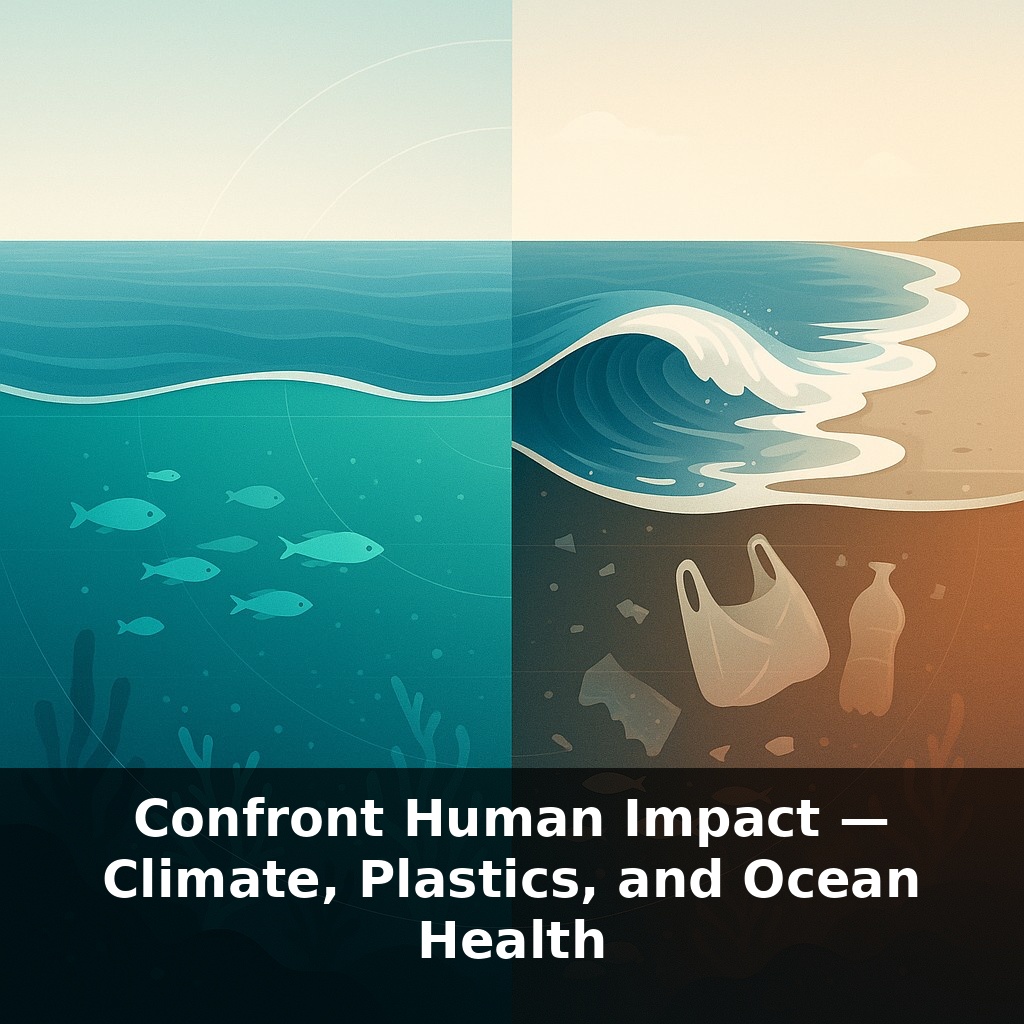
Right now, the ocean is quietly swallowing about a quarter of our carbon pollution—and more than nine‑tenths of the extra heat we create. Yet on a remote beach, a wave rolls in carrying… shredded plastic. Same ocean, same moment: global life‑support and global landfill.
The ocean is changing faster than at any time in human history, and not just at the surface where we swim. Its basic chemistry, temperature layers, and living communities are all shifting at once—and that collision of changes is what really matters. Warm water expands and creeps higher onto coasts. Extra dissolved CO₂ nudges pH downward, quietly reshaping which shells can form and which species can’t keep up. At the same time, a steady rain of packaging and fibers filters through the water column, from busy shipping lanes to the darkest trenches. These trends don’t stay “out there.” They bend storm paths, rearrange fish migrations, and test the resilience of reefs that buffer cities. In this episode, we’ll trace how these invisible shifts ripple into food on plates, safety of shorelines, and the stability of climate far beyond the sea.
Beneath those shifting temperatures and subtle chemical tweaks, entire ocean neighborhoods are being redrawn. Species that once stayed in the tropics are turning up near Iceland; cold‑loving creatures are squeezed toward the poles like people pushed to the back of a crowded bus. Heatwaves in the sea now scorch kelp forests much like wildfires racing through a dry hillside, stripping away shelter and nurseries for young fish. At the same time, tiny drifting larvae must navigate not only altered water, but a growing blizzard of plastic fragments that can be mistaken for food or surfaces to settle on.
Beneath the headlines about “warming seas,” the details get more unsettling—and more tangible. Start with sea level. That extra 20 centimeters since 1900 isn’t just a number; it changes how often high tides quietly flood streets, corrode wiring, and back up sewers. Add storms on top and you get compound events: in places like Miami, Lagos, or Jakarta, a routine high tide plus a heavy rain can now mimic a once‑in‑a‑decade flood.
As water creeps higher, natural defenses erode from both sides. Coral reefs bleached by repeated heat stress protect fewer shorelines from waves. Mangroves and salt marshes can, in theory, march landward as seas rise—but only if we don’t pin them in place with seawalls and roads. Where they’re squeezed out, cities face a choice: build ever‑higher concrete barriers or restore living buffers that grow as seas climb.
Higher temperatures also rewire the ocean’s “conveyor belts.” In Episode 7, we used sonar to map seafloor ridges; those same ridges steer deep currents that carry oxygen and nutrients. As surface waters warm and stratify, the vertical mixing that feeds phytoplankton weakens in many regions. That’s bad news for entire food webs. In parts of the tropics, catches of key fish species have already dropped, pushing small‑scale fishers farther offshore and into conflict with industrial fleets.
Now layer plastics into those food webs. It’s not only bottles on beaches; microfibers shed from laundry turn up in Arctic zooplankton, and tire‑wear particles wash off city streets into estuaries. Plastics concentrate hitchhiking pollutants—heavy metals, flame retardants—that can move up the chain into tuna, seabirds, even our salt and drinking water. For coastal communities that depend on marine protein but lack strong health systems, this adds a silent toxic burden atop shifting fish stocks.
Acidification brings its own twist. Even as pH stays on the alkaline side, the chemical forms of carbon available to organisms change. Some algae and seagrasses may actually photosynthesize faster, tipping the balance of who wins space and light in crowded habitats. The risk is less a single “collapse” than a series of ecological reshuffles that leave fewer robust, diverse systems to buffer storms, soak up carbon, and feed billions.
A coral reef under stress doesn’t just “die”; it reorganizes. Picture a bustling open‑air market where half the stalls suddenly switch to selling only one kind of food. You can still eat, but your diet narrows, and anyone who depended on variety suffers first. On shifting reefs, fast‑growing, hardy corals and algae can crowd out slower, intricate builders, trimming away the architectural nooks that sheltered juvenile fish and invertebrates.
Farther offshore, climate‑driven shifts play out like a moving border. Commercial fleets that once fished temperate waters now follow cooler currents poleward, sometimes crossing into the traditional grounds of small‑scale fishers in neighboring nations. That raises thorny questions: whose fish are these when a stock spends only part of the year in each country’s waters?
Even deep‑sea communities, once thought safely remote, are beginning to reflect surface choices, as altered food supply and drifting debris subtly rewrite who can thrive in the dark.
By mid‑century, today’s “freak” marine heatwaves could feel as routine as summer thunderstorms, forcing cities to redesign ports, cooling systems, even insurance models around warmer, wilder coasts. Policy choices now—like the strength of a Global Plastics Treaty or how strictly we cap emissions—will script where people can safely live and fish. Think of it as editing a recipe while it’s in the oven: tweaks made early can still save the dish; wait too long, and you’re scraping burnt pans.
We’re still mapping this new seascape as it forms around us. Satellites now track marine heatwaves like storms; citizen divers log bleaching on phone apps; river cleanups measurably cut plastic loads downstream. The more precisely we read these signals, the more options we uncover—not to restore some frozen past ocean, but to co‑design the next one with care.
Before next week, ask yourself: 1) “If I opened my trash from just the last 48 hours, which plastics would most likely end up in the ocean—single-use bottles, food wrappers, takeout containers—and which of those am I realistically willing to stop buying this week?” 2) “Looking at where my electricity, food, or transport comes from, what is one climate-related choice (like skipping a short car trip, changing one meat-heavy meal, or unplugging a rarely used appliance) that would meaningfully shrink my daily footprint starting today?” 3) “Whose ocean health story—coastal communities, fishers, future kids in my family—hits me hardest, and how can I honor that by supporting one concrete effort this week, like a specific local cleanup, a verified ocean nonprofit, or a policy petition I can sign and share?”