Introduction to Biohacking: What You Need to Know
📝 Transcript
Right now, someone your age is adding years to their healthy lifespan just by changing when they eat and how they walk. No new meds, no fancy lab. Just a tighter feedback loop with their own body. The strange part? Most of what they’re doing is already available to you today.
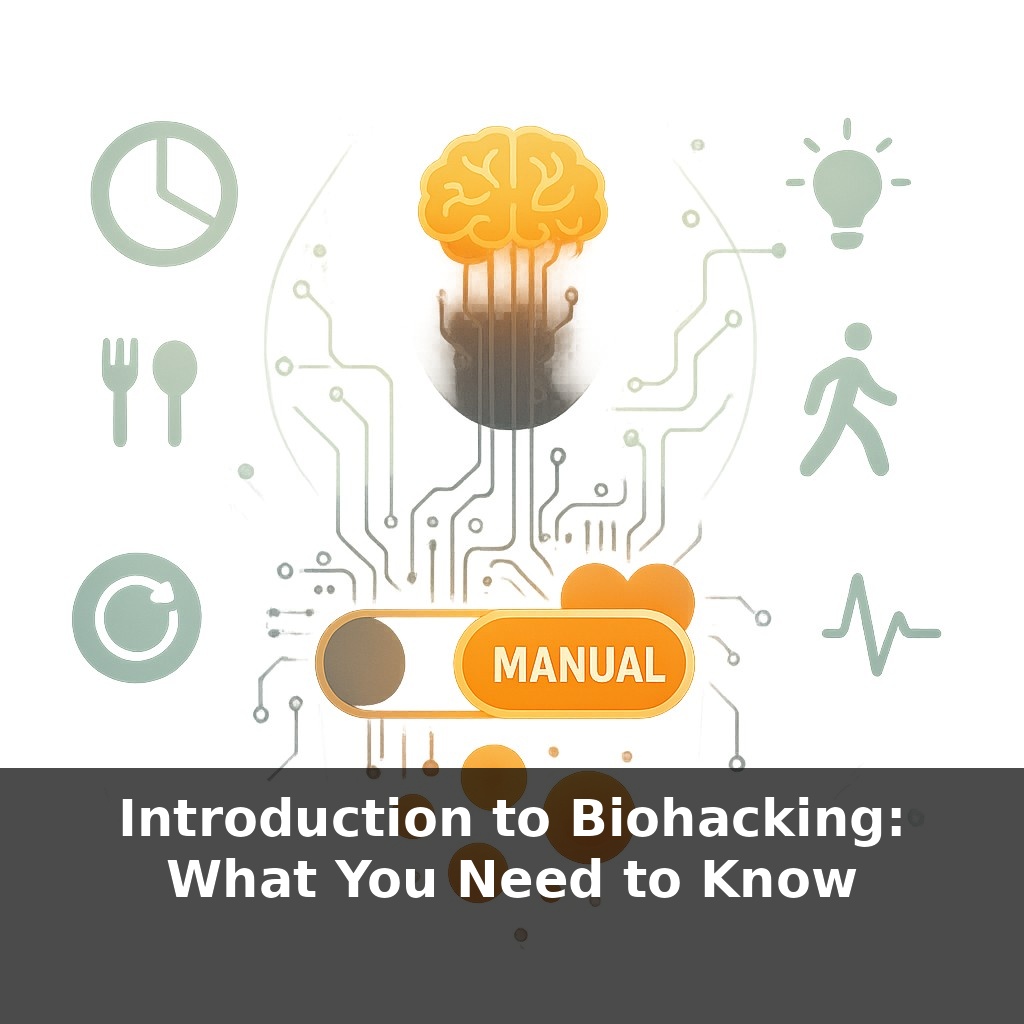
Biohacking is simply taking your biology off “auto‑pilot” and into manual mode. Instead of hoping you age well, you start treating your daily choices as small, testable experiments. Some people start with data: a cheap step counter, a basic sleep app, or a fasting window on a kitchen timer. Others go further—glucose monitors, brain-training tasks, even lab panels they order themselves.
What unites these approaches isn’t gadgets; it’s curiosity. Biohackers ask, “What actually happens in *my* body when I change this?” Then they measure, adjust, and repeat.
In this series, we’ll stay on the practical, low-risk end of the spectrum: movement, food timing, sleep, light, stress, and a few carefully chosen tools. Think of it like learning a new city by walking its streets instead of just staring at the map—you’ll discover what really matters for *your* aging process.
Now we add one more layer: context. Data points make sense only when you know what “normal” looks like for your age, your goals, and your life constraints. For example, that Harvard step study says every extra 1,000 steps is linked to lower mortality risk—but if you sit for 10 straight hours, those steps land differently than if you’re on your feet all day. Same with intermittent fasting: a shift that’s helpful for a 45‑year‑old office worker might backfire for a lean 70‑year‑old. Think of this series as your field guide, helping you place each experiment in the right ecosystem so it can actually thrive.
Here’s where we separate hype from something you can actually use. “Biohacking” stretches from reasonable (tracking your evening screen time) to extreme (injecting DIY gene therapies in a garage). Same word, wildly different risk profiles. To navigate that, you need two filters for every idea you hear:
1) What’s the *evidence*? 2) What’s the *cost of being wrong*?
Evidence can range from large clinical trials to a single influencer’s N=1 story. Both can be interesting; only one should guide major decisions. For example, we have solid human data that changing daily steps affects long‑term health risk. In contrast, we have almost no long‑term safety data on self‑administered gene edits or unregulated “longevity” injections. The gap isn’t subtle—it’s a canyon.
Then there’s the cost of being wrong. If you try a new walking pattern and it doesn’t help, you’ve lost time and a little effort. If you implant a device without proper sterility, you could gain data but trade it for infection, scarring, or legal trouble. Many invasive tools are legal to buy but still risky to use without medical supervision. “Legal” is not the same as “smart.”
A practical rule: adjust the ambition of your experiments to match both the strength of the evidence and your ability to monitor side effects. Low‑cost, reversible changes with strong research behind them—like step count, meal timing, or consistent wake‑up hours—belong at the front of the line. High‑stakes, poorly studied interventions should stay in the “observe, don’t copy” bucket until medicine catches up.
You can also think in layers of commitment: - Layer 1: tracking-only (wearables, journals, simple apps). - Layer 2: behavioral changes (how you eat, move, work, and wind down). - Layer 3: biological inputs (supplements, prescriptions, lab tests) chosen with professional guidance. - Layer 4: structural changes (implants, surgeries, gene-level edits) that permanently alter your baseline.
For this series, we’ll play almost entirely in Layers 1–3, favoring tools where you can start small, see measurable shifts, and reverse course quickly if your body sends early warning signals.
Your challenge this week: sketch your own “risk line.” Decide now which layers you’re willing to experiment with over the next year—and which are hard no’s—so future curiosity doesn’t outrun your safety brakes.
Think of this like planning a trek in a new national park. Before you start, you pick trails that fit your fitness, weather, and daylight. Same terrain, very different routes for a casual stroller versus an ultrarunner. Your “trail map” here is the four layers you just outlined—tracking, behavior, inputs, structural changes—and your risk line is the point where the trail turns from marked path to cliff edge.
Concrete examples: Layer 1 might be a $20 step counter and a paper log of when you feel most alert. Layer 2 could be rearranging your workday to put focused tasks in your naturally sharp hours. Layer 3 might mean asking your clinician to add a fasting glucose or lipid panel so you’re not guessing about metabolic trends. Layer 4? Watching, not doing: reading about people with implanted glucose sensors or sub‑dermal RFID chips and noting what questions you’d ask a surgeon *before* even considering anything similar.
Each layer isn’t “better,” just heavier commitment. Your job is to match the trail to your current season of life.
Health data is about to get as personal as your playlists. Instead of one annual checkup, you’ll juggle streams of real‑time signals—wearables, home tests, maybe even gut or epigenetic readouts—shaping choices week by week. Think less “doctor’s orders,” more “collaborative dashboard” you and your clinician both read. The upside: earlier course‑corrections, fewer nasty surprises. The risk: data overwhelm, overreacting to noise, and a bigger gap between those who can access guidance and those who can’t.
You don’t need to overhaul your life overnight. Start with one lever—steps, meal timing, or light exposure—and watch how your “dashboard” responds over a few weeks. Like tuning an instrument, small adjustments can bring your system into better harmony. Stay curious, notice trends, and treat each tweak as practice for bigger experiments ahead.
To go deeper, here are 3 next steps: 1) Download a habit-tracking app like **Habitica** or **Notion** and set up a simple “biohacking dashboard” with 3 metrics the episode mentioned (e.g., sleep hours, daily steps, and caffeine intake) you’ll track for the next 7 days. 2) Order or borrow **“Head Strong” by Dave Asprey** or **“Boundless” by Ben Greenfield**, and bookmark the chapters on sleep optimization and nutrition so you can experiment with one protocol (like blue-light blocking glasses or early time-restricted feeding) this week. 3) Install a wearable-friendly app like **Oura**, **WHOOP**, or **Apple Health** (depending on what you own), and connect it to a free visualization tool like **Gyroscope** so you can start correlating your sleep, heart rate, and activity in one place—just as the episode suggested for data-driven experimentation.
From this course
Practical Biohacking for Aging Gracefully
8 episodesUnlock all episodes
Full access to 8 episodes and everything on OwlUp.
Subscribe — $1.99/monthLess than a coffee ☕ · Cancel anytime