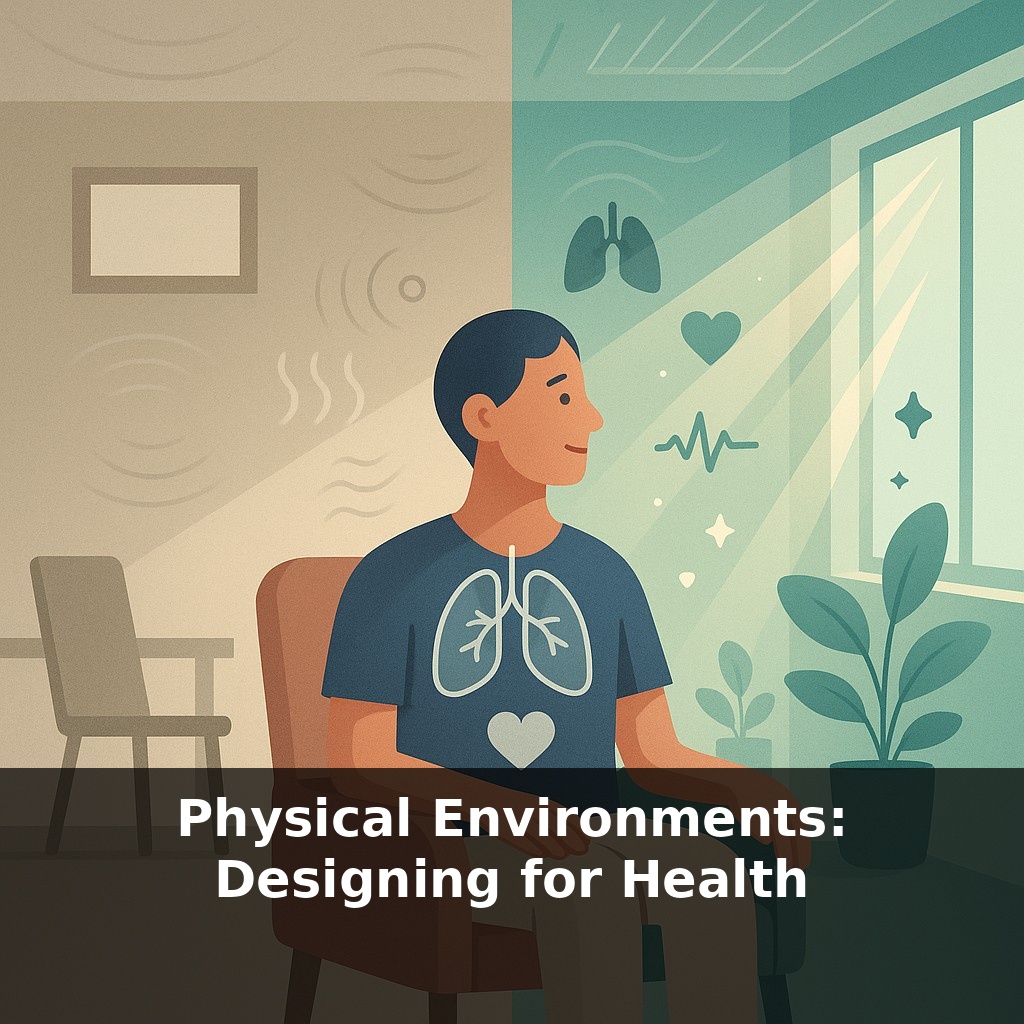
Right now, your walls, windows, and ceiling are quietly changing your blood pressure, sleep, and mood—whether you notice or not. In one office study, access to daylight alone boosted productivity by about one-tenth. So what, exactly, is your home making your body do today?
That “neutral” beige living room or standard office cubicle isn’t neutral at all. Every surface, sound, and draft is sending tiny signals into your lungs, heart, hormones, and joints. Most people try to fix their health with more willpower—better diets, tougher workouts—while spending 90 % of their time in spaces that quietly push their biology in the opposite direction.
This episode is about flipping that script: turning your home and workspace into allies that do some of the health work for you. We’ll zoom in on concrete levers you can actually control in ordinary apartments, shared offices, or busy family homes: air movement instead of “freshener” smells, light that supports your body clock even when you’re at a laptop late, layouts that make the healthy choice the lazy default, and small material choices that matter over decades, not days.
Most people think of “environment” as climate change or city pollution, but your true climate is the micro‑zone from your mattress to your monitor. That zone is constantly nudging your breathing, posture, and stress chemistry. Shift a few details there, and you can quietly change how you feel at 7 a.m. and 11 p.m.—without adding another supplement or habit to your life. In this episode, we’ll treat your space like a lab: testing how air, light, sound, temperature, and layout stack together. The goal isn’t perfection; it’s stacking small, evidence‑based tweaks until your rooms start doing some of the healthy aging work for you.
Let’s start with the most invisible piece: the air sitting a few centimeters from your nose. You pull in roughly 15 000 liters of it indoors every day, yet most people judge air by smell alone. That’s unreliable. Truly “clean” air often has no scent at all, while that pleasant new‑paint or new‑sofa smell is your lungs sampling volatile organic compounds. Over time, those low‑level exposures nudge inflammation, respiratory health, even cardiovascular risk. The single most powerful move isn’t buying a giant purifier; it’s reducing what needs purifying in the first place—fewer scented cleaners, fewer “fast furniture” items that off‑gas heavily, more simple materials like solid wood, glass, metal, and cotton.
Ventilation is your next lever. Instead of permanently cracking every window (often unrealistic in cities), think in bursts and zones. You can aggressively flush a room after cooking or cleaning, or cross‑ventilate a workspace for 10–15 minutes every few hours. Pair that with a HEPA filter near where you actually sit or sleep, and you’ve just changed the “soil” your lungs grow in without touching the rest of your routine.
Light is the second big dial. Even if you already know it affects your body clock, most indoor lighting is still treated as decoration, not biology. A simple rule: your day should look like a slow sunrise and sunset, not a 24/7 convenience store. Brighter, cooler‑tone light earlier; warmer, dimmer light as the day goes on. You don’t need a lighting designer. Two or three well‑placed lamps with warmer bulbs for evenings, and a bright, higher‑output source near your main daytime workstation, can mimic a much friendlier “sky” indoors.
Then there’s what your nervous system hears and feels all day. Constant, low‑grade noise—HVAC hums, street traffic, hallway chatter—keeps your stress system slightly “on,” even when you think you’ve tuned it out. Rugs, fabric panels, bookshelves, and door seals don’t just make rooms look finished; they absorb those micro‑irritations. Thermal comfort works similarly: being a little too cold or too hot for hours forces your body to spend energy on regulation that could be going toward repair. Small, localized fixes—a lap blanket, a small fan, a draft blocker—often matter more than fighting over the thermostat.
Your goal isn’t to create a showroom; it’s to create a space where your default settings quietly favor lower stress, better breathing, and steadier energy without you “trying” all day.
A useful way to think about tweaking your space is to treat each room like a different “health role” you’re casting. Your bedroom might be cast as the recovery specialist: quieter than other rooms, with softer surfaces and a cooler temperature than the rest of the home. Add one small plant by the window, not as decoration but as a low‑maintenance air helper, and keep electronics off the nightstand so the area feels more like a cabin than a command center.
Your kitchen can be the metabolism coach. Store the healthiest, ready‑to‑eat foods at eye level, keep a cutting board and knife always visible, and place a small rug where you tend to stand longest to spare your joints.
Your workspace becomes the focus trainer. Position your main seat where your back faces the busiest part of the room, use a lamp that’s brighter than surrounding areas to create a “spotlight” of attention, and keep the floor around the desk clear so short movement breaks feel frictionless rather than like navigating an obstacle course.
Healthy buildings are about to become less like static shells and more like responsive partners. As sensors track CO₂, noise, and even your movement, rooms could “tune themselves” the way navigation apps reroute around traffic—quietly shifting light, airflow, or layout suggestions based on how you actually live. Cities may follow suit: micro‑parks, low‑noise corridors, and walking‑first streets turning entire neighborhoods into extended nervous systems that buffer, rather than amplify, daily stress.
Treat this like editing a draft you live inside: every small change—quieter corners, cleaner air, softer light, easier paths to move—adds up. Over months, these tweaks can shift cravings, focus, even how quickly you recover from stress. Your challenge this week: pick one room and change just three things that make your body feel noticeably calmer there.