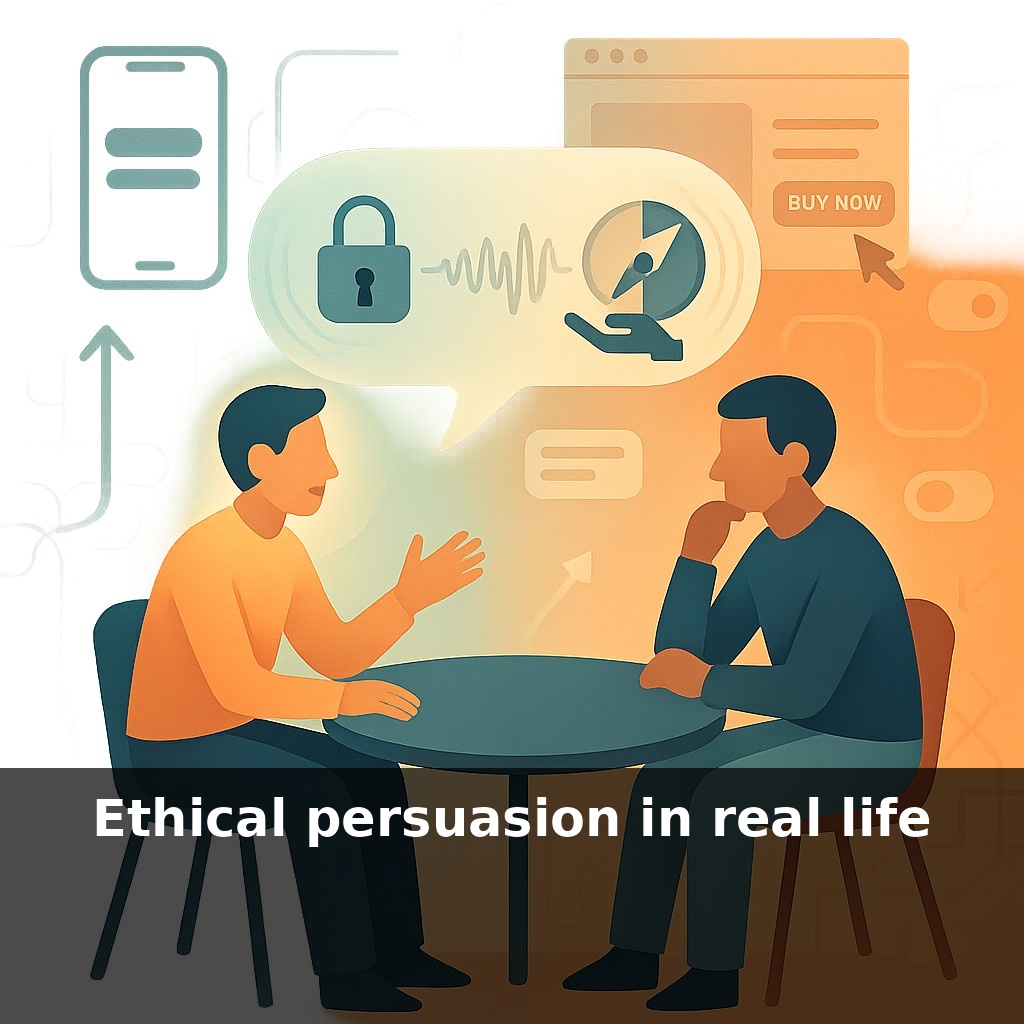
“Most people say they hate manipulation, yet almost all of us still click ‘Buy now’ on limited-time offers we don’t fully trust. You’re in a checkout line, a sales call, a tough conversation at work—someone is gently steering you. The real question is: are they telling you they’re driving?”
Only 17% of people say they trust brand messages that *feel* manipulative—yet the same people happily respond to a friend’s recommendation, a doctor’s advice, or a colleague’s enthusiastic “You have to read this.” The difference isn’t the presence of persuasion; it’s the presence of respect.
Ethical persuasion doesn’t mean turning off influence; it means turning on transparency. Governments now hire behavioral scientists to design tax letters and health reminders. Companies A/B test everything—from button colors to pricing frames. The question isn’t “Is persuasion happening?” It’s “Whose goals does it serve—and how honestly?”
In this episode, we’ll zoom in on everyday influence: how to use Cialdini’s principles in a way that can stand the light of day, and how to spot the moment a helpful nudge starts to slide into a hidden shove.
You already live inside dozens of influence systems: app notifications that “remind” you, office norms that shape how boldly you speak up, even the order of options on a form. None of these feel like a motivational speech; they’re more like background music that quietly sets the mood. Ethical persuasion is about deciding *who* picks the playlist and *why*. Behavioral scientists now help hospitals boost vaccination rates and cities cut energy use by tweaking default choices and message framing. The grey zone appears when these same tools are used to stretch budgets, pressure consent, or bury better options off-screen.
“Ethical” persuasion becomes real the moment there’s something concrete on the line: a subscription renewal, a consent checkbox, a yes or no in a tense meeting. Nice-sounding values are easy; design choices are where they’re tested.
One practical test: *Could the other person reasonably predict what I’m trying to do?* If the answer is yes, you’re likely in safe territory. That might look like: “I’m going to show you what most people choose, because that helps many clients decide,” or “I’ll give you my recommendation first, then a couple of alternatives.” You’re still using social proof or authority—you’re just labeling it instead of hiding it.
Notice how this changes the power dynamic. The other person can lean in (“Great, tell me what most people do”) or lean out (“Actually, I don’t care what most people do—tell me what’s cheapest”). Their goals start steering the interaction.
A second test: *Does this still feel fair if we switch roles?* You’re booking a hotel; would you accept the same countdown timer or “X people are viewing this room” message if you were the guest, not the marketer? You’re coaching a teammate; would you be okay if your manager used identical tactics on you about overtime?
Respect also shows up in what you *don’t* do. You leave the “opt out” option visible instead of tucking it behind three menus. You state actual limits (“We have 40 seats because the venue is small”) instead of vague pressure (“Spots are disappearing fast!”). You give people time to sleep on big commitments instead of piling on urgency.
Think of your persuasion tools less like secret tricks and more like a shared score in music: both players can see the notes. When you say, “Here’s my bias; here’s what I’m hoping you’ll choose,” you lose a bit of short-term leverage and gain a lot of long-term credibility.
The paradox: the more clearly you reveal your intentions, the more comfortable people feel saying yes—and the more they trust themselves when they decide to say no.
You can see the difference between ethical and shady tactics in tiny, ordinary choices. A newsletter signup that says, “We’ll email you 1–2 times a week with practical tips; unsubscribe anytime,” is using commitment and consistency, but it’s also honest about the cost. A rival popup quietly checks the “Yes, send me partner offers” box by default and hides the unsubscribe link; same psychological levers, different respect level.
In a doctor’s office, one clinician might say, “Most patients in your situation choose treatment A; here’s why, and here’s what I’d pick for myself.” That’s authority plus social proof, laid on the table. Another might bury side‑effects in jargon and push a particular drug because of an incentive. Same outcome on paper, very different ethics.
Or think of a travel guide who clearly marks detours, risk levels, and time estimates. They’re still steering your route, but you can see the map, opt for the harder trail, or head back to the hotel when you’ve had enough.
Regulators are already circling “dark patterns,” but the subtler frontier will be settings you never see—recommendation sliders, default time limits, how many times a prompt may repeat. Ethical teams will treat these like a studio soundboard: every adjustment logged, reviewable, and reversible. Expect “persuasion diets” in apps, letting you cap how often you’re nudged, and independent audits rating products not just for security, but for how they steer your attention and choices.
Real life won’t hand you a label saying “this is ethical” or “this is a trap.” You’ll feel it in the aftertaste: do you feel informed or subtly cornered? Over time, notice where you’re most persuadable—fatigue, loneliness, FOMO. Those are like damp wood for any spark. Protecting that space is how you stay influence‑aware without becoming influence‑paranoid.
Before next week, ask yourself: 1) “The next time I’m trying to get buy-in (with my boss, partner, or client), how can I clearly surface *their* self-interest and values first—what concrete questions will I ask them so I’m not guessing?” 2) “Looking at one real conversation I have coming up, where might my persuasion cross the line into pressure or manipulation—what specific ‘red-flag’ tactics (e.g., guilt-tripping, hiding trade-offs, overpromising) do I need to consciously avoid?” 3) “If the person later described our interaction to a friend, what would I want them to say about how I treated their autonomy and dignity—and what, specifically, can I do in that conversation to earn that description?”