Alex closes another quarter with a half-filled notebook, a tired brain, and no clear wins—just a vague sense of “I should be further along.” Goals like “get fit” and “be better with money” float around. What if you ran your next 12 weeks as an experiment, not a blurry to‑do list?
Research on behavior change is blunt: vague hopes rarely beat clear systems. People who decide exactly when, where, and how they’ll act are 2–3 times more likely to follow through. But most self-improvement still happens in foggy bursts—motivated weeks, then drift. The gap isn’t ambition; it’s structure and feedback.
In this episode, you’ll turn the next 12 weeks into a personal experiment roadmap that behaves more like a live project than a wish list. Think of a founder testing a new feature: they ship a tiny version, watch the data, and adjust fast. You’ll do the same with your habits.
We’ll map one focused area of your life into a sequence of small, testable moves. You’ll define what “better” actually looks like, choose simple metrics you can track weekly, and set up lightweight reviews so you can correct course before you stall again.
Many people stall because they try to upgrade everything at once: sleep, diet, work, relationships. Momentum dies under the weight of competing priorities. In this roadmap, you’ll zoom in tightly and treat one life domain like a short, intense project cycle. Think: “energy,” “focus at work,” or “financial breathing room.” For example, Priya chose “evenings” as her domain and ran small trials on screen time, dinner timing, and wind‑down rituals. Jamal picked “mornings” and iterated on wake-up times, first task, and phone rules. You’ll design equally specific cycles that stack into real progress.
Start by sizing your 12‑week window correctly. You’re not cramming everything into three months; you’re sequencing learning. A useful pattern is three 4‑week “blocks”: weeks 1–4 for exploration, 5–8 for refinement, 9–12 for consolidation.
Block 1 is about aggressive curiosity. You intentionally try slightly different approaches and expect some duds. For instance, Elena wanted more consistent reading time. In the first two weeks she tested three slots: early morning, lunch, and before bed, logging only “did I read 15 minutes, yes/no?” and brief notes: “too sleepy,” “kept getting Slack pings,” “worked well after brushing teeth.” By week 3–4, she’d narrowed down to two promising options and dropped the rest without guilt.
Block 2 is where you commit to the best pattern you’ve discovered and tighten it. You keep the behavior stable but tweak the environment. When Diego focused on strength training, he used weeks 1–4 to try home workouts, a nearby gym, and a friend’s garage. In weeks 5–8, he picked the gym, then experimented with calendar reminders, packing his bag the night before, and going with a coworker. Same core action, different support systems.
Block 3 turns “this seems to work” into “this survives real life.” You stress‑test against travel, busy weeks, or low motivation. Rather than chasing novelty, you work on recovery after disruptions. If week 10 blows up with family emergencies, week 11 has a pre‑decided “minimum viable version” (five pushups, two pages, one outreach email) so you don’t reset to zero.
To keep the roadmap lean, cap yourself at one primary experiment and, at most, one tiny “bonus” tweak that doesn’t compete for the same energy (for example, pairing a short stretching test with a main focus on email batching). More than that and cause‑and‑effect gets muddy: if sleep, diet, exercise, and deep work all change at once, you can’t tell what’s helping.
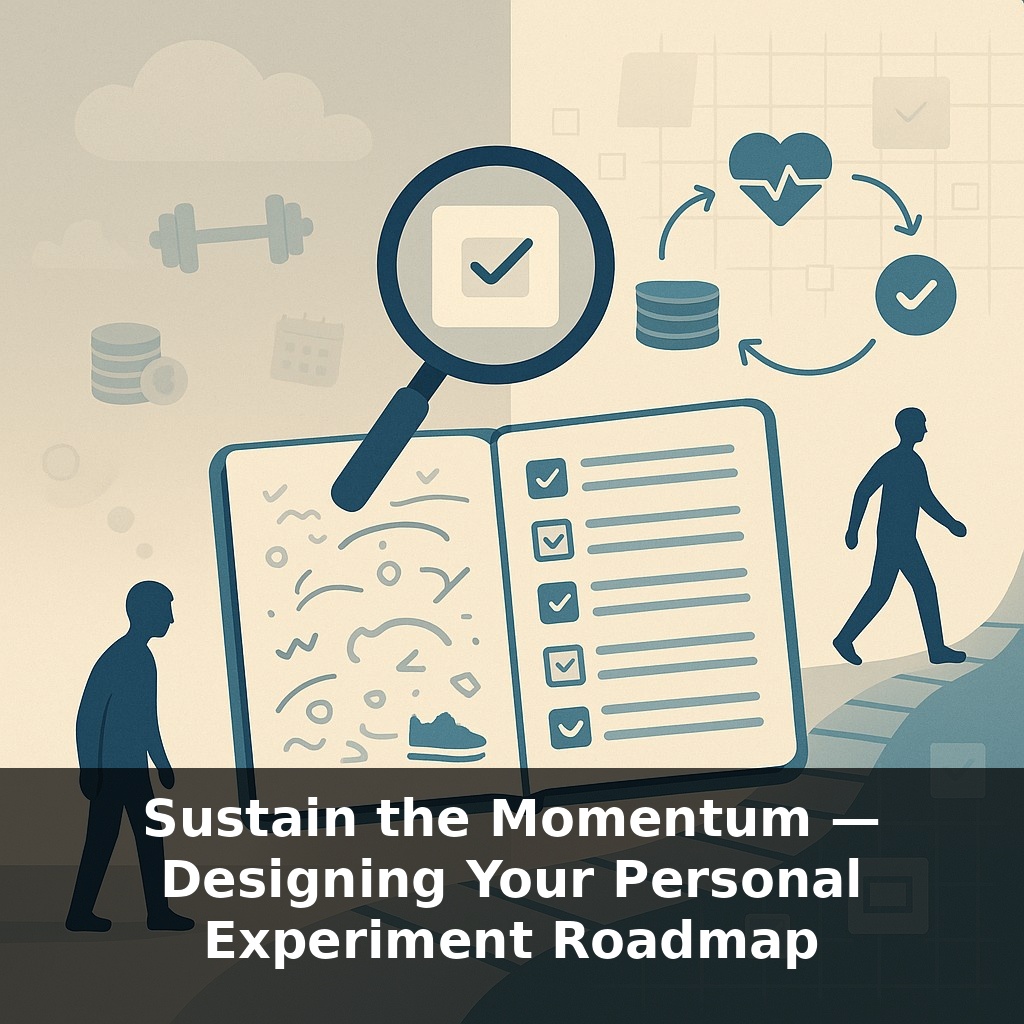
Treat your written plan like a living clinical chart, not a manifesto. One page is enough: a 12‑row table, one row per week, with three columns labeled “this week’s tweak,” “what I expect to see,” and “what actually happened.” You’re not chasing perfection; you’re building a rhythm of noticing, adjusting, and carrying forward only what proves itself.
Jared was exhausted from late‑night work marathons, so he picked “energy after 3 p.m.” as his next 12‑week focus. Instead of vague promises to “have better afternoons,” he lined up three concrete trials. Weeks 1–4, he alternated between a 10‑minute walk, a 90‑second cold splash, and a high‑protein lunch on different days, marking only how alert he felt at 4 p.m. on a 1–5 scale. By the end of week 4, the data showed a clear front‑runner: the short walk plus water beat everything else.
In weeks 5–8, he kept that pattern but played with timing and environment: walk before or after lunch, solo or with a coworker, with or without checking his phone. His log shifted from “what” to “under which conditions this works best.” By week 9, he wasn’t searching for new tricks—he was making the winning pattern durable. He added a recurring calendar block, a backup “indoor lap” route for rainy days, and a rule: if a meeting cut his walk, he’d stand and stretch for two minutes immediately after.
Building on that one‑page plan, here’s the bigger payoff: when you stack a few of these 12‑week cycles, your year stops feeling like one long blur and starts feeling like distinct “seasons of learning.” Instead of burning out on a giant New Year push, you get several fresh starts, each with a clear focus.
Over time, something deeper shifts. You’re no longer the person who “should get it together someday.” You become the kind of person Alex became: someone who runs small experiments on purpose, expects mixed results, and stays curious instead of ashamed when things don’t work.
That’s key here: a “failed” experiment isn’t a personal verdict, it’s tuition. The only real loss is the week you don’t learn from.
Have you noticed how much lighter it feels when you say, “I’m testing this,” instead of, “I must not screw this up”? That one language shift protects you from all‑or‑nothing thinking.
And here’s a quiet benefit: planning these cycles doesn’t kill spontaneity; it protects it. Because your core experiment is thoughtfully designed, you don’t waste as much energy on random fixes. That leaves more room for genuine surprises—opportunities you can actually say yes to, without sacrificing your direction.
With that foundation, let’s lock in your next step.
1) Within a day, do a 10‑minute audit: ask, “Where am I most curious to improve right now?” Then write one 12‑week experiment hypothesis on a sticky note or in your notes app.
2) Set a recurring weekly 10‑minute check‑in on your calendar.
Start with this tiny habit: When you open your laptop each morning, add just *one* ultra-small experiment to your "Personal Lab" list—like “Test a 10-minute deep-work block after lunch” or “Try a no-notification commute home.” Then, when you close your laptop at the end of the day, quickly circle or star the *one* experiment you’re most curious to try tomorrow. Don’t plan the whole roadmap—just keep growing that list by one experiment a day and tagging one you’re excited about.
Alex did this and, even with messy follow‑through, finished their first cycle with sharper priorities and a clear next move.