You probably fail at your goals more often than you succeed—and that might be the best thing about them. You break your streak, eat the thing, skip the workout… and in that tiny window right after, your future results are mostly decided. Not by willpower, but by what you do next.
Most people don’t just slip once in a while—they slip constantly. One study found the average dieter “falls off” more than five times a month. The real difference between people who keep progress and people who lose it isn’t how perfectly they perform; it’s how quickly they reset after those stumbles. That tiny gap between “I blew it” and “What now?” is where your next week is decided.
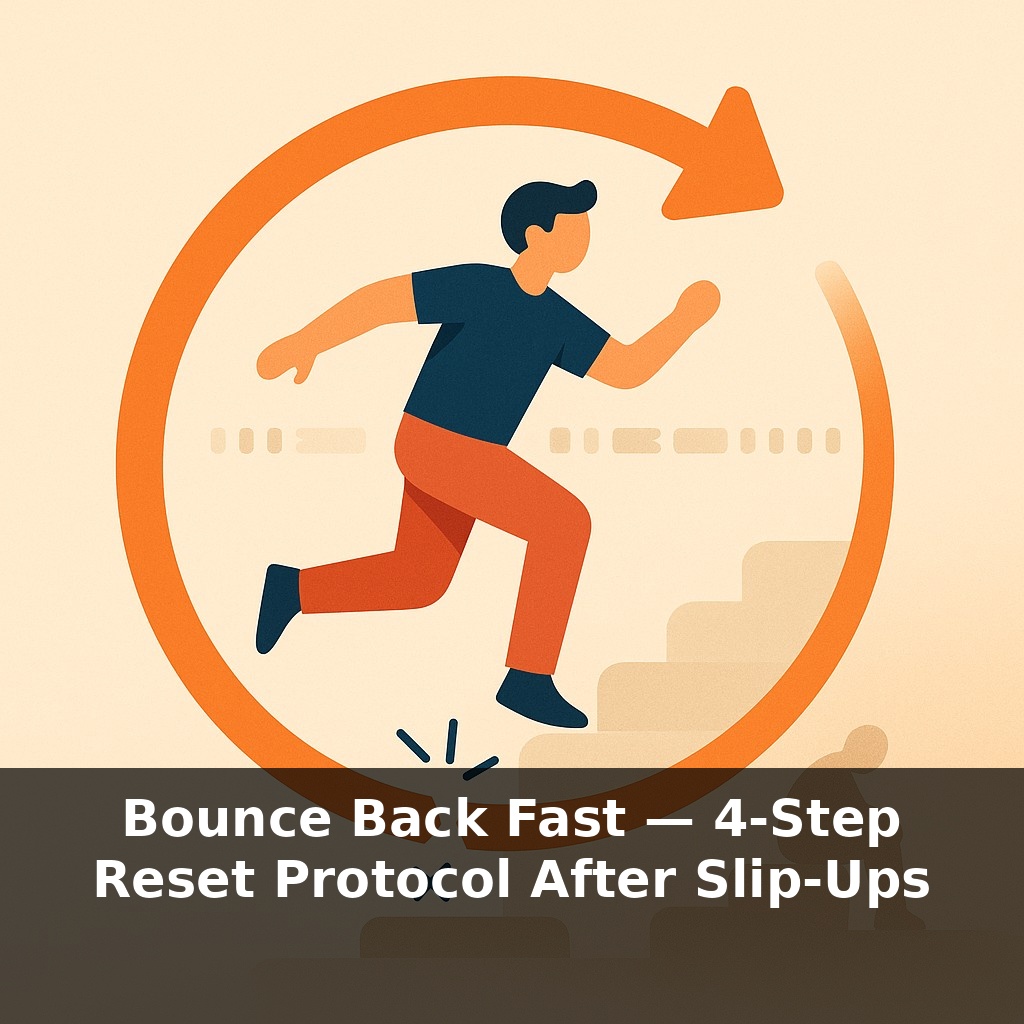
In earlier episodes, you built systems for tracking, calming your nervous system, and doing focused bursts of work. Today is about what happens when those systems break down for a day—or a week. Instead of spiraling into self-criticism or pretending nothing happened, you’ll learn a simple 4-step reset that treats each lapse like a useful lab result: neutral data you can use to adjust the experiment and step back in, often stronger than before.
Those “lab results” you collect in messy weeks are more valuable than the ones from perfect days. They show you where your real life collides with your plans: the late meeting that killed your workout, the argument that derailed your focus, the surprise win that came after a bad morning. Instead of chasing a flawless streak, you’re learning to notice these collision points and mine them for patterns. Think less like a judge and more like a curious coach on the sidelines, replaying the last play in slow motion so the next one has a higher chance of working—even if the field is still a bit muddy.
Step one, Pause & Acknowledge, is about hitting a psychological brake before your brain writes a dramatic story. That two‑minute gap interrupts the automatic chain from “slip” → “shame” → “give up.” This is where the cortisol research matters: a short mindful check‑in (“What just happened? Where do I feel this in my body?”) stops your stress response from running all day. You’re not fixing anything yet; you’re just refusing to add extra damage.
Step two, Analyze the Data, is where you zoom out. Instead of “I was lazy,” you’re asking, “What were the conditions?” Sleep, time of day, who you were with, where you were, what you’d just been doing. Cognitive‑behavioral therapy calls these “situational triggers” and “thought patterns,” but you can keep it simple: What was stacked in my favour? What was stacked against me? You’re searching for leverage points, not blame.
Now step three, Adjust the Plan, turns those observations into small engineering tweaks. Maybe your workouts keep dying at 7 p.m. because that’s when email spikes; move them to 7 a.m. Maybe “eat better” keeps collapsing at social events; build in a concrete rule like “one plate, no seconds.” This is where implementation intentions shine: “If it’s 3 p.m. and I’m reaching for sugar, then I’ll walk outside for 3 minutes first.” You’re pre‑deciding what “back on track” looks like in the exact situations that usually derail you.
Step four, Rapid Re‑engagement, is the quiet but crucial finale. You shrink the “time to reset” as much as possible—next meal, next task, next morning—without trying to “make up” for the slip. No punishment workouts, no starvation day, no all‑nighter to compensate for procrastination. Quick, normal action signals to your brain: this is a blip, not an identity. Over time, that repetition wires in a powerful association: “When I go off course, I calmly take the next right step.”
Used together, these four steps create a kind of psychological shock absorber. You’ll still hit potholes—tired days, bad moods, unexpected chaos—but you stop cracking the axle every time. Instead of long streaks of “on track” and “off track,” you get lots of tiny wobbles with fast recoveries. That’s what long‑term change actually looks like: not a pristine straight line, but a messy graph that keeps trending in the right direction because you’ve trained yourself to come back quickly, again and again.
A founder misses a key investor call, feels the flush of panic, and instinctively reaches for frantic damage control. Instead, she opens a shared doc and jot-dumps the last 24 hours: travel, sleep, nagging worries, calendar clutter. She notices every “important” task had no buffer—anything unexpected toppled everything else. Her next move isn’t a heroic all‑nighter; it’s adding 15‑minute buffers before critical meetings for the rest of the month and a simple rule: no back‑to‑back high‑stakes calls on Mondays.
A student bombs a quiz after three solid weeks of studying. Old habits whisper, “You’re just bad at this.” But he pulls up his notes and mock tests and notices a pattern: concepts are fine, wording tricks him. He starts a tiny ritual—five minutes each evening rewriting tricky questions in his own words, plus one low‑pressure practice quiz every Friday. No drama, just micro‑upgrades.
Over time, these small, specific shifts turn into a quiet confidence: “Whatever happens, I know how to respond.”
Tech is quietly turning your day into a live dashboard. Wearables already flag sleep debt or glucose swings; next up are apps that notice skipped routines the way a fitness watch spots missed steps. Instead of a vague sense of “I blew it,” you’ll see a timestamped ripple: poor sleep, tense meeting, late snack, foggy focus. Like weather radar for your behaviour, the system can nudge tiny course‑corrections early, so you adapt in hours instead of drifting off course for weeks.
Over time, this approach changes scale: you stop grading days as “good” or “bad” and start noticing micro‑moves—like choosing water after dessert, or opening your notes after Netflix. Each tiny turn is a vote for the kind of person you’re becoming, the way steady drops carve stone: slow at first, then suddenly the groove is obvious.
To go deeper, here are 3 next steps: (1) Print out or save the “Bounce Back Fast: 4-Step Reset” as a one-page checklist (you can recreate it in Notion or Google Docs with the exact steps: Interrupt → Investigate → Integrate → Initiate) and pin it where you usually slip up—on the fridge, by your desk, or next to your bed. (2) Pick one area you recently slipped in (like late-night snacking or skipping workouts) and listen to a short, targeted episode from The Habit Coach or Mel Robbins’ podcast on that exact habit while you walk, commute, or clean today, then plug ONE idea from that episode into your 4-step reset page as your go-to response next time it happens. (3) Download a habit-tracking app like Habitify or Streaks and create a specific “Bounce-Back Reps” habit (e.g., “Run 4-step reset after any slip-up”), then for the next 7 days, check it off every time you actually use the protocol so you can see proof that you’re becoming a fast resetter, not a perfectionist.