You’re probably not most productive on days you clear your calendar… but on days you have just enough time pressure. In a packed afternoon of calls, you sit down for one tight window—and suddenly, work that’s dragged for weeks flies forward. Why does that tiny slot work so well?
That tiny slot often works because it quietly forces you into something research calls “bounded focus”: you can’t do everything, so your brain finally commits to one clear move. Instead of roaming through tabs and to‑dos, it narrows in like a spotlight on a single small target: finish this paragraph, clean up that dataset, send those two difficult emails. The boundary is doing half the work.
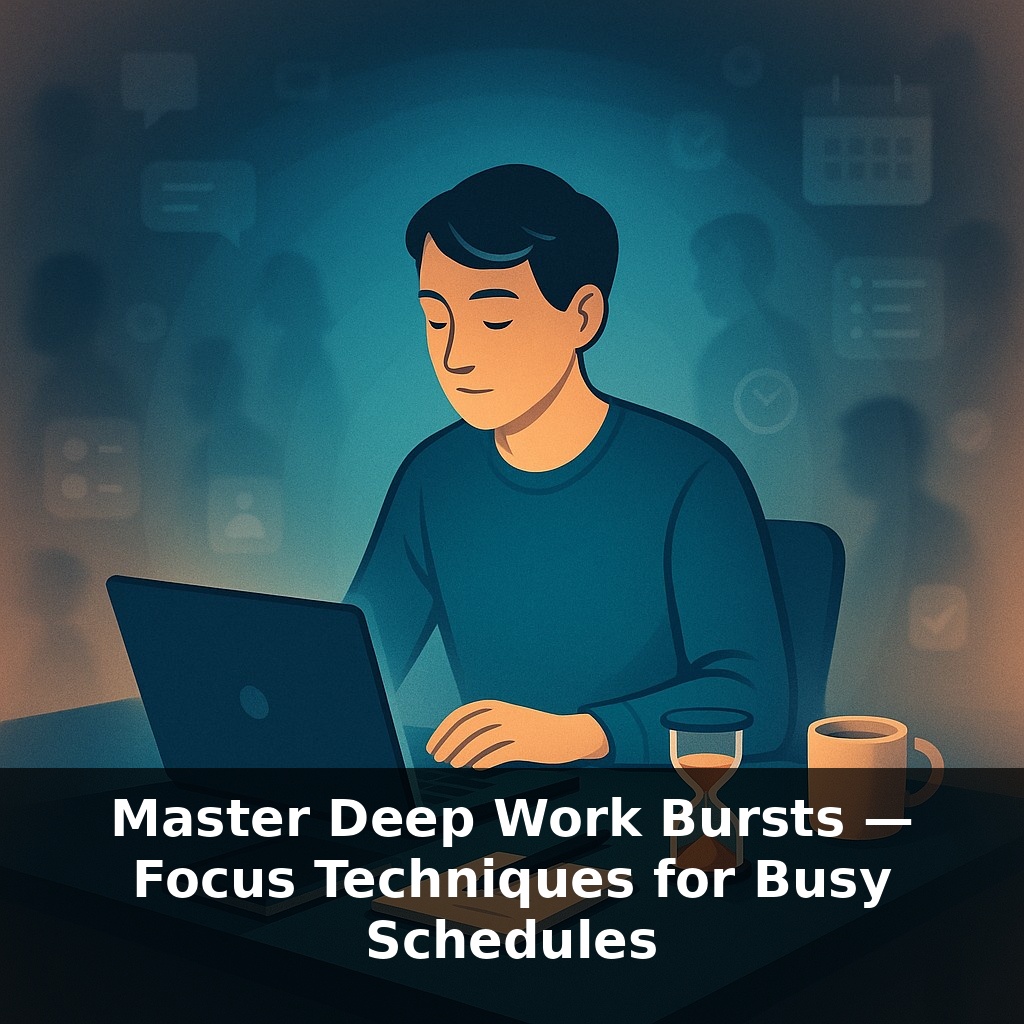
In this episode, we’ll stop waiting for those rare, accidental pockets and start engineering them—on purpose, and on your terms. We’ll use short, intense “deep work bursts” that fit between meetings, kid pickups, and notifications, so you can get serious traction even on the busiest days. Think less “heroic marathon session,” more “deliberate, well-placed strike.” The goal isn’t to squeeze more hours out of your week, but to raise the quality and impact of the minutes you already have.
Most of us treat focus like weather: we hope for a “clear day” and feel doomed when the forecast is cluttered. But the research behind those short, bounded-focus windows suggests something different: your brain doesn’t actually need vast open plains of time—it needs a clear start line, a clear stop line, and fewer escape hatches in between. That’s good news if your calendar looks like Tetris. In this episode, we’ll zoom in on what makes a 25‑minute slice potent: how you choose the task, how you “seal the edges” against interruptions, and how you use the tiny break after to reset instead of derail.
Here’s the hidden lever those intense windows make visible: structure. Not just “work hard for 25 minutes,” but how you set up what happens before, during, and after that window. The interval itself is just a container; what you pour into it matters more than the length.
Start with what goes in. Not every task deserves a burst. Shallow work that’s mostly clicking and confirming can fit anywhere. These short, deliberate intervals shine on work that has two qualities: it’s mentally heavy enough that you’d usually avoid it, and it can be moved meaningfully in a small chunk. Editing three critical slides, outlining the next section of a report, diagnosing one stubborn bug, writing the first draft of a tricky email—that’s ideal. If it feels important but slippery, it probably belongs here.
Next, define a “win state” that’s smaller than your ambition but bigger than busywork. “Work on project” is useless. “Draft the three bullet points that open the proposal” is clear. Your brain knows when it’s done, which makes starting easier and quitting less tempting. This is where many people unintentionally sabotage a burst: the target is so vague that any distraction seems equally valid.
Then, seal the edges. Instead of relying on willpower, you change the default environment for just one interval. Close everything that isn’t needed for this task. Disable notifications instead of promising you won’t look. Put your phone in another room, or at least out of reach and sight. Even tiny moves—like a sticky note that says “Back at 10:25” over your inbox—signal to others and to yourself that this window is spoken for.
Because attention-switching is so costly, treat the break as part of the system, not a bonus. Step away from screens if you can. Move, stretch, drink water, look out a window. The point is to let your cognitive “static” settle, so you’re not dragging fragments of one task into the next. Think of it like a surgeon scrubbing out between patients: the reset protects the next case from contamination.
Over time, chaining a few of these intervals together teaches your brain a rhythm: commit fully, release fully, repeat. You’re not waiting for a rare perfect day; you’re learning to create small pockets of clarity on demand.
Think of each burst like prepping a complex recipe in stages instead of cooking an entire feast in one go. One session is just chopping vegetables: you gather every ingredient, line up the cutting board, and slice until the board is clear. Next burst might be only for making the sauce—no touching side dishes, no “quick taste” of dessert. Dividing “make dinner” into these micro-missions turns a blurry obligation into a series of concrete moves.
Try mapping this to your day. Label one nagging project as the “main course.” For the first burst, do only the “mise en place”: open the right files, list substeps, pull data, decide priorities. Second burst, tackle just step one. Third burst, review and season—tighten language, fix logic, clean formatting. Like a good kitchen, you’re never doing everything at once, but something specific is always moving forward.
Over a week, notice which “courses” keep getting left in the fridge. Those are prime candidates for tomorrow’s first burst, before you let anyone else’s agenda onto your plate.
Used well, these intervals can quietly reshape your career. As more routine tasks shift to AI, the rare skill will be turning vague problems into sharp, solvable segments on command. You’re not just “getting more done”; you’re training pattern‑recognition—spotting which knot to untangle next, when to pause, and what to ignore. Over months, that habit compounds into a kind of strategic calm: while others chase every ping, you keep returning to the small levers that actually move the work.
Treat these bursts as experiments, not verdicts on your willpower. Some days they’ll feel like a scalpel, other days like a blunt spoon—and that’s useful data. Adjust the length, the timing, or the shields like you’d tweak spices in a stew. Over weeks, your calendar stops being a wall of obligations and starts looking more like a control panel.
Start with this tiny habit: When you sit down to start a deep work burst, set a 10-minute timer and choose just ONE “needle-mover” task you can finish or move meaningfully forward before it goes off (like drafting the intro paragraph of a report or solving a single tricky problem). Before you hit start, close only one distraction source—either silence your phone or shut your email tab, not both. When the timer ends, jot a single sentence in your notes about what you want to tackle in your next deep work burst, then you’re free to stop.