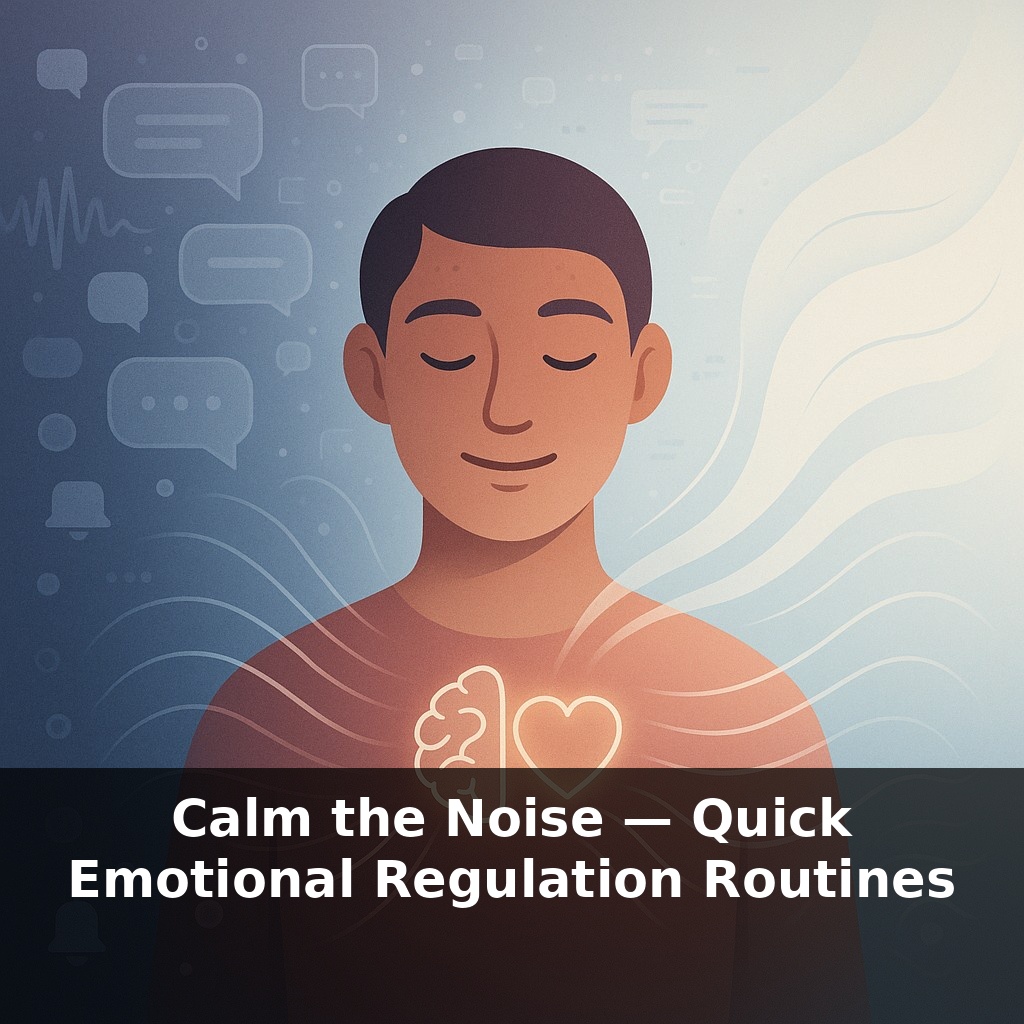
You can reboot your stress response in less time than it takes to scroll a social feed. Right in the middle of an anxious spiral—heart racing, thoughts racing faster—two tiny shifts in how you breathe and how you talk to yourself can quietly flip your body back to calm.
Most people treat motivation like weather: if it’s bad, they just wait for it to pass. But you can actually change the “forecast” on demand—faster than your phone can load a new app. In this episode, we’re shifting from long-term habit architecture (keystone habits, identity, feedback loops) to something more tactical: what you do in the exact moment your system starts to stall.
Those moments are sneaky. You sit down to work, open your laptop, feel a spike of resistance, and suddenly you’re “just checking” messages. Or a single email pulls your mood into a tailspin and the whole afternoon melts.
Here, we’ll use two micro-routines you can run anytime, anywhere—no journal, no quiet room, no perfect conditions. Think of them as tiny, trainable buttons you press when your inner noise drowns out your intentions, so you can return to the task instead of abandoning it.
On good days, your mind feels like a clear desk: you know what to do and where to start. On bad days, it’s more like a browser with 37 tabs open—none of them quite loading, all of them making noise. This episode sits right at that messy intersection. Instead of redesigning your whole “productivity system,” we’re zooming into the first 2–3 minutes after you notice yourself stalling. That tiny window matters. It’s where you either slip into autopilot avoidance or deliberately steer back on track. Think of what follows as your short, repeatable startup sequence for those moments.
There are two levers you can actually pull in those noisy moments: one in the body, one in the mind. We’ll keep them small on purpose, so they’re usable in real life—right before a meeting, after a sharp email, or halfway through a task you suddenly want to escape.
First, the body lever: box breathing. Not “deep breathing” in the vague wellness sense, but a specific pattern: inhale, hold, exhale, hold, all for the same count. Research from Stanford suggests that just five minutes of this rhythm can shift heart-rate variability and anxiety in a measurable way. The key twist: shorter is better to start. Those dramatic 10‑second holds you see online can leave beginners lightheaded because CO₂ rises too fast. Clinically, a 4‑4‑4‑4 or 5‑5‑5‑5 pattern is the sweet spot—strong enough to nudge your physiology, gentle enough to be sustainable.
You don’t need a yoga mat or privacy. You can run one “box” while your video call loads, or three cycles while someone’s pulling up a document. It’s less about one perfect session and more about teaching your body, over many tiny reps, “When I do this pattern, we downshift.”
Then comes the mind lever: cognitive reframing, or taking the same situation and asking your brain to tell a different, truer story about it. Not “everything is fine” when it isn’t, but “What else might this mean?” and “How would I talk to a friend in this exact spot?” Distanced self-talk helps here: using your name or “you” instead of “I” tends to cool the emotional charge faster. “You’re overwhelmed; of course this feels big. What’s the next small move?” often lands differently than “I’m failing; I can’t do this.”
Think of box breathing and reframing as the emotional version of a quick checkup at a clinic: one vital sign from the body, one from the mind. You aren’t fixing your whole life in two minutes—you’re stabilizing enough to make a non-panicked choice about the very next step.
The interesting part is how they stack. A short breathing sequence quiets the physical noise just enough that your reframing doesn’t feel fake. And once your inner commentary softens, it’s easier to return to the email, the document, or the conversation you were about to abandon. Over time, this becomes less of an emergency maneuver and more of a quiet, practiced reflex whenever inner static spikes.
You don’t need a crisis to use these tools; they’re just as useful in tiny, everyday wobbles. Think of that moment right before you open a difficult document, when your cursor hovers and you’re tempted to “check one more thing.” That’s a perfect time to run a quiet cycle or two and then ask, “Okay, [your name], what’s the smallest piece of this you can handle in 10 minutes?”
You can also use them proactively, the way a runner does warm‑ups. Before a presentation, three calm cycles plus a quick reframe—“You’re not being judged; you’re sharing something useful”—often beats rehearsing every possible failure.
Over a week, you might notice patterns: maybe Mondays at 3 p.m. are always noisy, or conflict conversations trigger the same tightness and story. Instead of treating those as random bad patches, you can treat them like scheduled “practice reps” for these routines—regular, predictable chances to get a bit smoother at running them on demand.
In a few years, these quick resets may feel as ordinary as checking the weather. Your calendar could flag “high‑stakes” blocks and auto‑suggest a 60‑second reset beforehand. Teams might open tough meetings with a shared cycle and a reframing prompt, the way kitchens do a quick safety check before a rush. Your future self isn’t calmer by accident; they’re someone who has rehearsed these tiny interventions so often that “overwhelmed” becomes a cue, not a sentence.
Treat these tools like seasoning in a meal: sprinkled in often, not saved for “special occasions.” Try pairing them with existing cues—opening your calendar, stepping into a hallway, waiting for coffee. Over time, those everyday moments become quiet check‑in points, where you can notice your state, adjust slightly, and re‑enter the day with a bit more choice.
To go deeper, here are 3 next steps: (1) Download a breathwork app like Othership or Breathwrk and set a 3-minute “physiological sigh” timer you’ll use before your next stressful meeting or email session. (2) Print or save the free “Name It to Tame It” emotion wheel from Greater Good Science Center and keep it on your desk so, the next time you feel flooded, you can quickly label your exact emotion and choose a matching regulation tool. (3) Tonight, queue up a short Yoga Nidra or NSDR track from Dr. Andrew Huberman’s recommended YouTube playlist and test how it changes your baseline stress level compared to your usual wind-down routine.