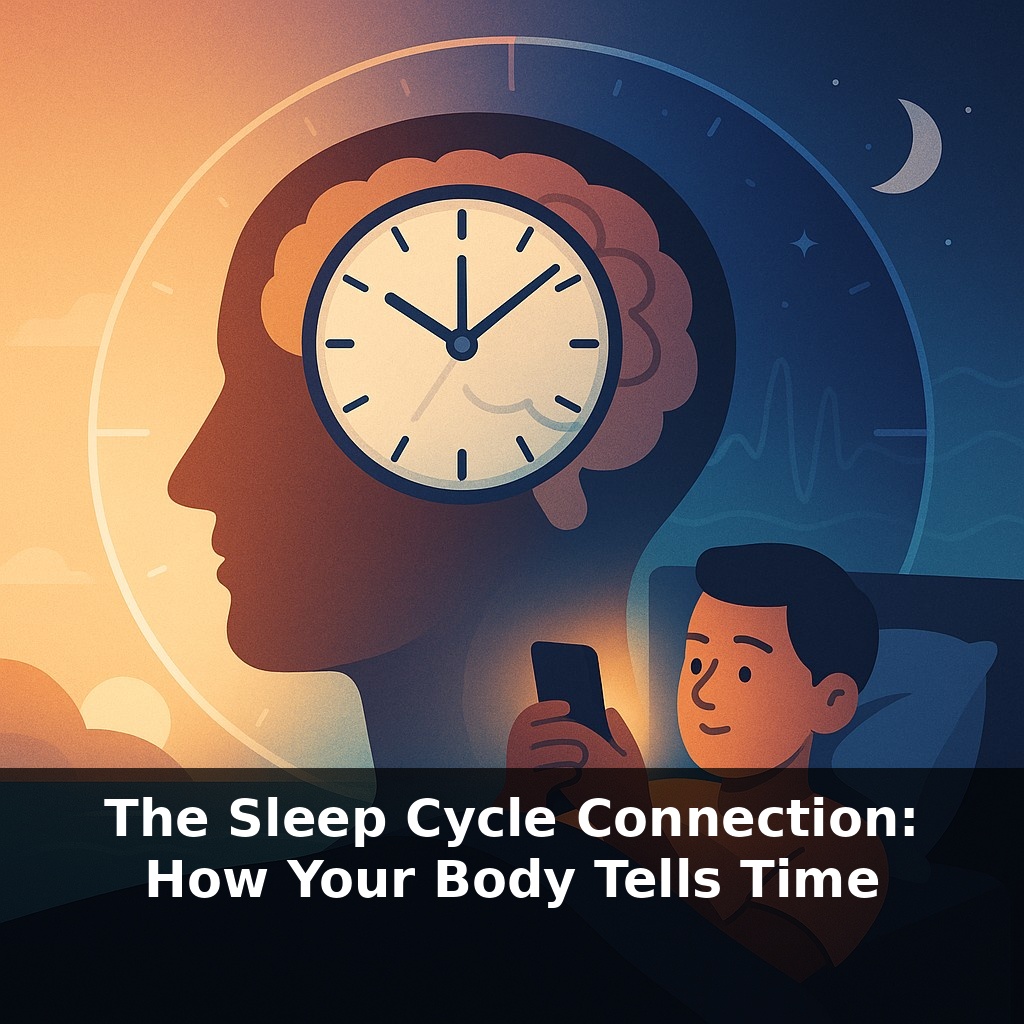
You have a hidden clock in your brain that keeps ticking even if you never see daylight. Now, here’s the twist: the moment you check late-night emails or scroll in bed, you quietly nudge that clock off schedule—and your sleep, mood, and appetite start paying the price.
That internal clock isn’t just counting hours; it quietly reshapes your whole 24-hour day. Long before you feel tired, your body is already rearranging the schedule: shifting hormones, tweaking blood sugar handling, and changing how alert your brain feels at different times. Around the same time each evening, your core temperature dips, reaction time slows, and your gut becomes less ready for big meals—signals that your system is switching from “day mode” to “night mode.”
Miss those daily time cues, and the clock starts to drift. Stay up late under bright light all week, then try to “catch up” by sleeping in, and you’ve effectively flown a few time zones without leaving home. Over time, your body’s idea of “morning” and the one on your alarm clock can slide apart, making it harder to fall asleep, wake up, or feel fully “on” at any point in the day.
While all that’s happening in the background, a “master clock” in a tiny brain region—the suprachiasmatic nucleus, or SCN—quietly keeps score of light and dark. Specialized cells in your eyes send it updates whenever you step outside, switch on a lamp, or stare at a screen after sunset. The SCN then broadcasts timing signals to clocks scattered throughout your body: in your liver, muscles, even fat tissue. Eat a big meal at midnight, or nap under bright light at noon, and those local clocks get mixed messages, like receiving two conflicting calendar invites for the same meeting. Over time, that confusion adds up.
Most people’s internal day is slightly longer than 24 hours—about 24.2 hours on average. Left alone in constant dim light, without clocks or sunrise, many of us would drift later and later, falling asleep and waking up a bit later each day. That tiny 0.2-hour difference doesn’t sound like much, but over a week it adds up to more than an hour of delay. This is why daily “time stamps” from the outside world matter so much: they keep that drift in check.
Light is the strongest of those stamps, but it’s not the only one. When you eat, exercise, socialize, and even when you take medications all offer timing clues. Your brain weighs these signals, and different tissues may privilege some over others. That’s how you can end up tired at night but still “wired,” or hungry at odd times: parts of you think it’s day, others think it’s still night.
Melatonin sits right at the center of this timing conversation. In dim conditions, levels start rising roughly two hours before your usual bedtime, marking what chronobiologists call the dim-light melatonin onset, or DLMO. Rather than knocking you out, that rise acts more like a “now entering evening hours” flag. Take melatonin too early and you can pull your internal evening forward; take it too late and you can shove it later. Dose matters far less than timing because you’re talking to the clock, not flipping an off switch.
When that conversation breaks down—through rotating shift work, frequent red-eye flights, or a wildly shifting social schedule—the consequences go beyond feeling groggy. Around a third of chronic insomnia cases have a timing problem baked in: the desire and ability to sleep are intact, but the biological “permission” to sleep is misaligned with real-world demands. The result can look like a stubborn sleep problem when it’s really a stubborn clock problem.
You can see this clearly in teenagers. In Seattle’s 2016 school start delay, students didn’t just sleep “more whenever.” Bedtimes slid a bit later, but wake times shifted even more, so total sleep increased and grades rose. Align the social schedule with the biological one, and performance improves without a single extra study session.
Jet lag is the same principle in fast-forward. Each time zone you cross nudges your clock into new territory, but only so quickly. On average, your system can shift about an hour per day. Fly across six time zones and it’s biologically reasonable for your sleep, digestion, and alertness to feel “wrong” for nearly a week. For eastbound travelers, the challenge is even steeper: asking a clock that prefers slightly longer than 24 hours to abruptly adopt a shorter local day.
Chronic misalignment—sometimes called “social jet lag”—is like living in a mild version of that state all the time. Late nights followed by early alarms, catch-up sleeping on weekends, rotating work shifts: these patterns repeatedly force your internal and external clocks apart. Over months or years, that separation is linked with higher risks of metabolic disorders, depression, and anxiety. The issue isn’t only “too little sleep,” but sleeping and eating at biologically odd hours, when your system is less prepared to process food, regulate glucose, or stabilize mood.
All of which raises a practical question: if your timing system is constantly negotiating between its built-in rhythm and your environment, how can you gently steer it instead of fighting it?
Think of your daily routine like a software schedule your body runs every 24 hours. The code isn’t just “sleep/wake”; it also includes when you’re best at deep focus, when cravings tend to spike, and when your muscles respond most efficiently to training. Miss enough “system updates” from the outside world, and that code starts to run at the wrong times—like a calendar app stuck in the wrong time zone, quietly shifting meetings into the middle of your night.
You can see this mis-timing in real life. A nurse rotating from nights to days may feel alert at bedtime and foggy during 10 a.m. rounds. An entrepreneur who works under bright LEDs past midnight can find themselves oddly energized when they intend to wind down. Teens forced into pre-dawn bus schedules often sit through first period while their biology still insists it’s the end of the night.
On the flip side, people who anchor their timing cues—consistent morning light, regular meal windows, predictable exercise slots—often report it becomes easier to fall asleep and wake up without relying on sheer willpower.
As researchers map this timing system, “when” is starting to matter as much as “what” and “how much.” Chronotherapy already times cancer drugs to catch tumors at their sleepiest, like hitting “send” when you know someone checks their inbox. Smart homes may dim and warm their lights in the evening while offices stay bright and cool. Even HR policies could shift, matching early meetings to larks and creative work to owls, turning schedule design into a health tool.
Treat this as an ongoing experiment, not a test you pass once. Your challenge this week: notice when your energy, focus, and hunger feel “off‑schedule,” as if a meeting got booked in the wrong time zone. Those mismatches are clues. Over time, they can guide you toward small timing tweaks that make your whole day run more smoothly.