Tonight, millions of people will climb into bed exhausted—and then feel more awake with every passing minute. Your body is tired, but your brain acts like it just drank a strong coffee. How can rest and alarm exist at the same time? That tension is where we’re going today.
Roughly one in three adults will go through a stretch of insomnia; for one in ten, it becomes a long-term companion. Yet the culprit is often invisible: the way our brain responds to stress and anxiety long before we turn off the light. You already know your circadian rhythm and sleep inertia shape when you feel sleepy and how you wake; now we’ll layer in the emotional side of the story—how your built‑in alarm system can override those natural rhythms. Think of a night when a tense email, a money worry, or a relationship conflict followed you into bed like a notification that wouldn’t stop pinging. The body may be horizontal, but the mind is in a meeting. In this episode, we’ll unpack what that internal “meeting” actually does to your sleep stages, and how targeted psychological tools can quiet the room so deep rest has space to return.
Stress and anxiety don’t just “keep you up”; they quietly reshape *how* your nights unfold across the week. One rough conversation or deadline can spill into several choppy nights, and those short, broken sleeps then make your threat‑detection systems even jumpier the next day. Over time, your brain starts linking the bed with forecasting tomorrow’s problems instead of closing the books on today. It’s like opening a budgeting app and seeing only worst‑case scenarios—no wonder you stop wanting to check the numbers. In this episode, we’ll map that loop and show how small, precise shifts can begin to flip the association back toward safety and rest.
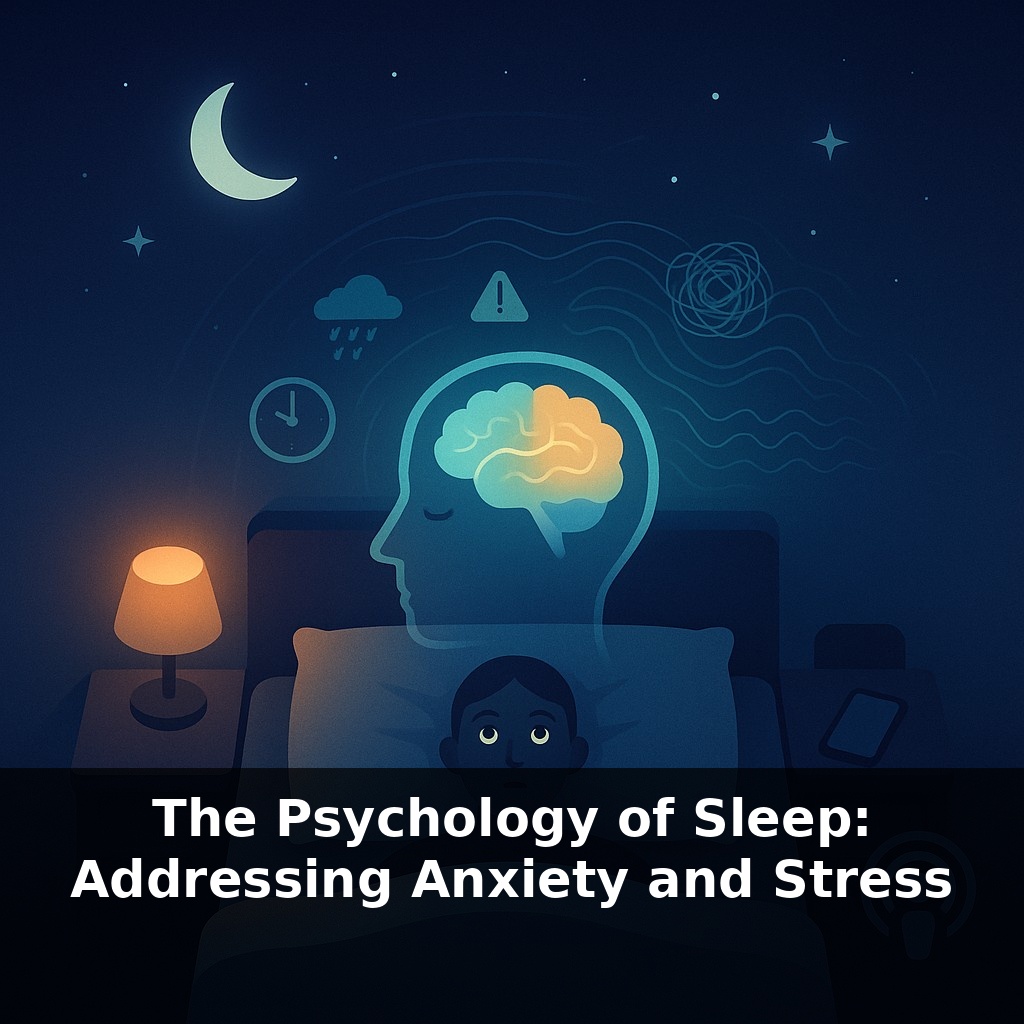
Anxiety and stress often hijack the night *before* you even get into bed. Hours earlier, your brain has already started running “what‑if” simulations: the tricky conversation tomorrow, the budget that doesn’t quite add up, the vague sense you’re falling behind. By evening, you’re not just tired—you’re mentally “pre‑spinning” scenarios. That mental rehearsal keeps the body in a light state of readiness, so when you finally lie down, it takes only a tiny cue—a creak in the hallway, a flicker of a thought—to kick the system back into high gear.
Two patterns tend to show up. The first is *sleep-onset anxiety*: the dread of “another bad night.” You see the clock, do the math—“If I fall asleep now I’ll get 5 hours… 4½… 4”—and every calculation pushes sleep further away. Your brain quietly learns: bed = performance test. Just like public speaking anxiety, the more you try to *force* a perfect result, the more your body rebels.
The second is *middle-of-the-night anxiety*. You surface at 3 a.m., feel a jolt of alertness, and your mind instantly fills the space: “Why am I awake? What’s wrong with me? How will I function tomorrow?” That secondary commentary is often more disruptive than the brief awakening itself. Many people actually fall asleep reasonably fast, but these nocturnal thinking spirals carve the night into tense, forgettable fragments.
Layered on top are coping habits that unintentionally reinforce the cycle. Staying in bed “trying harder,” scrolling to distract yourself, or reaching for a drink or a pill teaches the brain that night = struggle + substances + screens. Short term, you might feel a bit calmer; long term, your internal alarm learns to fire earlier and louder, because it expects a fight.
Cognitive-behavioural approaches work here not by *pushing* you into sleep, but by quietly changing the rules of the game. They help you notice the specific thoughts that spike your arousal—“If I don’t sleep, tomorrow is ruined”—and test them against reality. They shift your focus from controlling sleep (which you can’t do directly) to controlling the preconditions: when you get into bed, what you do when you can’t sleep, how you wind down your nervous system in the final hour. Think of it less as “fixing your sleep” and more as rewriting the bedtime script your brain has been rehearsing for years.
Think of a night of sleep like a software update quietly installing in the background: it only runs smoothly when other demanding apps are closed. If your “worry app” keeps launching new tasks—replaying a tense meeting, drafting tomorrow’s email in your head—it hogs processing power, so the update pauses, restarts, and never quite finishes.
In real life, this shows up in subtle ways. A manager who always checks email “one last time” in bed trains their mind to open work files the second their head hits the pillow. A parent who only processes fears about money at 11 p.m. teaches their brain that darkness = spreadsheet time. A student who studies in bed, doomscrolls there, and then lies there *hoping* to sleep has turned the mattress into a multi‑tab browser—rest is just one of many open windows.
CBT‑I experiments flip this: bed becomes a single‑purpose app again. Worry gets a scheduled “office hour” earlier in the evening, and mental drafts move to paper instead of looping on repeat at 2 a.m.
Anxiety‑aware sleep tools are edging toward custom “coaches” in your pocket. Wearables already sense subtle stress shifts—like tiny changes in heart rhythm—before you consciously feel wired. Paired with CBT‑I–style prompts, they could nudge you to downshift *before* bed turns into a mental boardroom. Vagus‑nerve‑based tech may add a gentle “brake pedal” for the body, letting therapy act more like a well‑timed software patch than a late‑night emergency fix.
The next step is curiosity: instead of battling nights, study them. Notice which thoughts show up like pop‑up ads, which sensations rise when you resist, which tiny shifts—cooling the room, pausing screens earlier, three slow breaths—change the “plot” even slightly. Over time, you’re not chasing perfect sleep; you’re learning how your system settles.
To go deeper, here are 3 next steps: 1) Tonight, try Andrew Huberman’s “Non-Sleep Deep Rest (NSDR)” protocol on YouTube (10–30 minutes) to calm your nervous system before bed, then log how quickly you fall asleep using the free app “Sleep Cycle.” 2) Grab a copy of “Say Good Night to Insomnia” by Gregg D. Jacobs and complete the first week’s exercises on stimulus control and sleep restriction exactly as laid out, pairing it with the CBT‑I Coach app (from the VA) to track worry, awakenings, and caffeine/alcohol intake. 3) For racing thoughts and pre-bed anxiety, listen to one guided “body scan for sleep” session on the Insight Timer app and then try replacing late‑night social media with one chapter from Matthew Walker’s “Why We Sleep,” focusing on the sections about how anxiety and blue light disrupt circadian rhythms.