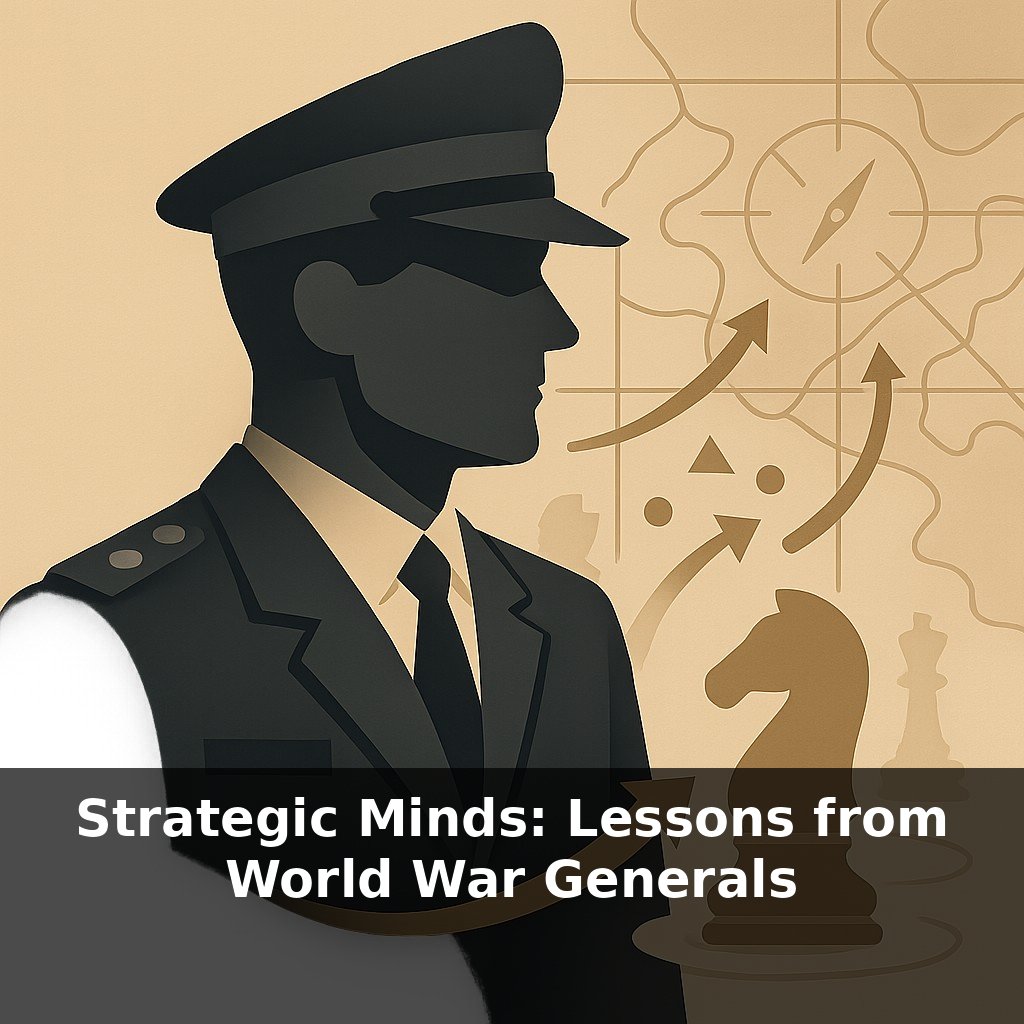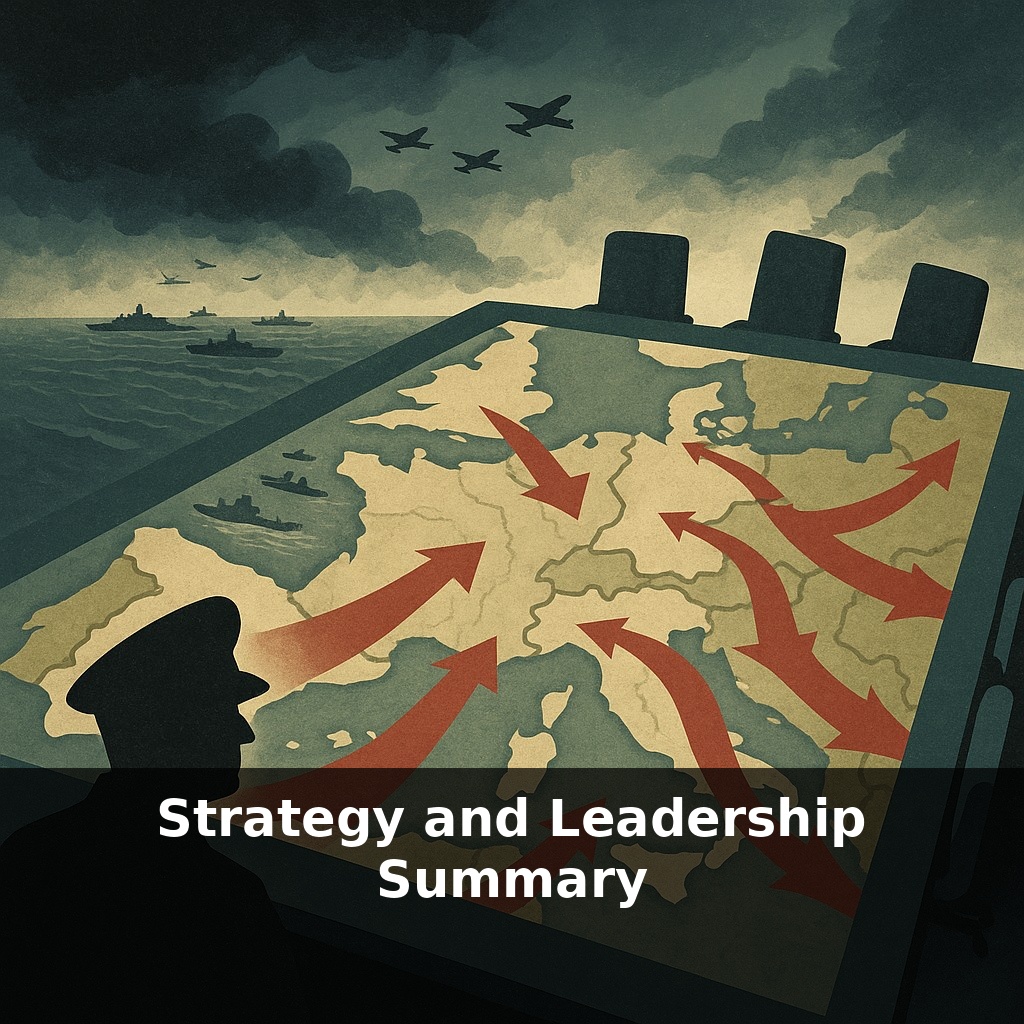
Under stormy skies on D‑Day, Eisenhower had to align over a hundred thousand people, thousands of ships and planes—and then let events unfold beyond his control. In today’s boardrooms, many leaders still try to micromanage what even wartime generals knew they couldn’t.
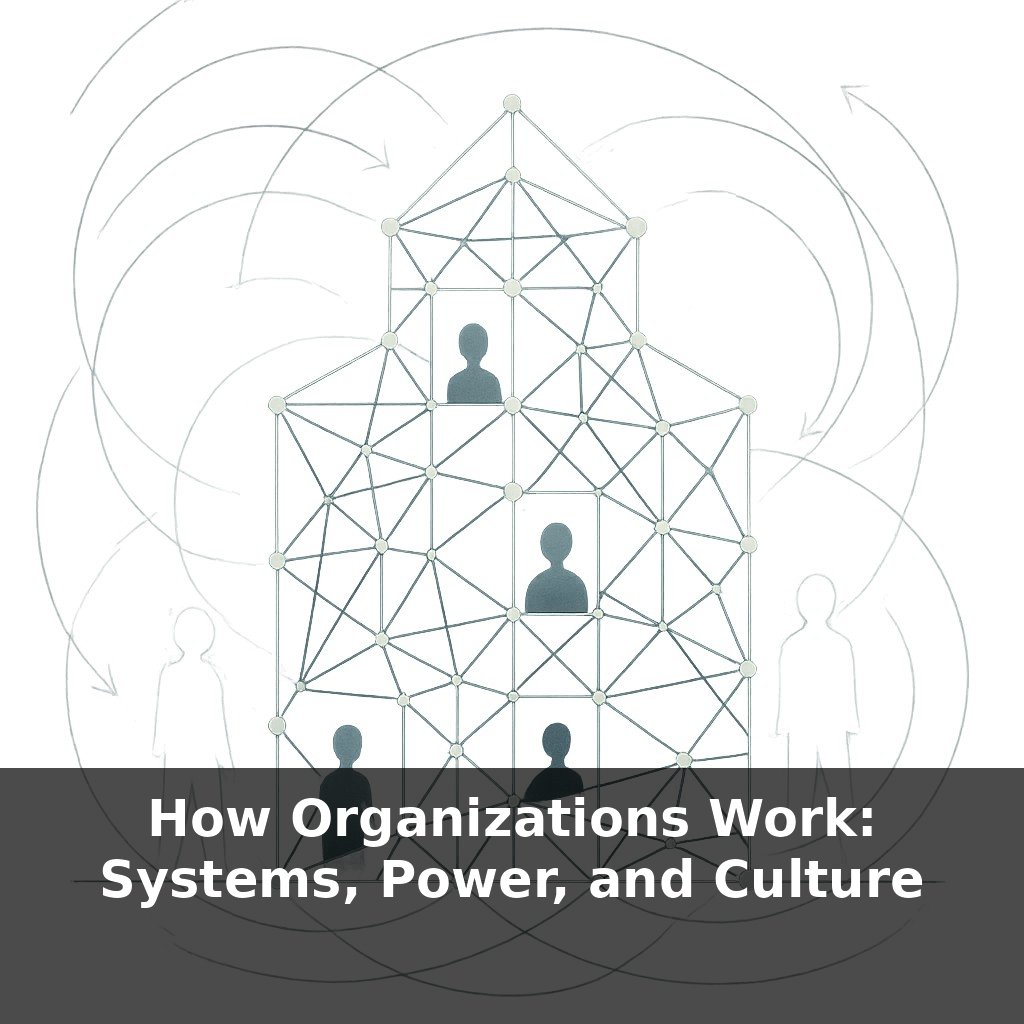
Eisenhower’s D‑Day assault wasn’t the only feat of orchestration in 1944. On the Eastern Front, Zhukov launched Operation Bagration, shattering most of Germany’s Army Group Centre in a matter of weeks. Very different theatres, same underlying pattern: leaders set a sharp intent, then pushed decisions as close to the action as possible. That’s the bridge to modern strategy. Today’s equivalents aren’t just armies and fronts, but product lines, regions, and cross‑functional squads—each facing its own “fog of war” in markets that shift faster than any battlefield map. The best organisations operate less like rigid pyramids and more like well‑coached sports teams: everyone knows the game plan, roles are clear, and on‑field players adjust in real time without waiting for instructions from the stands. This episode unpacks how to build that kind of strategic agility into daily leadership.
Modern leaders face a different battlefield: mergers that fall apart overnight, product launches hijacked by a competitor’s surprise move, regulators changing rules mid‑quarter. The tools have changed—dashboards instead of maps, Slack channels instead of field radios—but the leadership problem is eerily similar: how do you keep thousands of moving parts aligned when no one can see the full picture? The answer isn’t a thicker strategy deck; it’s a system where intent, information, and initiative circulate fast enough that teams can adjust like a good basketball offense—reading the play, not waiting for a timeout.
“Plans are worthless, but planning is everything,” Eisenhower told a room of American executives in 1957. He wasn’t dismissing plans; he was warning leaders who fall in love with their own PowerPoints. The WWII commanders who coped best with chaos didn’t write better binders—they built better *planning habits* and *decision systems*.
Start with intent. A good “commander’s intent” isn’t a slogan; it’s a practical filter. When Allied airborne units were scattered across Normandy, small groups still blew bridges and seized crossroads because they understood the *why* of the invasion, not just the original *how*. In companies, you see the same thing when a frontline engineer pauses a risky release because “protecting trust” has been made a non‑negotiable—and everyone is clear what that means in trade‑off decisions.
Next is situational awareness. WWII staffs obsessed over updated reconnaissance, radio intercepts, and logistics reports; today’s equivalent is an information architecture where the right people see the right data fast enough to act. High‑performing tech firms don’t just collect product metrics; they wire those metrics directly into the teams that can move them, with thresholds that trigger action without senior sign‑off.
Then comes iteration. Allied commanders treated operational plans as evolving drafts. Modern leaders can mirror this with short planning cycles and explicit “re-plan points”—moments where teams are expected to adjust course, not ask permission. The discipline isn’t in sticking to the first answer; it’s in revisiting assumptions before reality forces you to.
Finally, there’s learning. After major operations, WWII units ran structured debriefs that later became formal after‑action reviews. The key move wasn’t blame; it was turning messy experience into shared doctrine. Netflix’s post‑mortems, Toyota’s A3 reports, or Amazon’s narrative write‑ups all serve a similar function: they make reflection a system, not a personality quirk.
Think of this as upgrading your operating system for leadership: clear intent as the kernel, real‑time data as inputs, iterative plans as processes, and rigorous learning as the update loop that keeps the whole thing from decaying into bureaucracy.
Your challenge this week: pick one live initiative and (1) write a one‑sentence intent that a new joiner would understand in 30 seconds, (2) identify the three fastest signals that tell you if reality is drifting from plan, and (3) schedule a 30‑minute review *before* launch to decide what you’ll change if those signals move the wrong way.
A practical way to see this in action is to look at how modern firms run big, uncertain bets. When Spotify enters a new market, leadership doesn’t script every campaign; they state a sharp outcome (“become top‑3 streaming brand for Gen Z in 12 months”), then let local squads design pricing, partnerships, and content. What travels across countries is intent and shared metrics, not identical playbooks. Toyota does something similar on the factory floor: a line worker spotting a defect can stop production without asking permission, because quality has been elevated above throughput in local decision rules. In both cases, the centre focuses on framing trade‑offs, not approving moves. One useful test: could a smart outsider join your team, read a one‑page brief, and independently make 70% of the decisions you’d make? If not, intent isn’t yet concrete enough to guide real choices when conditions shift.
As AI joins human teams, leaders will need “dual‑language” intent: clear enough for people, structured enough for algorithms. Expect dashboards that don’t just report, but propose options; think of a chess engine surfacing three plausible lines while you still choose based on context and risk appetite. Organisations that rehearse with simulations, treat experiments as routine, and let local teams tune AI inputs will turn adaptation into a shared muscle, not a specialist function.
Treat this less as adopting a doctrine and more as tuning an instrument. Over time, you’ll learn which notes—intent, data, iteration, review—need amplifying in your culture. Like a software team refactoring old code, the goal isn’t perfection, but reducing “strategic bugs” each cycle so your organisation responds faster, with fewer costly rewrites.
Before next week, ask yourself: 1) “If I had to explain our current strategy on one page to a new team member, what would I keep, what would I cut, and what would I clarify so they instantly ‘get’ where we’re going?” 2) “Looking at my calendar for the next 7 days, which meetings and tasks clearly move our strategic priorities forward, and which ones reflect me slipping back into comfortable ‘operator’ mode instead of leading?” 3) “Thinking about one key person on my team, what’s the honest conversation I’ve been avoiding about expectations, decision rights, or accountability—and what’s the first sentence I’d use to open that conversation this week?”