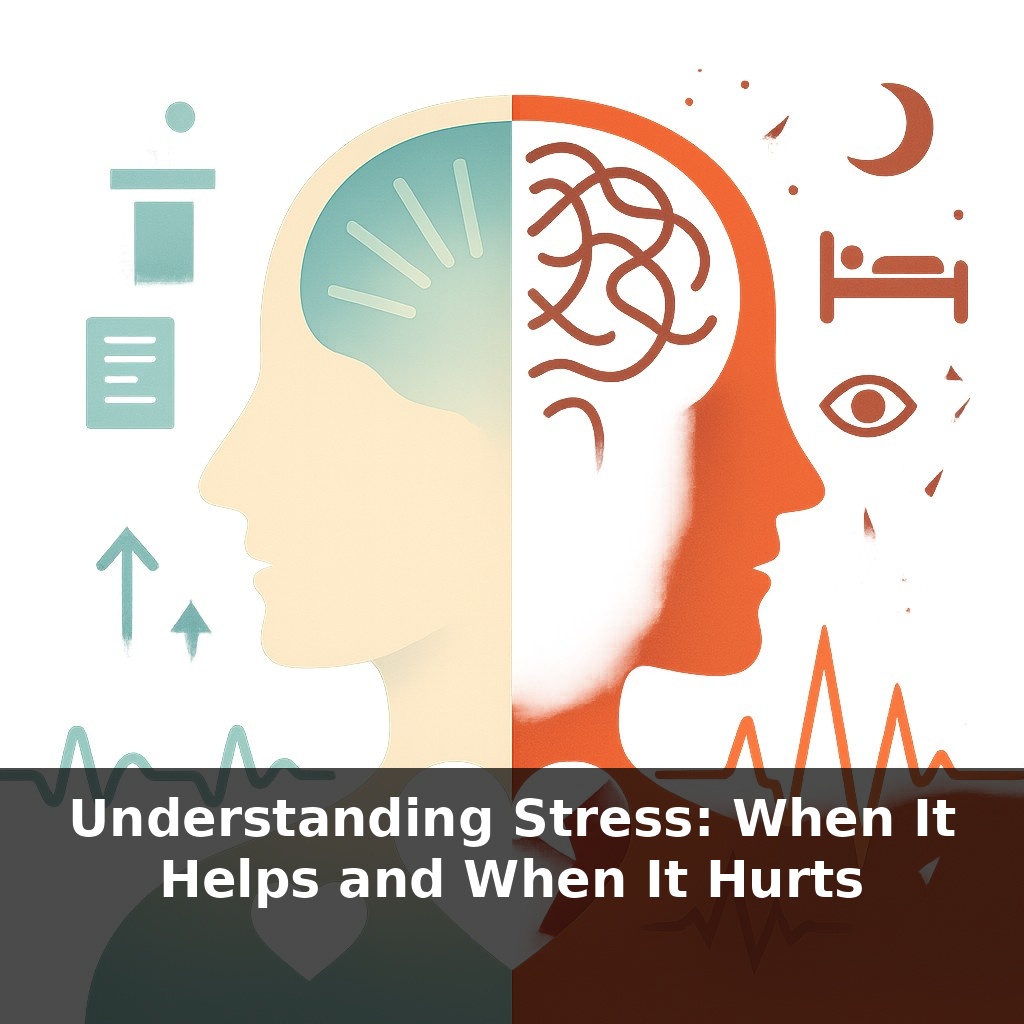
Understanding Stress: When It Helps and When It Hurts
📝 Transcript
Stress can boost your immune system by up to twice as much—yet it’s also tied to deadly heart disease. In one week, the same racing heartbeat might help you ace a presentation… and keep you awake all night. So is stress your secret weapon, or your silent saboteur?
Stress can boost your immune system by up to twice as much—yet it’s also tied to deadly heart disease. In one week, the same racing heartbeat might help you ace a presentation… and keep you awake all night. So is stress your secret weapon, or your silent saboteur?
To untangle that, we need to zoom in on *when* stress hits, *how long* it stays, and *what story your brain tells about it*. Two people can face the same deadline: one feels energized and clear, the other feels trapped and foggy. Physically, their bodies might be doing something similar—yet the long‑term impact can be completely different.
This is where intensity, duration, and recovery start to matter. Brief spikes, followed by real off‑time, often leave you sharper. But when alerts, demands, and worries stack without a reset, stress stops being a performance boost and quietly becomes a background drain. Over days and weeks, that shift is easy to miss—until your sleep, mood, or focus starts to fray.
Think of your days less in terms of “busy” or “not busy,” and more as a series of *stress pulses*. Some are sharp and meaningful—like hitting “send” on a high‑stakes email—others are tiny and forgettable, like glancing at yet another notification. Individually, those micro‑moments seem harmless. But when your phone steals your attention 50+ times a day, each check is a small jolt to your alert system. Without deliberate “off” moments, those jolts blur into a constant hum, making it harder to notice when you’ve crossed the line from “pushed” to “quietly overloaded.”
main_explanation:
One useful way to sort your daily “stress pulses” is into three buckets: *spark*, *stretch*, and *strain*.
**Spark stress** is brief and clearly meaningful. Your body surges, you focus, you act, and then things settle. Think: a tough but time‑boxed meeting, a workout interval, a live presentation. These moments often leave you feeling more *alive* afterward. Studies on “challenge” responses show better blood flow to the brain and faster reaction times when a task feels like an opportunity you can handle, even if it’s demanding.
**Stretch stress** is trickier. It’s not overwhelming yet, but it’s layered: back‑to‑back calls, minor conflicts, ongoing decisions, plus those micro‑checks of your phone. Nothing is catastrophic, but there’s little true “off.” Here, your body doesn’t get clear signals to fully ramp up or fully stand down. Cortisol and adrenaline hover in a middle zone, which feels like edgy fatigue: you’re tired but wired, sleepy but scrolling.
Left unaddressed, stretch often slides into **strain stress**. That’s when demands feel bigger than your resources *for too long*. You start to see tell‑tale shifts: you reread the same paragraph three times, make small mistakes, forget simple words, snap at people you like. Research on chronic load shows that memory, emotion regulation, and decision‑making are some of the first systems to get noisy here—not because you’re weak, but because your brain is reallocating energy to cope.
Here’s where perception matters. When your body ramps up, your brain runs a quick, mostly unconscious check: “Is this a *challenge* I can meet, or a *threat* I can’t control?” The same racing heart plus sweaty palms can either be labeled “I’m ready” or “I’m not safe.” In lab studies, people who are coached to reinterpret those sensations as fuel—“my body is gearing up to help me”—show healthier cardiovascular patterns and recover faster afterward, even when the task is identical.
One analogy from medicine helps: a fever that spikes and then breaks can help clear an infection; a low‑grade fever that never resolves is a warning sign. Stress is similar: it’s not the presence of activation, but whether your system gets to complete the cycle—rise, respond, and genuinely reset.
Spark, stretch, and strain show up differently in real life than they do on paper. A surgeon heading into a complex procedure may feel spark: clear goal, defined start and end, a trained team beside them. Their body shifts up a gear, and afterward, they often report a kind of energized calm. Now contrast that with a product manager whose launch date keeps moving, whose priorities shift daily, and whose Slack never stops. That’s classic stretch: no single moment is *the* crisis, but there’s no obvious time when it’s okay to fully exhale.
Strain tends to appear where control is lowest. A call‑center worker who must hit strict metrics while handling angry customers, with schedules and scripts dictated by others, is at far higher risk than a freelancer with similar hours but more choice over pacing and breaks. The demands might look similar from the outside; the internal equation—“resources versus control”—is radically different. Over time, the brain learns these patterns and starts bracing earlier and recovering later, quietly shifting the threshold where “enough” becomes “too much.”
Stress dashboards on wearables may soon feel as normal as step counters. Instead of guessing, you could see your “pressure pattern” for the day: which meetings spike you, which commutes settle you, which apps nudge you into late‑night overdrive. Workplaces might schedule tough tasks the way athletes time peak events, clustering hard efforts when your data show you’re most resilient, then stacking small “recovery pockets” like snacks between them, turning stress into a trainable skill, not just a problem.
So the real skill isn’t dodging pressure, but learning your personal “settings.” Notice which kinds of friction wake you up, and which slowly blur your edges—specific tasks, people, times of day. Like tuning a recipe with more heat or less salt, you can start adjusting inputs so your daily load tastes challenging, not corrosive. Your challenge this week: once a day, briefly label the main stressor you felt *by type*, not by emotion. For instance: “coordination load,” “money uncertainty,” “social tension,” “time pressure,” “health worry.” At the end of the week, scan for the one type that shows up most. That’s your next target—not to erase, but to redesign how, when, and how much of it you take on.
From this course
Stress-Proof: Manage Pressure Without Breaking
7 episodesUnlock all episodes
Full access to 7 episodes and everything on OwlUp.
Subscribe — $1.99/monthLess than a coffee ☕ · Cancel anytime