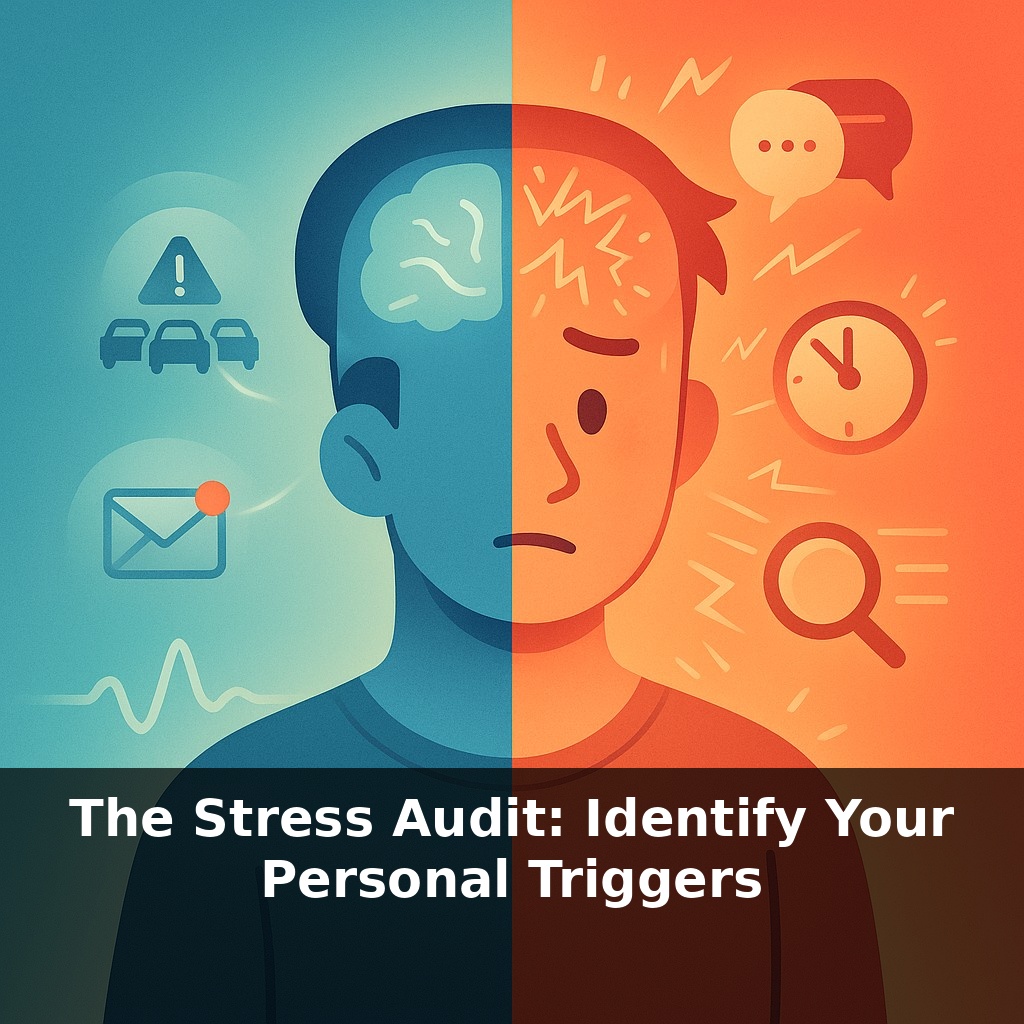
Stress can spike just because you *remember* an argument—your body reacts as if it’s happening again. On a normal day, stuck in traffic or scrolling email, your heart, breath, and thoughts quietly shift. The puzzle is: which tiny moments are secretly setting off your alarm system?
A curious twist of biology: your body reacts almost the same way to a tight deadline as it does to a near‑miss on the highway, and it also reacts to the *memory* of both. That’s why some days feel draining for “no reason” — the reasons are there, but they’re hiding in plain sight.
Today we’re going to start pulling those reasons into the light.
Most people guess wrong about what stresses them most. Research shows it’s often not the big crises but the “small stuff”: a certain tone in an email, a cluttered desk, a specific time of day, even a single name popping up on your phone. Like a faint background hum from a refrigerator, you only notice it once you deliberately listen for it.
This is where a personal stress audit comes in: not a judgment, but a systematic way to track when, where, and how your stress quietly spikes during everyday life.
Here’s the twist: your brain rarely labels a trigger in real time. It just whispers, “I’m fine,” while your shoulders climb toward your ears and your breathing gets shallow. That’s why a stress audit needs more than “How do I feel?” check‑ins. We want to catch the tiny, measurable shifts your body makes and connect them to specific moments in your day. A certain meeting, a lighting‑bright office, or three unread messages from the same person might all nudge your system upward, like slowly turning up a dimmer switch until the room is harshly lit and you can’t remember when it stopped feeling comfortable.
Stanford’s WELL for Life study found that heart‑rate variability—one of the better real‑time indicators of strain—drops just 3–5 milliseconds during everyday stress. That’s a tiny change, but over hundreds of moments, it adds up. A stress audit is about catching those small shifts and linking them to the specific *contexts* that produce them.
Think of three layers:
**1. Situations** These are the obvious “where and when” elements: Monday status meetings, late‑night screen time, commuting, certain projects or clients. Research on daily hassles shows these routine frictions predict long‑term health risks better than rare crises, precisely because they’re repeated exposures. As you map them, you’re not just naming “work” or “family,” but narrowing down to *which* call, *which* place, *which* hour consistently precedes tension, headaches, or fatigue.
**2. Thoughts and stories** Two people can walk into the same meeting and have opposite stress responses. The difference is often the story in their heads: - “If I make a mistake here, I’m done.” - “They’re already judging me.” - “I have to answer immediately or I’m falling behind.” Your nervous system reacts to those sentences as if they’re facts. Biologically, it can’t distinguish between a real threat and a vividly imagined one, so the HPA axis lights up either way. During an audit, you’re not trying to silence these thoughts yet—just capturing their exact wording so you can see which ones reliably turn a neutral situation into a spike.
**3. Body signals and behaviors** Maybe your jaw clenches every time a particular ringtone goes off. Maybe you scroll your phone faster, or your posture collapses after reading news headlines. Over days, repeated notes like “shoulders tight after checking inbox” or “breath shallow in open‑plan office” reveal patterns you’d otherwise miss. This is where physiological data (like HRV, sleep quality, or breath rate) can be helpful, but they’re optional. Pen‑and‑paper logs, done consistently, often uncover the same connections.
Here’s the paradox: the moments you’re most tempted to power through—“it’s not a big deal”—are often the exact moments worth recording. When you collect them, they stop being vague “busy weeks” and become a list of specific, modifiable ingredients you can actually work with.
You might start noticing patterns that initially seem trivial. For example, one person’s log shows a consistent pattern: tension rises not in big presentations, but in the 20 minutes *after* them, when they reread every comment and second‑guess what they said. Another person realizes their worst days cluster around late‑afternoon tasks that require detail work, when their focus is already frayed.
Use your entries to ask very specific questions: - “Is it the meeting, or the rushed five minutes beforehand?” - “Is it this project, or only when I’m working on it alone?” - “Does this feeling appear more on days when I skipped lunch?”
In medicine, a good differential diagnosis depends on ruling out what *isn’t* causing the problem. Your audit does the same: you’ll separate genuine high‑impact triggers from background noise. Over a week or two, this lets you move from “I’m just stressed” to “My stress spikes in these three repeatable situations—so *these* are what I’ll experiment with changing first.”
Daily hassles, not crises, are where your future is being shaped. As stress audits scale, AI could quietly sift your calendar, messages, and brief check‑ins to flag brewing overload—like a weather app issuing “storm watch” alerts for your week. Your challenge this week: treat your notes as a prototype dataset. Ask: “If an algorithm saw only this, what would it predict about my toughest hours tomorrow—and what simple tweak could I test before they arrive?”
Over time, your notes become less like a diary and more like a recipe card: “When I mix these people, this time of day, and this kind of task, tension rises; when I add breaks or clearer boundaries, it eases.” The goal isn’t to eliminate every spike, but to keep adjusting the ingredients until most days feel deliberately seasoned, not accidentally overcooked.
Before next week, ask yourself: 1) “In the last few days, when did I feel that familiar ‘stress spike’ in my body, and what exactly was happening right before it—was I checking email at night, rushing through my morning, saying yes to a last-minute request, or multitasking during a meeting?” 2) “If I replay one of those stressful moments like a slow‑motion video, what were the precise triggers—the person, the tone of voice, the notification sound, the looming deadline—and which of those could I realistically change, delay, or opt out of next time?” 3) “Looking at my week ahead, where can I pre‑empt my top two triggers by adjusting something concrete (like blocking 30 minutes between meetings, batch‑checking messages instead of reacting instantly, or setting a clear ‘no work talk after 8pm’ boundary), and what’s one sentence I’ll use to protect that change when someone pushes back?”