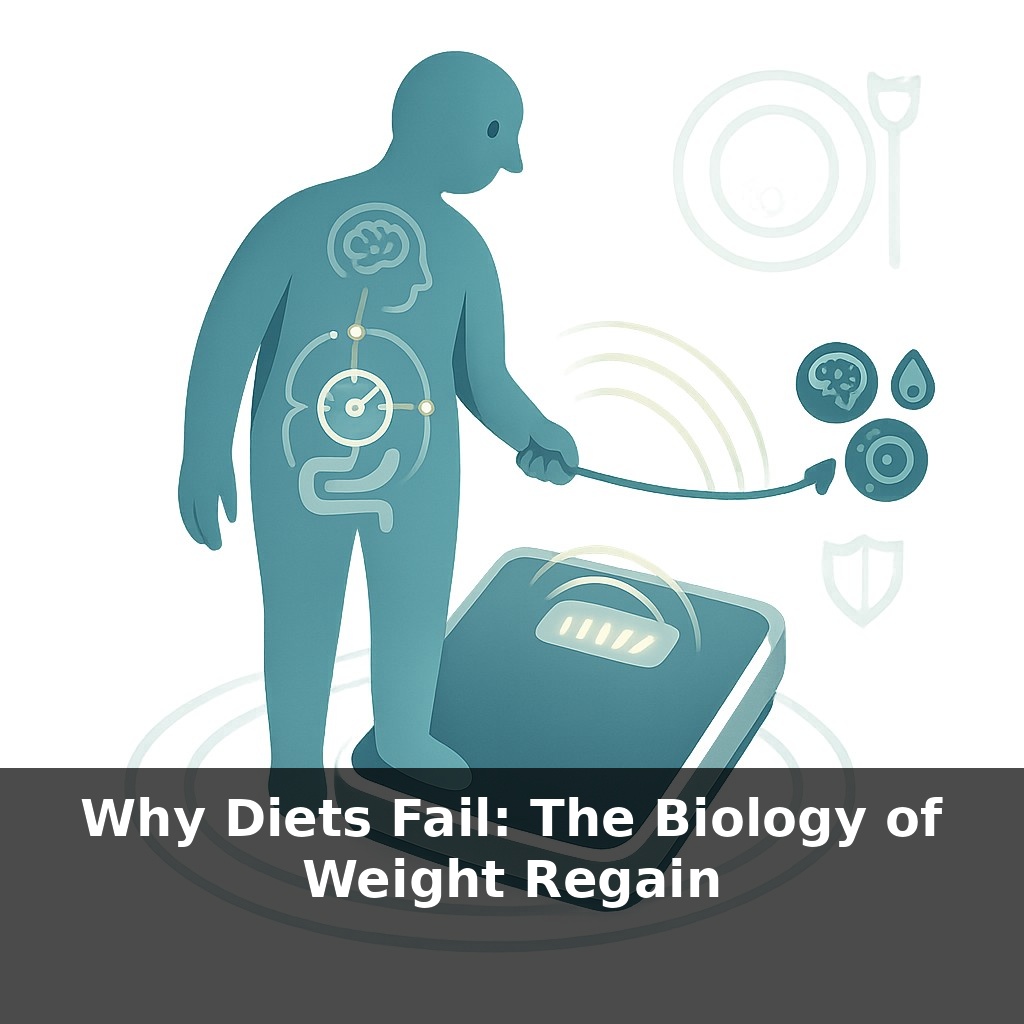
Why Diets Fail: The Biology of Weight Regain
📝 Transcript
“Most people who lose weight will gain it back—and often a bit more—even when they’re disciplined. You step on the scale, see success… and months later, the same number stares back. Today’s question is: what hidden system inside you keeps pulling that number home?”
Here’s the twist: that “hidden system” doesn’t just resist change—it learns from every diet you’ve ever tried. Each strict plan, every crash attempt, teaches your body one lesson: famine happens, defend the reserves. So the next time you cut calories, your biology responds faster and harder. Hunger hits sooner. Energy dips lower. Food ads feel louder. It’s not a simple lack of willpower; it’s more like arguing with a very old, very stubborn safety protocol. And this protocol keeps score. That’s why two people can eat the same “1200 calories” and get wildly different results: one body is relaxed, the other is on high alert from years of dieting. To make real progress, we have to stop triggering alarm mode—and start working with those ancient defenses instead of constantly provoking them.
So where does this leave you if you still want to lose weight without waking that whole defense system up? This is where biology gets uncomfortably specific. Research shows your body tracks not just *how much* you lose, but *how fast* and *how often* you’ve lost before. Rapid drops, huge deficits, and “on/off” plans send a clear pattern your brain remembers. Slow, boring changes barely register. That’s why some people can tighten up their habits and glide down a few sizes, while others follow the same plan and feel like they’re dragging a weighted vest. Your history changes the rules of the game—and the rules can be bent, but not ignored.
Here’s the uncomfortable pattern researchers keep seeing: when people lose weight, the body quietly rewrites the rules of maintenance. The number on the scale might be lower, but *the cost of staying there* just went up.
Three big changes show up in the data:
First, the “price” of your new weight in calories is often higher than you expect. In the Biggest Loser follow‑up, participants were burning hundreds fewer calories per day than people of the same size who had never dieted that hard. Their bodies weren’t malfunctioning; they’d simply become more fuel‑efficient. You can do the same walk, the same chores, the same workout you did before…and burn less to do it.
Second, appetite doesn’t reset just because the diet is “over.” Hormones like leptin and ghrelin don’t politely drift back to baseline. For many people, they stay tilted toward “eat more” for years. That means your day feels slightly skewed: portions that used to satisfy you now feel a bit small, “normal” meals leave a faint sense of deprivation, and highly palatable foods grab more of your attention. Nothing dramatic, just a steady nudge upward.
Third, your brain quietly upgrades how rewarding food feels when your weight is lower than its usual range. Functional MRI studies show stronger responses in reward circuits to pictures of food after weight loss. Translation: that office pastry you used to ignore now has a little spotlight on it.
None of this means long‑term change is impossible. It means that “lose it, then go back to normal” is almost guaranteed to clash with these new settings. The people in the National Weight Control Registry who’ve kept significant weight off for years tend to build an entirely new normal: more daily movement than average, more consistency with meals, less routine exposure to their biggest trigger foods, and a surprisingly un‑dramatic approach to eating.
Think of it less as a temporary fix and more like post‑surgery rehab: after a major change, your system behaves differently for a long time. The goal isn’t to beat it into submission, but to design your habits so that the new rules don’t constantly push you back to where you started.
A helpful way to *use* all this, without fighting yourself, is to zoom in on specific situations where biology quietly tilts the field. Think about late‑night eating after a “good” day: you white‑knuckled through smaller meals, hit your step goal, felt proud—and then find yourself standing in front of the pantry at 10:30 p.m. That’s not random “lack of discipline”; it’s often the point where your brain starts bargaining hardest, combining fatigue, amplified food cues, and that upgraded reward response.
Or consider weekends. Someone who’s been through years of aggressive dieting will notice that two “normal” restaurant meals and drinks can undo almost an entire week’s deficit—not because their body is broken, but because the new maintenance “price” is steeper and their appetite quietly favors calorie‑dense options. In contrast, people who maintain long‑term losses usually engineer small frictions here: they pick default orders, limit “surprise” foods in the house, and plan satisfying, higher‑protein meals before social events so the environment has less leverage over them.
In the next decade, the “try harder” model of dieting will look as outdated as bloodletting. As drugs, food policy and city design start shifting weight set‑points, the real skill will be learning *when* to lean on each tool. Think less “perfect diet,” more “treatment portfolio”: periods of medication, seasons of tighter structure, and looser maintenance phases—like a doctor cycling antibiotics and rest rather than relying on one mega‑dose and hoping the infection never returns.
So the real experiment isn’t “Can I lose 10 pounds?” but “What kind of life quietly supports the weight I want?” Like adjusting recipes until they fit your taste, you’ll tweak sleep, stress, movement, and food environment. The goal isn’t one perfect plan—it’s slowly discovering routines your biology doesn’t feel compelled to undo.
Try this experiment: For the next 7 days, eat your usual meals but deliberately add 20–30 grams of protein to breakfast (for example, 2 eggs plus Greek yogurt or cottage cheese) and keep everything else the same. Weigh yourself first thing in the morning on day 1 and day 8, and also rate your hunger from 1–10 before lunch and dinner each day. You’re testing the podcast idea that higher early-day protein helps blunt the biological “starvation response” and reduces rebound hunger that often leads to weight regain. At the end of the week, compare your hunger ratings, evening cravings, and weight to see if this small biological tweak changed how your body and brain responded.
From this course
Sustainable Weight Loss: The Anti-Diet Approach
8 episodesUnlock all episodes
Full access to 8 episodes and everything on OwlUp.
Subscribe — $1.99/monthLess than a coffee ☕ · Cancel anytime