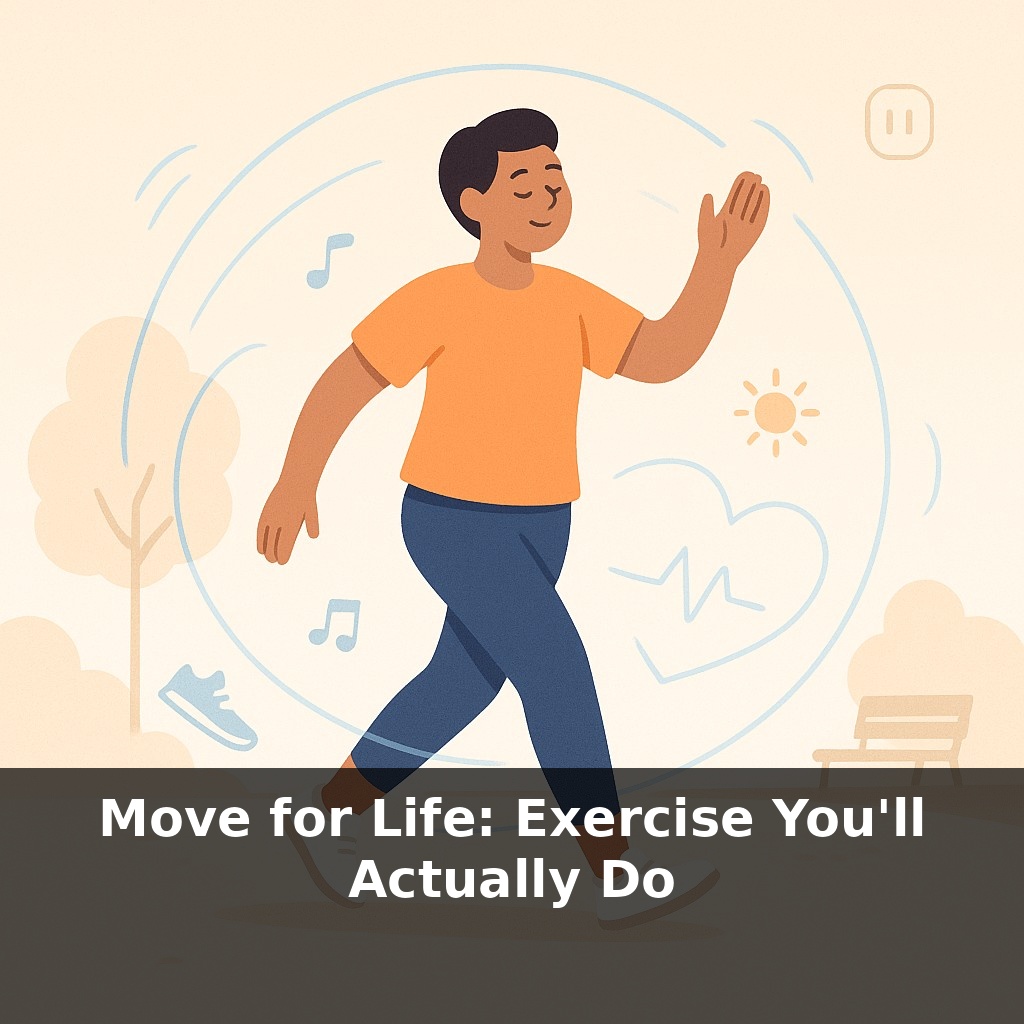
About 1 in 4 adults does the recommended exercise… but here’s the twist: most people who *keep* moving long‑term aren’t grinding out punishment workouts. They’re doing things that feel so good, they’d miss them if they stopped. Today, we’re going to explore how they pulled that off.
Here’s the strange thing: most of us *know* movement is good, yet our bodies treat the start of a workout like a bad software update—postponed, ignored, clicked “remind me later.” That’s not laziness; it’s biology plus environment. Your brain is constantly running a cost–benefit check: “Will this feel good *now* or just hurt and leave me tired?” If the answer is “mostly misery,” your motivation system quietly pulls the plug.
So instead of forcing “discipline” on top of a system that’s voting no, we’re going to change what the system is voting *on*. Tiny shifts in context—who you move with, what you hear, where you are, even the story you tell yourself while you move—can flip that internal decision from “avoid” to “I kind of want more of this.” This episode is about engineering those flips on purpose.
So now we zoom in on *where* and *how* those flips tend to happen in real life. Not in ideal gym schedules, but in messy Tuesdays with laundry, emails, and kids’ homework. Research keeps pointing to three amplifiers that quietly tilt the scales: joy, people, and friction. Joy is the part that makes you lose track of time. People are the ones whose texts pull you off the couch. Friction is every tiny hassle between you and moving—like shoes buried in a closet. Change these levers, and the same body, on the same day, can give you a totally different “yes” or “no” to moving.
Think of those three amplifiers—joy, people, friction—as dials you can turn, not traits you either “have” or “don’t.” Most plans crank “willpower” to max and leave these dials at zero. We’re going to do the opposite.
First, the joy dial. Instead of asking, “What burns the most calories?” ask, “What would I *actually* look forward to on a low‑energy day?” That question usually points you away from punishment workouts and toward things like dancing in your kitchen, slow bike rides, yard work with a podcast, or walking calls instead of sitting ones. The British Journal of Sports Medicine paper isn’t celebrating perfect workouts; it’s showing that regular, pleasant activity moves the mortality needle. Pain isn’t a prerequisite; consistency is.
Now the people dial. Group settings don’t have to mean a crowded fitness class if that’s not your scene. A “group” can be: - One friend you send a selfie to after each walk - A virtual step challenge with coworkers - A local running club where you mostly jog and chat at the back The University of New England study found less stress and more enjoyment in group movers, but the real power is subtle: someone else expecting you tilts your decision on the days you’d cancel on yourself.
Then there’s friction. This is where most plans quietly fail. You say you’ll work out after work—but your shoes are upstairs, your sports bra is in the wash, your living room is cluttered, it’s dark outside, and you haven’t picked a workout. Each tiny hassle adds up to “not today.” Lowering friction looks boring on paper and feels magic in practice: - Sleep in the clothes you’ll walk in - Keep a resistance band or dumbbell where you usually scroll your phone - Save a 10‑minute YouTube playlist labeled “Zero‑Brain Energy” - Pick *backup* options for bad weather, low mood, or sore joints
Here’s the paradox: when you deliberately make movement easier and more pleasant, you often end up doing *more* of it and at higher intensity—because you start more often and stay longer once you’re in motion. Over time, your identity shifts from “someone who should exercise” to “someone who moves most days,” and that’s where sustainable weight loss actually has a chance to stick.
Think of this like designing a personal “movement menu” instead of following a fixed meal plan. You’re not committing to one perfect workout; you’re stocking options so there’s always *something* that fits your day. For example, maybe your menu has:
- A “rainy day” slot: 8‑minute living‑room mobility video bookmarked on your TV - A “social” slot: Wednesday night beginner pickleball where no one keeps serious score - A “reset” slot: solo walk after stressful meetings, headphones ready with a comfort playlist
Real people do this without formal planning. The friend who never misses Saturday soccer isn’t more disciplined; that game is just a non‑negotiable calendar event, like brunch. Parkrun regulars often start with “I’ll just jog–walk one” and end up with a weekend ritual because the coffee chats after feel as important as the 5K. The pattern to steal: anchor at least one movement option to something that’s already automatic—your commute, your lunch break, your kids’ practice—so it piggybacks on a habit you already trust.
When cities, tech, and workplaces lean into this, your default day starts to move you even when you’re “too busy to exercise.” Commutes become bikeable, meetings become walking calls, stairwells feel welcoming, VR games sneak in squats and lunges. Think of it like updating the “operating system” around your body: the less you have to *decide* to move, the more your future health behaves like compound interest quietly growing in the background.
Let this be a season of testing, not perfection. Treat your week like a lab bench: swap one car errand for a walk, one scroll break for stretching, one lonely evening for a low‑pressure class. Notice which tiny swaps leave you clearer, calmer, or sleeping better. As those “good experiments” pile up, your body quietly votes for a new normal.
Here’s your challenge this week: Pick one “move for life” activity you genuinely enjoy (like dancing in your living room, brisk neighborhood walks, or 10-minute strength bursts between tasks) and do it for a total of 20 minutes a day, 5 days this week. Stack it onto something you already do daily—right after your morning coffee, during a mid-afternoon slump, or while dinner’s in the oven—so it feels automatic, not forced. Keep the intensity at a level where you can still hold a short conversation, and if you miss a day, simply add 5 extra minutes to the next one.