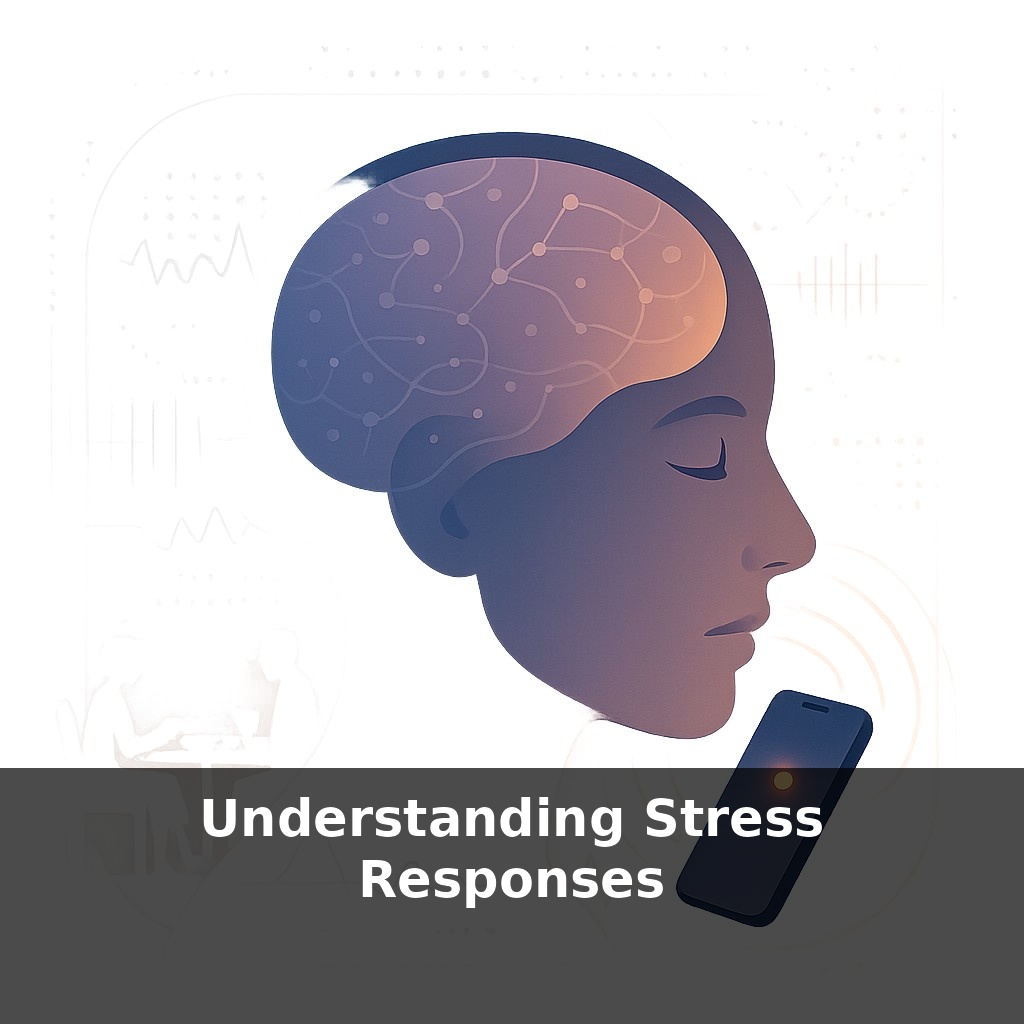
Understanding Stress Responses
📝 Transcript
A silent dinner with your partner, a half-read message from your boss, or your phone lighting up—these moments often seem insignificant but can trigger a cascade of stress reactions. How does such mundane start create an internal alarm that feels disproportionate?
People around the globe experience stress in unexpected places—inside quiet conversations or as they read a simple text message. These subtle triggers show that stress doesn't need a dramatic event to be real, highlighting how biology responds to even the smallest catalysts. Subtle things—a half-read text from your boss, a silent dinner with your partner, your phone lighting up at 11:47 p.m.—can quietly flip your internal switches long before you feel “stressed.”
Here’s the twist: your body reacts to *perceived* threat, not just actual danger. A critical comment can register like a speeding car swerving toward you; a tight deadline can feel, physiologically, closer to a sprint finish than to a calendar event. And sometimes, your body launches that response based on an old story—past failures, childhood patterns, or the way you explain events to yourself—rather than what’s in front of you right now.
In this episode, we’ll unpack how those hidden appraisals decide when your stress machinery powers up—and when it mercifully stands down.
Here’s where biology gets even more interesting: your brain doesn’t weigh every challenge on a blank slate. It consults your personal “settings”—sleep, hormones, past experiences, even whether you’ve eaten—before deciding how big a deal something is. The same email can land as a mild nudge on a rested Tuesday, or as a threat when you’re depleted on Friday night. Over time, repeated patterns of tension can teach your body to hit the alarm faster, or to stay calmer, in certain situations. Those patterns are trainable—both toward reactivity and toward resilience.
Think of what happens next as a rapid series of “if–then” checks your body runs in the background.
First: **“Can I handle this?”** Your brain makes a snap judgment about resources. Not abstract confidence—actual, embodied resources: How much sleep did you get? Are your blood sugar and electrolytes stable? Are you in pain? Do you have people you can call if things go badly? When the answer tilts toward “yes,” your body tends to mount a focused, temporary surge that helps you tackle the problem. When the answer leans “no,” the same situation is more likely to feel overwhelming and exhausting.
Second: **“Is this new, or is this *that thing* again?”** Your memory system is constantly pattern-matching. If today’s argument sounds like a hundred past arguments that ended badly, your response usually ramps up faster and lasts longer. If similar situations have ended well, your system can stay more contained. This is why two people with the same workload can have wildly different internal reactions: they’re not just reacting to the task, but to their entire history with tasks like it.
Third: **“How trapped am I?”** The body reacts very differently when you sense you can *do* something versus when you feel cornered. Challenges with clear actions—study for the exam, call the client, apologize to your partner—tend to produce sharper, briefer responses. Situations that feel inescapable—chronic debt, a hostile workplace, caring for a loved one with no support—push your system toward longer, flatter, wear-you-down activation.
Here’s the key twist: each of these judgments is trainable, not fixed. - Resource judgments shift when you consistently protect sleep, movement, and nutrition; your body “believes” you can handle more. - Pattern-matching shifts when new experiences contradict old stories—like setting boundaries and finding out people stay. - Trapped-versus-empowered shifts when you practice even tiny acts of choice in stuck-feeling situations.
Over time, these micro-adjustments change the thresholds at which your biology ramps up, how high it goes, and how quickly it comes back down. That’s the difference between a life where every email feels like a crisis and one where even real challenges don’t own your entire day.
A useful way to spot these internal “if–then” checks in daily life is to watch how your body behaves in different contexts that look similar on paper. Text from your boss at 9 a.m.: quick jolt, then you draft a reply and move on. Same number, 11:47 p.m.: your jaw tightens, and sleep suddenly feels far away. The content might be identical; what’s changed is your system’s sense of history, timing, and room to maneuver.
Or take two meetings on your calendar. One is with a colleague who’s backed you before; you notice a light, focused buzz as it nears. The other is with someone who’s cut you down in public; your shoulders lift toward your ears hours in advance. That anticipatory tension is your past writing over the present.
In sports terms, it’s like being down by two points with ten seconds left: one athlete feels “here comes my moment,” another feels “here we go again.” Same scoreboard, different body story—and over time, practice can nudge you toward the first.
Here’s the twist for the future: those fast body “checks” could soon be mapped in real time. Wearables may flag your biological “red zones” before you notice them, like a car dashboard lighting up before the engine overheats. AI tools at work might spot when your late-night emails spike and nudge you toward recovery blocks. Schools could train kids to ride out activation the way they now teach reading—core literacy for a world that won’t slow down.
Begin a focused experiment to recalibrate your stress responses: Use the Sleep Cycle app to monitor your sleep quality after instituting a 'digital sunset' policy, shutting off screens one hour before bedtime. Pay close attention to any shifts in your morning mood and alertness levels, noting specific improvements or challenges throughout the week. They don’t rewrite your whole system overnight, but they quietly change what tomorrow’s body story is allowed to become.
To go deeper, consider these targeted steps: (1) Dive into Dr. Andrew Huberman’s “Stress Toolkit” at hubermanlab.com and implement a physiological sigh protocol during a specific stressor, like your next intense meeting. Track heart rate and muscle tension changes within the Calm app’s Stress & Sleep section. (2) Explore your stress response patterns by highlighting real-life examples matching your response type (freeze, fawn, fight, flight) in Robert Sapolsky’s *Why Zebras Don’t Get Ulcers*, gaining clarity on how these responses operate in daily life. (3) Download the “Polyvagal Safety Anchors” worksheet from Deb Dana’s resources on rhythmofregulation.com and select a distinct calming signal—whether it’s a tune, aroma, or setting. Use it intentionally to alleviate tension, conducting a small experiment to recalibrate your nervous system’s adaptability.
From this course
The Biology of Stress: From Survival to Thriving
5 episodesUnlock all episodes
Full access to 5 episodes and everything on OwlUp.
Subscribe — $1.99/monthLess than a coffee ☕ · Cancel anytime