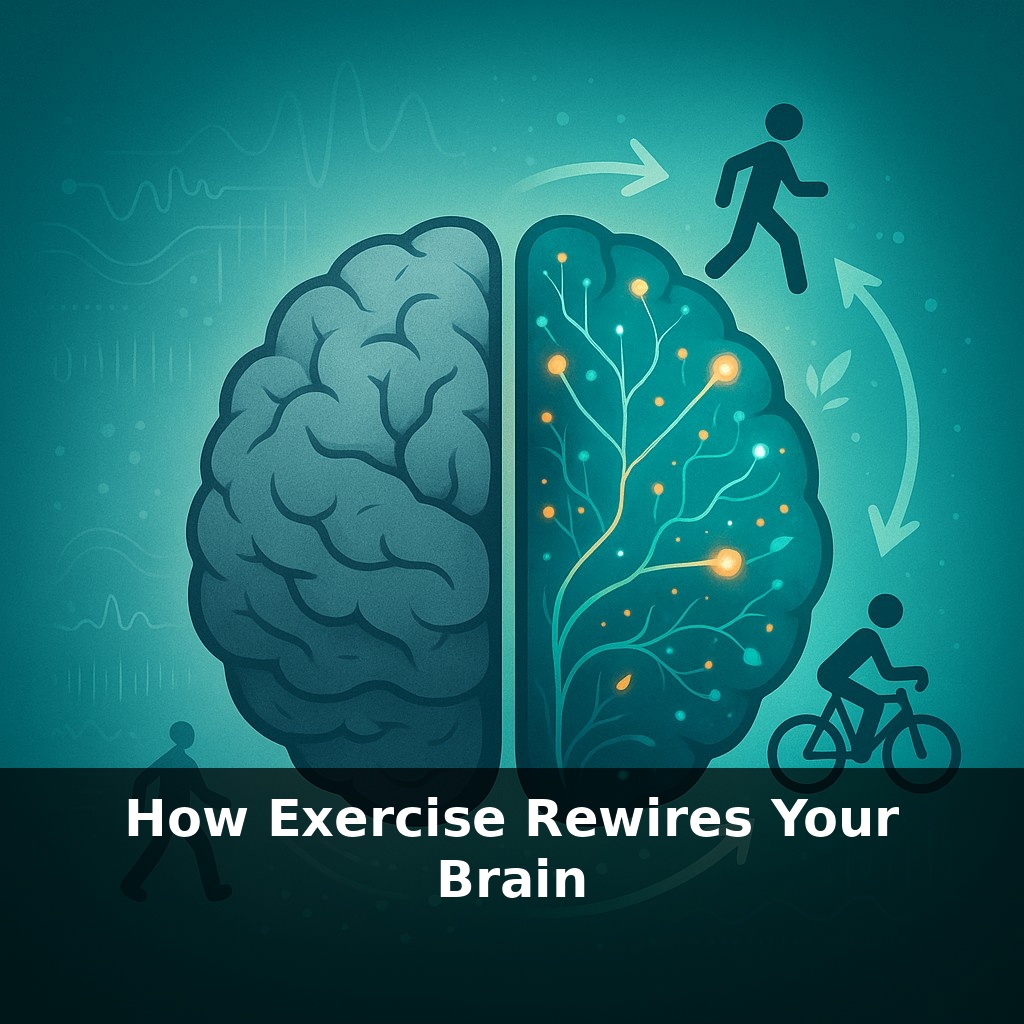
How Exercise Rewires Your Brain
📝 Transcript
Right now, as you’re just sitting or walking, your brain might be quietly shrinking with age—or secretly rebuilding itself. The twist is, one simple habit can push it in either direction. And most adults on the planet aren’t doing nearly enough of it.
The strange part is, your brain doesn’t just respond to marathons or brutal gym sessions. It reacts to surprisingly small nudges. A short bike ride that barely breaks a sweat, a brisk walk where you can still talk in full sentences, a few flights of stairs taken on purpose—these can all start shifting the chemistry and wiring inside your head.
Most people still think of movement as a way to “burn calories” or “get toned,” so they underestimate what’s happening above the neck. They’ll protect their phone battery more carefully than their mental energy, then sit all day and wonder why their focus frays by mid‑afternoon or their mood slowly dulls over the years.
We’re going to zoom in on what those modest, doable bursts of activity are actually doing inside your skull—and how little you need to trigger benefits your future self will feel.
Here’s the odd twist: the brain changes you care about most don’t show up as sore muscles or a higher step count—they show up as “hidden upgrades” in how your day feels. The email that normally derails your mood suddenly feels manageable. Names stick a bit better at meetings. That mid‑afternoon fog lifts 20 minutes earlier than usual. These are tiny, quiet signals that your wiring is shifting. In this episode, we’ll connect those subtle daily wins to specific changes in your brain—and then map out how little movement it actually takes to earn them on purpose.
Most people assume those “hidden upgrades” are vague or mystical. They’re not. They’re measurable, and they show up fast.
Within about 20 minutes of moderate movement—say cycling where you can still chat—your blood levels of a brain growth signal called BDNF can jump by roughly a third. Labs see this on actual blood tests, not just mood surveys. BDNF helps brain cells survive stress, repair damage, and form stronger links with their neighbors. When that rises repeatedly across weeks, you’re not just having a “good workout day”; you’re accumulating biological reasons for clearer thinking under pressure.
Zoom out from minutes to months, and the picture gets more structural. In older adults who simply stuck to a walking program for a year, MRI scans showed the memory‑critical hippocampus actually getting larger—about a 2% bump, effectively turning back the clock on typical age‑related loss. That’s not elite training; that’s one consistently chosen walk after countless chances to stay on the couch.
There’s also a quiet, long‑term bet you’re placing on your future cognition every time you move. Researchers track fitness in units called METs—basically how hard your body is working compared with rest. Each single step up the fitness ladder, even from “not great” to “slightly better,” has been linked to a double‑digit drop in Alzheimer’s risk. Not a miracle cure, but a tangible nudge of the odds in your favor.
Here’s the uncomfortable part: global guidelines suggest about 150 minutes a week of moderate activity, yet three out of four adults never hit that mark. So the people enjoying more resilient memory, quicker thinking, and steadier mood aren’t necessarily the fittest-looking ones—they’re often just the ones who quietly cross that line most weeks.
Think of your brain as a nature reserve you manage: when you move, you’re funding trail maintenance, species protection, and new pathways. When you skip it, erosion slowly wins. Neither outcome is dramatic in a day, but over years the difference in what that landscape can support is enormous.
The upshot: you don’t have to chase peak performance. You’re aiming for “enough, often,” because that’s the zone where the numbers start to tilt your way—on scans, in blood work, and, eventually, in how long your mind stays sharp.
Think of real days, not lab graphs. You wake up underslept, meetings stacked, brain already buzzing. Ten minutes before your first call, you walk briskly around the block instead of scrolling. That’s not “fitness”; that’s you giving your attention system a nudge so you’re 5–10% sharper for the next few hours. Repeat that most mornings, and you’ve quietly changed what your “default Tuesday” feels like.
Or take the 3 p.m. wall. You could power through with coffee, or set a timer for 8 minutes of stair climbing or cycling. Many people notice that problems they were stuck on suddenly untangle afterwards—not because the task changed, but because the way their brain sifts options did.
Sleep is another example. People who add regular, moderate movement often report falling asleep faster and waking up fewer times. Better sleep then feeds back into clearer thinking the next day, compounding the effect.
None of this requires a gym identity. It’s more like adding short, deliberate movement “bookmarks” around the moments you most want your brain online.
As tech tracks our steps and heart rhythms, it won’t just count movement; it could learn which patterns sharpen *your* focus, calm *your* stress, or steady *your* sleep, then nudge you at the right moment—like a smart coach whispering, “Five minutes now, not later.” Cities may follow: safer stairs, shaded walking loops, bike‑first streets turning commutes into quiet brain upgrades instead of drained arrivals, shifting “exercise” from a chore to the invisible backbone of how we think at scale.
The frontier now is personalization: not “exercise is good,” but “this pattern of steps, at this time of day, for this long, steadies your thinking.” Like tuning an instrument, tiny adjustments in timing, intensity, and type can shift how your mind performs under stress, during creative work, or in recovery after setbacks. Your data becomes your coach.
Try this experiment: For the next 7 days, do a 10–15 minute brisk walk or light jog **before** any mentally demanding task (like deep work, studying, or problem-solving), and keep the pace just high enough that you’re slightly out of breath but can still talk. Each time, quickly rate your focus and mood **before** and **15 minutes after** the exercise on a 1–10 scale, and notice whether your mental “clarity window” feels longer or sharper. On two of those days, skip the pre-task exercise completely and rate your focus/mood the same way to compare. After the week, look at your notes and decide whether your brain works better on “movement days” or “no-movement days,” then lock in the version that clearly helps you think better.
From this course
The Hidden Science of Exercise Magic
6 episodesUnlock all episodes
Full access to 6 episodes and everything on OwlUp.
Subscribe — $1.99/monthLess than a coffee ☕ · Cancel anytime