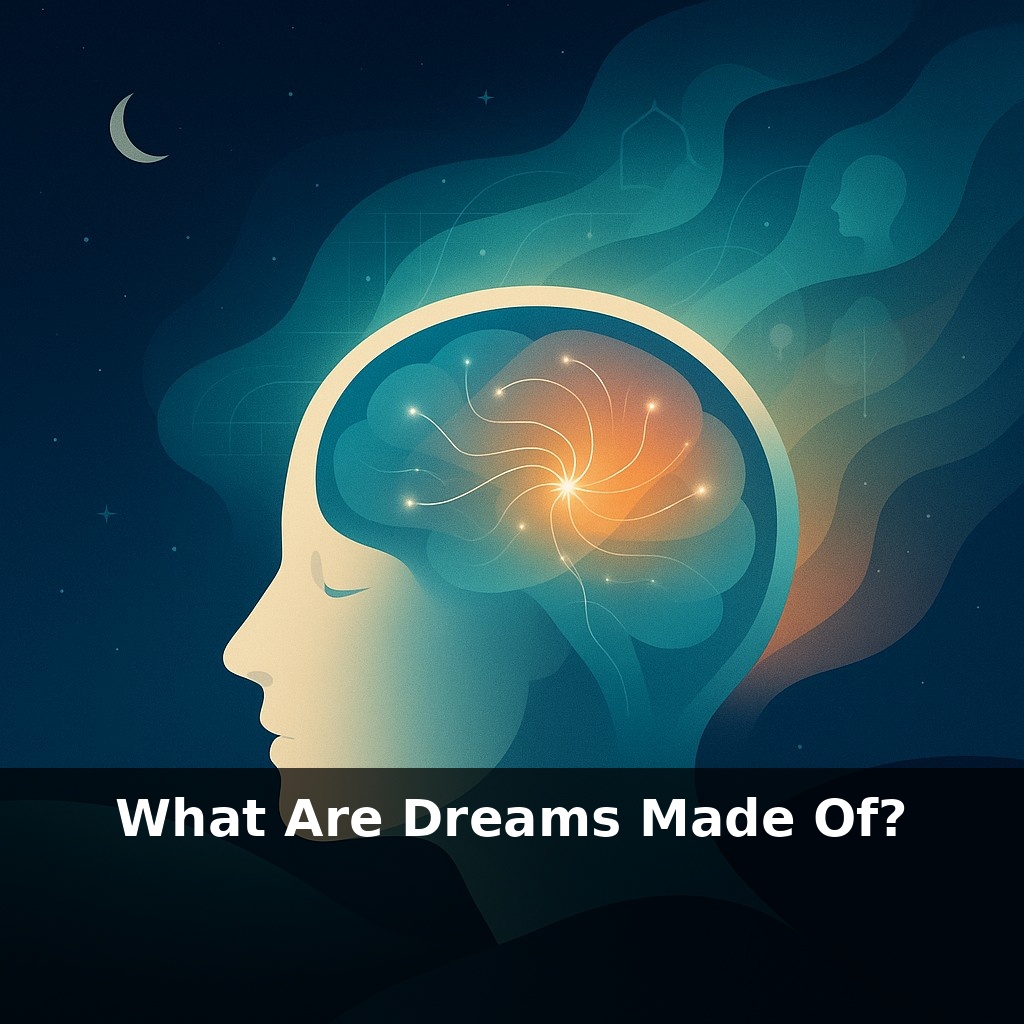
What Are Dreams Made Of?
📝 Transcript
Right now, as you sleep through an ordinary night, your brain can burn as much energy as it does during a busy workday—without moving a muscle. In this episode, we’ll step inside that silent storm and untangle what your dreams are actually made of.
That silent storm isn’t random chaos. While you sleep, different brain regions take turns stepping into the spotlight. Areas tied to emotion and memory light up, while the systems that normally keep your thoughts orderly loosen their grip. That’s why a math test can suddenly happen in your childhood home, with your current boss grading you in the hallway.
Tonight’s dream might borrow the sound of yesterday’s notification ping, the face of a friend you haven’t seen in years, and the sinking feeling from an email you haven’t answered yet. These pieces are shuffled and replayed under a very different rulebook than when you’re awake. Instead of asking, “Does this make sense?” your brain leans toward “What might this connect to?”—and follows that thread into the dark.
As this looser rulebook runs in the background, your body is following a strict schedule. Across the night, you cycle through stages of sleep like stations on a train route: light sleep, deeper slow-wave sleep, then REM, repeating about every 90 minutes. Each pass tweaks the balance between how deeply disconnected you are from the outside world and how busy things get inside your head. Early in the night, deeper stages dominate, reinforcing what you learned and stabilizing your mood. Later cycles lean more heavily on REM, when your dreams grow stranger, longer, and often more emotionally charged.
Slip a scanner into that “storm” and you’d see something striking: dreams aren’t a single thing your brain “turns on,” but a layered process, mixing electrical rhythms, shifting chemicals, and old memories that refuse to stay in their folders.
One layer is timing. Just before vivid dreaming hits, brief bursts of activity called PGO waves ripple from deep brain structures toward visual areas, as if someone is pinging the system: “Get the imagery ready.” These pulses arrive several times a second, then the full dream sequence blooms. If you wake people seconds after these bursts, they’re far more likely to report intense, story-like scenes rather than fuzzy thoughts.
Another layer is chemistry. As certain transmitters drop, others rise, quietly changing the “rules” for what feels important. Emotional tones get amplified, while fine logical details fade into the background. That’s why a tiny social slip can dominate an entire dream, while the actual words spoken blur out. Dopamine-rich circuits also stay active, sprinkling novelty and reward into the mix. The brain doesn’t just replay the day; it experiments with versions of it that never happened.
Then there’s memory selection. Recent experiences are especially likely to appear within a day or two, but rarely as exact copies. A single element—a color of a train seat, a colleague’s laugh—can stand in for the whole situation. Older, long-term memories get pulled in too, often those linked to similar feelings. A minor disagreement at work can recruit a decades-old classroom embarrassment, fusing them into one strange scene that still “feels” coherent from the inside.
Control is the final layer. In ordinary dreams, self-awareness is muted, so the narrative can bend without resistance. But in lucid dreams, when people realize they’re dreaming, parts of the monitoring system briefly re-engage. That shift can be tracked in real time: trained dreamers move their eyes in a pre-arranged pattern, sending a visible signal from the dream world to the lab. Inside the dream, they can sometimes tweak the script—revisiting a threatening scene, changing the ending, or simply observing how the whole apparatus keeps running even as they watch it.
Think of your dreaming brain as a late-night coder pushing experimental updates to a complex app. The “live version” is your waking mind; the test server is your sleeping one. On that server, the system can run wild A/B tests: “What if this fear pairs with that memory?” “What if social rules loosen by 40%?” Most of these tests are discarded before morning, but some leave faint traces—shifts in attitude, a softened emotional edge, a fresh angle on a problem.
You can see this in people who rehearse skills in dreams: musicians who wake up with a tricky passage suddenly smoother, athletes who report “practicing” a move all night. Nightmares show another side: overactive threat simulations, where the system keeps stress scenarios on repeat, sometimes overshooting into distress. Lucid dreamers are rare beta-testers with partial admin access, stepping into the code to tweak one variable—face the pursuer, ask a question, change the scene—and then observing how the whole simulation adapts around that single, deliberate choice.
Dream research may soon move from observation to intervention. Labs are already testing ways to nudge dream themes with sounds, scents, or smart headbands that time cues to your sleep stage. That could someday help dial down nightmares or reinforce what you studied. But it also raises consent questions: who controls your “night feed”? As wearables, meds, and mental health apps converge on sleep, dream data could become as sensitive as your search history—intimate, valuable, and in need of protection.
As tools to track and tweak dreams spread from labs to bedrooms, you’ll likely see sleep masks that sync with playlists, or apps that pair your dream notes with mood trends and heart-rate dips. Your challenge this week: when you wake from any dream, name one feeling and one question it leaves you with—like labels on folders you might revisit later.
From this course
The Science of Dreams
7 episodesUnlock all episodes
Full access to 7 episodes and everything on OwlUp.
Subscribe — $1.99/monthLess than a coffee ☕ · Cancel anytime