Introduction to the Science of Running
📝 Transcript
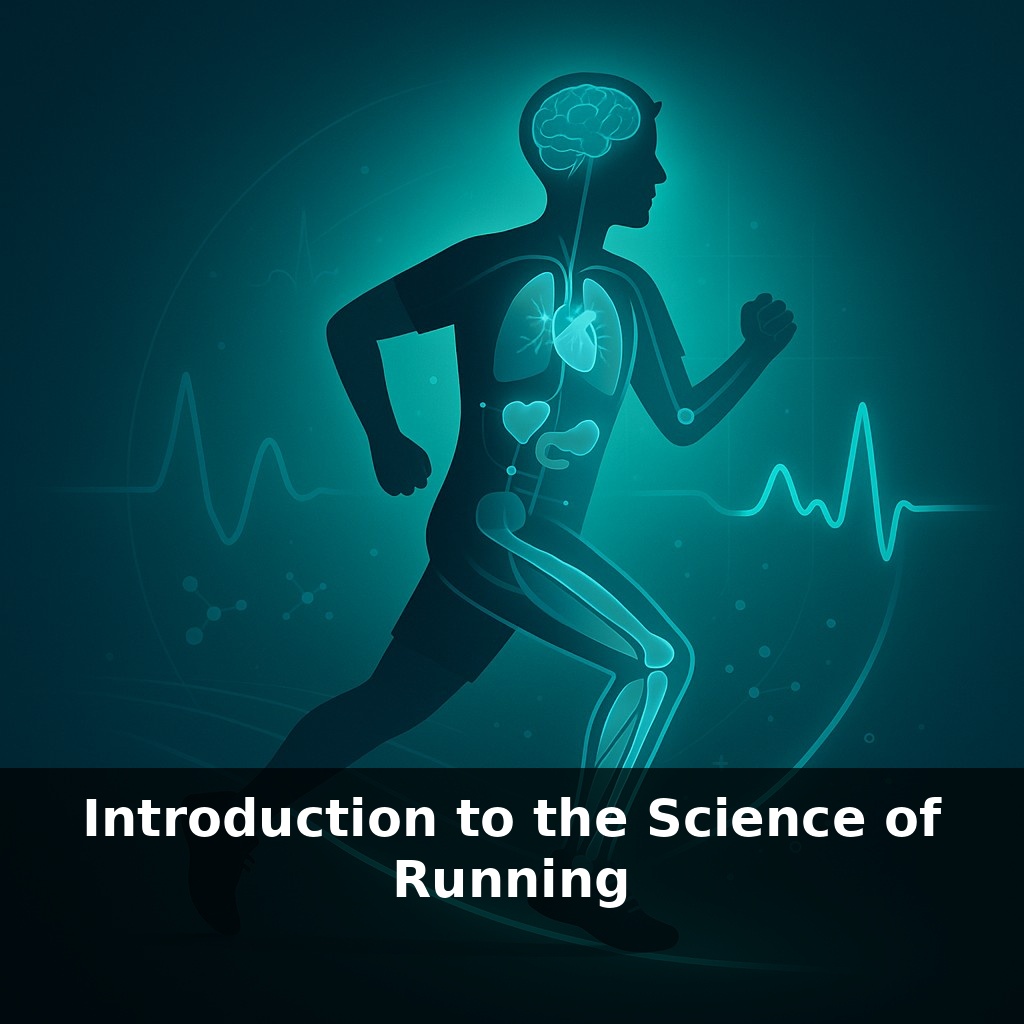
Your next run will secretly rewire almost every system in your body. In the span of a few heartbeats, your brain releases mood‑shifting chemicals, your muscles negotiate with your lungs, and your bones brace for forces far greater than your body weight—with zero conscious input from you.
With every run, your body keeps a running “ledger” of stress and response. The heart notes how hard it had to work, blood vessels record how much they had to widen, muscles track how many fibers were recruited, and your nervous system logs which movement patterns felt efficient—or clumsy. Over time, this biological bookkeeping drives adaptation: what was once a red‑alert effort gradually becomes routine. This is why an easy jog for you today might have felt impossible a year ago. But running isn’t only about getting “fitter”; it’s about how different systems coordinate under pressure. Your cardiovascular system must deliver oxygen precisely when muscles demand it, while your brain juggles pacing, posture, and fatigue signals. In this series, we’ll unpack how that coordination evolves—and how to train it on purpose rather than by accident.
Over thousands of strides, those logged stresses don’t stay isolated in one place—they start changing which tissues your body “invests” in. Capillaries sprout deeper into working muscles, mitochondria multiply, and tendons subtly stiffen to store more elastic energy with each step. Even your running form is quietly edited: tiny adjustments in arm swing, foot placement, and hip stability are tested, kept, or discarded based on how much energy they cost. Some changes happen in weeks, others over years, which is why your training history matters as much as your latest workout.
Every step you take is also a vote for which energy system your body should prioritize. In the first seconds of a run, you lean heavily on stored phosphocreatine—your emergency “burst” system. As the minutes tick by, your body increasingly shifts toward aerobic metabolism, learning to rely more on oxygen and fat, less on sugar alone. Well‑structured training doesn’t just “make you fitter”; it teaches your metabolism what kind of runner you are: someone who needs short, explosive efforts, or someone who must stay efficient for hours.
This is where VO₂ max enters the picture. It’s often described as your “engine size”—the maximum rate at which your body can use oxygen—but that number hides a lot of teamwork. Your heart must pump forcefully, your blood must carry ample hemoglobin, your capillaries must be dense enough to offload oxygen quickly, and your muscle cells must be packed with mitochondria ready to use it. When training raises VO₂ max by 15–25% in a matter of months, it’s not just one part improving; it’s the whole oxygen supply chain being upgraded simultaneously.
Meanwhile, your musculoskeletal system is learning to tolerate and reuse impact instead of simply surviving it. Those 2.5×‑body‑weight ground reaction forces act as a stimulus: tendons thicken slightly, calf muscles learn to behave more like springs, and ligaments refine how they guide joint motion. This is one reason that, in recreational runners, knee joints often age better than in people who rarely load them at all. The crucial distinction is progression: tissues remodel well under gradually increasing demands, and poorly under sudden, unprepared spikes.
Zoom out to the long term, and running’s systemic effects become clearer. Population studies linking even small amounts of weekly running to lower all‑cause mortality hint that the benefits go beyond “better race times.” Regular bouts of moderate stress followed by recovery nudge blood pressure downward, improve insulin sensitivity, and fine‑tune autonomic balance—the tug‑of‑war between “fight‑or‑flight” and “rest‑and‑digest.” Over years, this repeated rehearsal of stress and recovery seems to recalibrate how your body handles every other stressor you encounter.
Your challenge this week: treat one short run as a field experiment. During a 20–30‑minute easy run, mentally “scan” three checkpoints—early (minutes 0–5), middle (10–15), and late (20+). At each point, briefly note: breathing effort, leg heaviness, and sense of rhythm. You’re not judging performance; you’re observing how your internal systems gradually settle, coordinate, or fatigue under a single, continuous stress.
On a practical level, this “ledger” shows up in small, trackable shifts. That hill that once forced you to walk might still feel hard, but your breathing recovers faster at the top. Easy days begin to feel truly easy instead of like “barely controlled survival.” Sleep sometimes deepens after a run, and the background hum of stress during your workday can dial down a notch—not because life changed, but because your body’s stress‑response calibration did.
You’ll also notice that not all runs leave the same entry in the ledger. A short, relaxed jog might quietly nudge your joints, tendons, and low‑level aerobic system. A brisk interval session writes a loud note to your nervous system about speed, coordination, and tolerance for discomfort. Over weeks, your body “reads” these patterns and starts prioritizing the systems you keep using most often, much like a forest trail becoming clearer the more frequently it’s walked.
One tiny sensor-packed shoe could soon tell you more about your run than a full lab test today. As genomics, wearables, and AI merge, your watch might suggest not just pace, but how your individual tissues and genes likely handle today’s terrain, sleep, and stress. Training plans could update like navigation apps rerouting in traffic, while cities that track crowd movement might reshape paths and lighting so your evening run becomes safer, smoother, and subtly faster over time.
Over time, your logbook of runs becomes less about distance and more about patterns. You’ll see how sleep, stress, and terrain quietly shape each outing, the way tides reshape a shoreline. That awareness is the real upgrade: once you can notice these subtle cause‑and‑effect links, you’re no longer just “going for a run” – you’re running your own experiment.
Before next week, ask yourself: 1) “If I graphed my last 10 runs by pace and heart rate, what patterns would I actually see—am I truly doing easy runs easy enough to build my aerobic base, or am I secretly ‘racing’ most of them?” 2) “Looking at one specific workout, can I explain *why* I chose that distance, pace, and recovery (e.g., tempo run to raise lactate threshold, intervals near 5K pace to boost VO₂ max), or am I just copying plans without understanding the purpose?” 3) “If I had to pick one variable to track this week—like cadence, heart rate drift on an easy run, or how my legs feel 24 hours after a session—which one would teach me the most about how my body actually responds to training, and how will I check it after my next 2–3 runs?”

Unlock all episodes
Full access to 9 episodes and everything on OwlUp.
Subscribe — $1.99/monthLess than a coffee ☕ · Cancel anytime