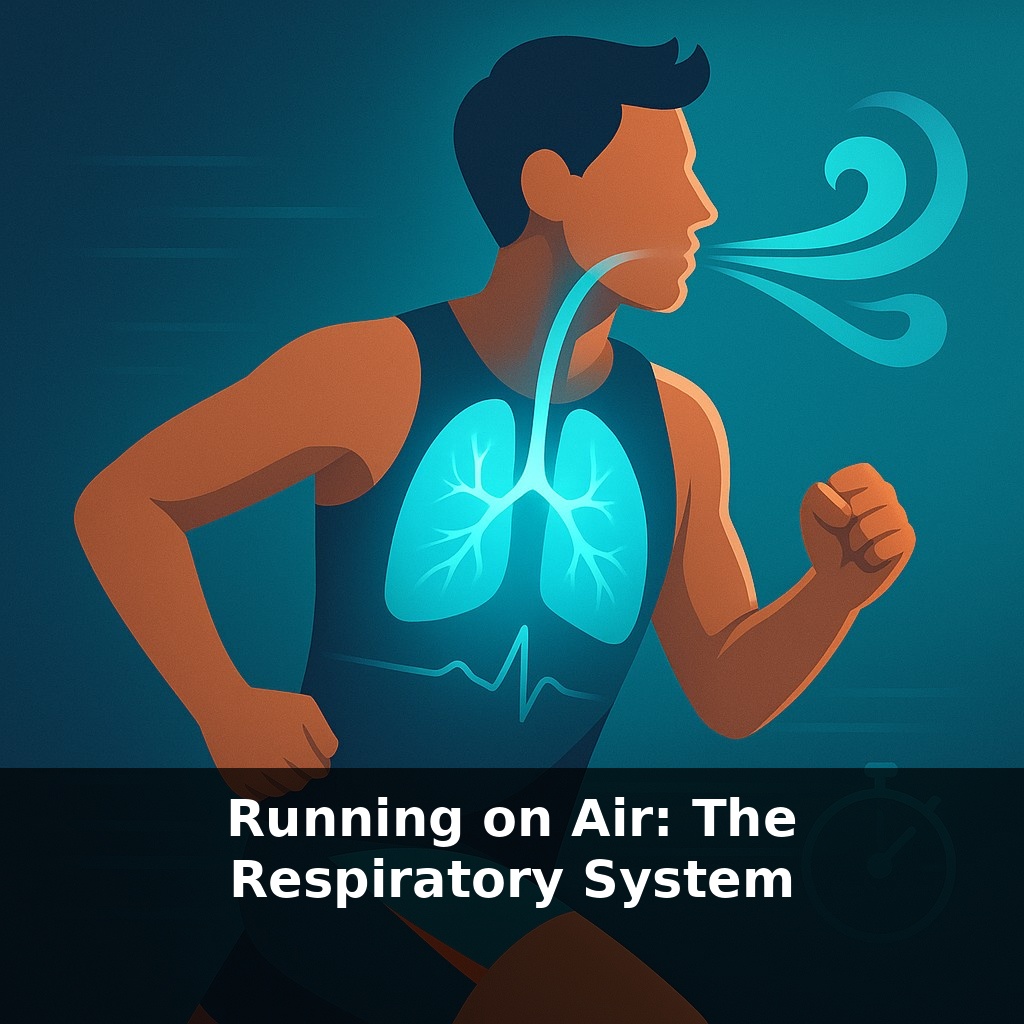
Halfway through a hard run, your legs aren’t the only things close to their limit—your breathing muscles can quietly steal a chunk of your oxygen. The paradox? Most runners train everything except the very system that decides how long they can hold that pace.
At rest, your lungs move so quietly you barely notice them—about 12 calm breaths a minute. Yet in a hard race, that same system can be moving over 150 liters of air every sixty seconds, coordinating thousands of tiny air sacs across a surface area roughly the size of a tennis court. That’s a massive upgrade in output for something you rarely train on purpose.
So far in this series, we’ve looked at muscles and heart as primary engines of performance. Today, we shift to the “air side” of the equation: how well you can actually get oxygen in and carbon dioxide out when the pace rises. It’s not just about how fast you breathe, but how precisely your breathing rate, depth, and timing line up with your stride and effort. Subtle changes—like whether you breathe mostly through your nose or mouth, high in the chest or lower in the ribs—can alter how hard a given pace feels.
On a steady run, your breath often feels automatic—until a hill, surge, or late-race push suddenly exposes every inefficiency. That “I’m out of air” signal isn’t just your lungs protesting; it’s your brain tracking rising CO₂ and deciding how urgent breathing should feel. Think of it less as a simple pump and more as a live negotiation between brain, blood gases, and muscles. Factors like posture, core stiffness, and even how much you twist your torso can change how freely your ribcage expands, subtly shifting how quickly that redline sensation shows up and how long you can stay just under it.
When the pace climbs, your respiratory system starts playing a subtle resource game with the rest of your body. Blood flow is finite. At around 90% of your maximum aerobic capacity, the muscles that power breathing can demand close to 15% of the total oxygen on offer. That’s the same oxygen your quads and calves are begging for. If those breathing muscles are undertrained, they “bid” higher—forcing your legs to back off first.
This is where ventilatory efficiency comes in: how much useful gas exchange you get for each liter of air you move. Two runners can both be pulling over 150 liters a minute, but the one who keeps the chest relaxed, ribs mobile, and diaphragm coordinated wastes less effort. Their breathing feels smoother at the same speed, even though the numbers on the watch match.
Pattern matters too. Many runners lock into shallow, hurried breaths as soon as things get hard, which spikes the sense of panic long before they’re truly near their limit. A steadier rhythm—often synced loosely to stride—can keep CO₂ changes more gradual, so your brain doesn’t hit the alarm as early. Elite runners often ride right under their “ventilatory threshold,” that tipping point where breathing suddenly ramps up, for remarkably long stretches. They aren’t just fitter; they’re better at hovering on that edge without crossing it.
Posture and core control can quietly shift this threshold. A collapsed torso or over-tensed abs compress the ribcage, shrinking the space your lungs can effectively use. Even mild side stitches often show up when this system is stressed: the diaphragm and surrounding ligaments are working harder than the available blood flow and support allow.
The encouraging part: this is trainable. Specific inspiratory muscle drills, hill sprints that force you to organize your breathing under load, and occasional sessions focused on nasal breathing at easy paces can all reshape how costly each breath is. Done consistently, they don’t just make you feel more “in control” of your breathing—they can translate into faster times at the same perceived effort, because less of your total engine is being spent just to keep the air moving.
Think about how small tweaks in “air management” shift what’s possible. A runner who subtly widens their arm carriage and relaxes their jaw on hills often discovers the climb feels less like a wall and more like a ramp—same grade, different internal cost. Another might experiment with slightly longer exhales during tempo efforts and notice their shoulders stop creeping toward their ears at the 10-minute mark.
Here’s where a travel analogy helps: if each breath is a train arriving at a crowded station (your working muscles), you can’t add endless new trains, but you can streamline the schedule and reduce delays. Adjusting torso angle on descents, softening your belly between breaths, or lightly “bracing” only on footstrike can free space for those trains to glide in and out with fewer bottlenecks.
Elite milers sometimes practice controlled surges—20–30 seconds above race pace—specifically to feel how their breathing “reorganizes,” then practice returning to smoothness without slowing. You can borrow that idea: use short, deliberate bursts to learn how quickly you can tidy your breathing back up while holding the line on pace.
Future tech may turn your breathing into a live dashboard. Wearables that sense ribcage motion and airflow could flag when each breath starts “costing” too much, nudging you to ease off before form crumbles. AI might learn your personal “breath signature” on good days versus overtrained ones, like a bank tracking healthy versus risky spending. Post-viral rehab tools could migrate into everyday training apps, guiding gentle respiratory work that doubles as performance insurance.
Your lungs are more adaptable than they feel mid-race. Altitude, heat, and even pollen quietly reshape how your breath behaves, like traffic lights changing a familiar commute. Treat each run as a small field test: notice which conditions tighten your chest and which open it up. Over time, you’re mapping not just routes on roads, but routes through your own capacity.
Before next week, ask yourself: “When during my day do I actually feel most out of breath (climbing stairs, rushing for the bus, during workouts), and what is my breathing doing in those exact moments—shallow chest breaths or slow belly breaths?” “If I set a 3-minute timer right now and try nasal, diaphragm-based breathing the way the episode described, what changes do I notice in my heart rate, tension, or focus by the time the timer goes off?” “Thinking about my current routine (sleep, screen time, exercise), what is one specific situation where I could deliberately practice that slower inhale–longer exhale pattern so my respiratory system isn’t always stuck in ‘stress mode’?”