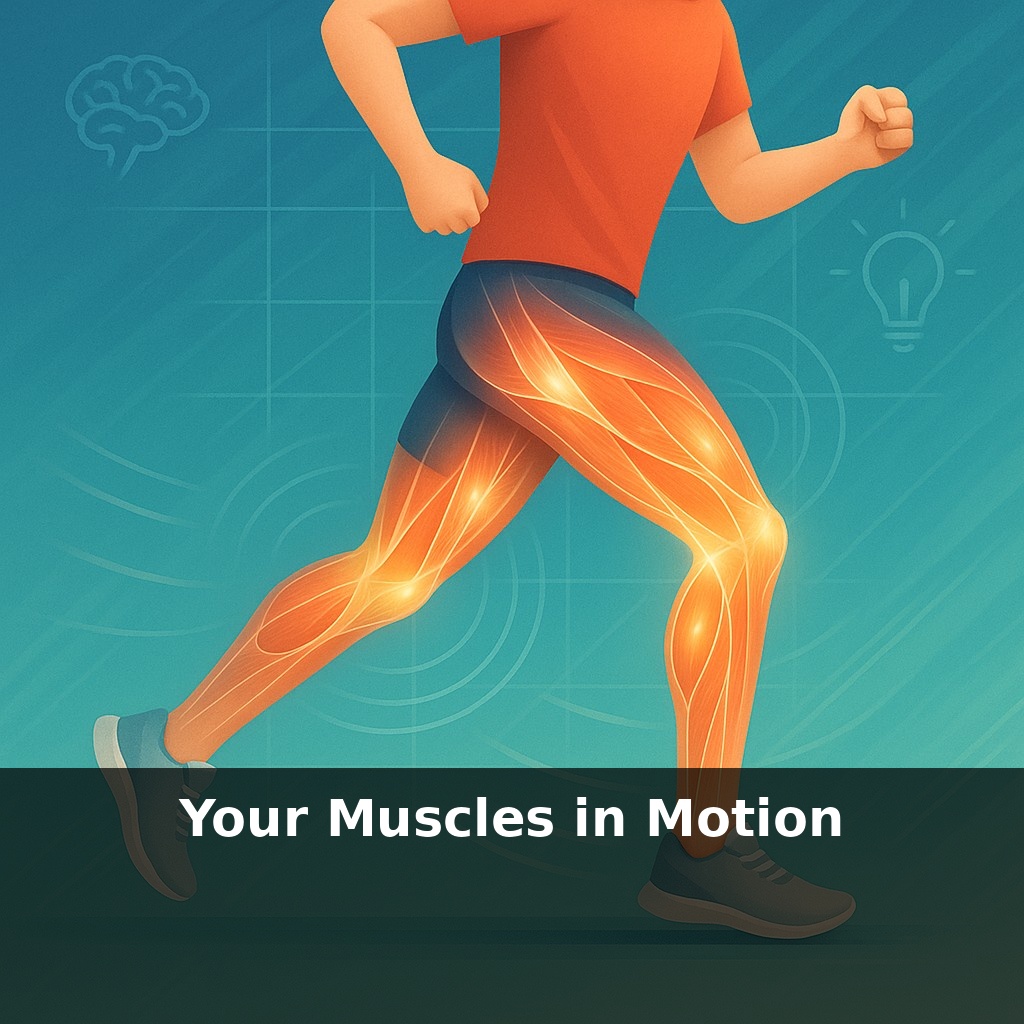
In a single step of your run, roughly two hundred muscles fire almost in sync—most without your awareness. Now, start in the middle of a stride: one foot on the ground, one in the air. Which muscles are carrying you forward, and which are quietly keeping you from falling?
Your legs may feel like they’re “just moving,” but underneath that simple sensation is a power hierarchy: a small group of muscles doing the heavy lifting, and a much larger support staff keeping you upright, aligned, and efficient. In this episode, we shift from *which* muscles switch on to *how much* each one matters for speed, control, and injury risk. Eight main groups supply nearly all of your forward drive, with the glutes, quads, hamstrings, and calves acting like the blue‑chip stocks in your movement “portfolio,” while smaller stabilizers manage risk at your hips, knees, ankles, and spine. When that balance tilts—overpowered quads, underactive glutes, or a tired core—the load doesn’t disappear; it’s redistributed, often into tissues like the Achilles tendon or hamstrings that are already operating near their limits.
Now we zoom in on *when* each major player shows up during your stride. Think of a single step as two acts: stance, when your foot meets the ground, and swing, when it travels through the air. In early stance, certain muscles brace to tame impact forces that can reach several times your body weight; milliseconds later, others switch on to release stored elastic energy and send you forward. During swing, different groups guide your leg’s path and prepare it for the next landing. Subtle timing shifts—often too quick to feel—can influence both efficiency and which tissues take the brunt of each step.
When your foot first meets the ground, the show actually starts *above* the point of contact. The hip muscles on the side of the standing leg fire to keep your pelvis from dropping, while your trunk resists bending or twisting. This is the quiet, high-stakes battle that keeps your knee from caving inward and your stride from wobbling side to side. Subtle weakness here doesn’t usually announce itself as “my hip feels tired”; it more often shows up as cranky knees, irritated IT bands, or a feeling that one leg “works harder” than the other.
As you roll forward over that foot, the quadriceps ease their braking role and the calf–Achilles complex takes center stage. The tendon behaves less like a motor and more like a loaded spring: it stretches as your heel sinks slightly, then recoils near toe-off to help push you ahead with minimal extra energy from your muscles. Because the forces are so high—up to 10–12 times body weight—small changes in how stiff or fatigued this system is can decide whether you feel bouncy and light or heavy and flat by the end of a run.
Meanwhile, behind the scenes, the hamstrings are juggling two jobs. In late swing, they act like a safety net, slowing your lower leg so your foot doesn’t whip forward and slam into the ground. Then, as the foot prepares to land again, they help coordinate hip extension with the glutes. When this timing is off—even slightly—those muscles can be asked to absorb more load at longer lengths, which helps explain why they’re so frequently injured in runners.
Up top, your arms are doing more than just “going along for the ride.” The muscles around your shoulders and upper back help counter-rotate your torso with each step, reducing unnecessary twisting and keeping your center of mass moving mostly forward, not side to side. If your arm swing becomes rigid or asymmetrical, your legs often compensate with extra rotation at the hips or spine, making each step a little less economical.
Over many strides, these tiny inefficiencies add up. A small improvement in how steadily you hold your trunk, or how smoothly your leg swings under you, can reclaim just a few percent of wasted energy—but across thousands of steps, that’s the difference between finishing a run feeling controlled versus feeling like everything is working too hard.
Watch a slow‑motion replay of elite runners and notice how “quiet” their heads look: minimal bounce, almost no side‑to‑side drift. That stillness is your first visual cue that deeper systems are doing their job well. Another clue hides in sound. Softer footsteps usually mean your tissues and tendons are recycling impact efficiently; loud, slappy landings often signal you’re losing energy as noise and vibration instead of storing it for propulsion.
Real‑world examples make this clearer. Take a runner who always feels their calves burning by mile three. Often, they’re asking the lower leg to do work that could be shared upstream by hips and core. Strengthening only the calves might help briefly, but capacity without redistribution just raises the ceiling on an already overloaded room.
On the other hand, when someone improves trunk control and hip strength, a curious shift happens: their “easy pace” heart rate drops a few beats, and post‑run soreness migrates from angry hotspots to a more general, tolerable fatigue—evidence that work is being shared more evenly across the chain.
Treat those firing patterns like a bank account: deposits are strength, mobility, and rest; withdrawals are hard workouts, long runs, and daily stress. Overdraft the system and you see stiffness, niggles, or form breaking down late in a session. As AI gait tools and smarter shoes arrive, they’ll mostly help you *see* this balance sheet in real time. The real leverage will still come from how you adjust training, not just from what the tech reports.
Your challenge this week: pick one easy run and, for 5 separate 60‑second windows, focus on a different body region—1) how steady your head feels, 2) how your ribcage moves, 3) the path of your knees, 4) your footstep sound, 5) your arm swing. No need to change anything; just notice. Jot a quick note after the run about which window felt least controlled. That region becomes your priority for strength or mobility work before the next episode.
Over time, practice turns this awareness into a quiet skill: you start sensing when form drifts the way a driver feels a crosswind nudge the car. That’s where technology can help—not by dictating your stride, but by highlighting subtle trends in how you tire, compensate, or tighten. Treat each run as data, not a verdict, and you’ll keep uncovering new ways to move smarter.
Before next week, ask yourself: 1. When during my normal day (walking up stairs, getting out of a chair, carrying groceries) do my muscles feel weakest or most tired, and what’s that telling me about which specific muscles need more attention? 2. If I repeated just one move from the episode’s examples—like slow, controlled squats or wall push-ups—every day this week, which one would most improve how my body feels in real life, and why? 3. The next time I notice stiffness or tension, can I pause and ask: “What muscle is actually working right now, and is it helping or compensating?” and then experiment with adjusting my posture or movement to see what changes?