The Science of Stress: What Happens in the Brain?
📝 Transcript
Your brain can spot a threat in less time than a blink, long before you consciously know what you saw. You’re sipping coffee, scrolling your phone, and suddenly your heart jumps. No lion, no car crash—just an email subject line. Why does a sentence hit like a physical danger?
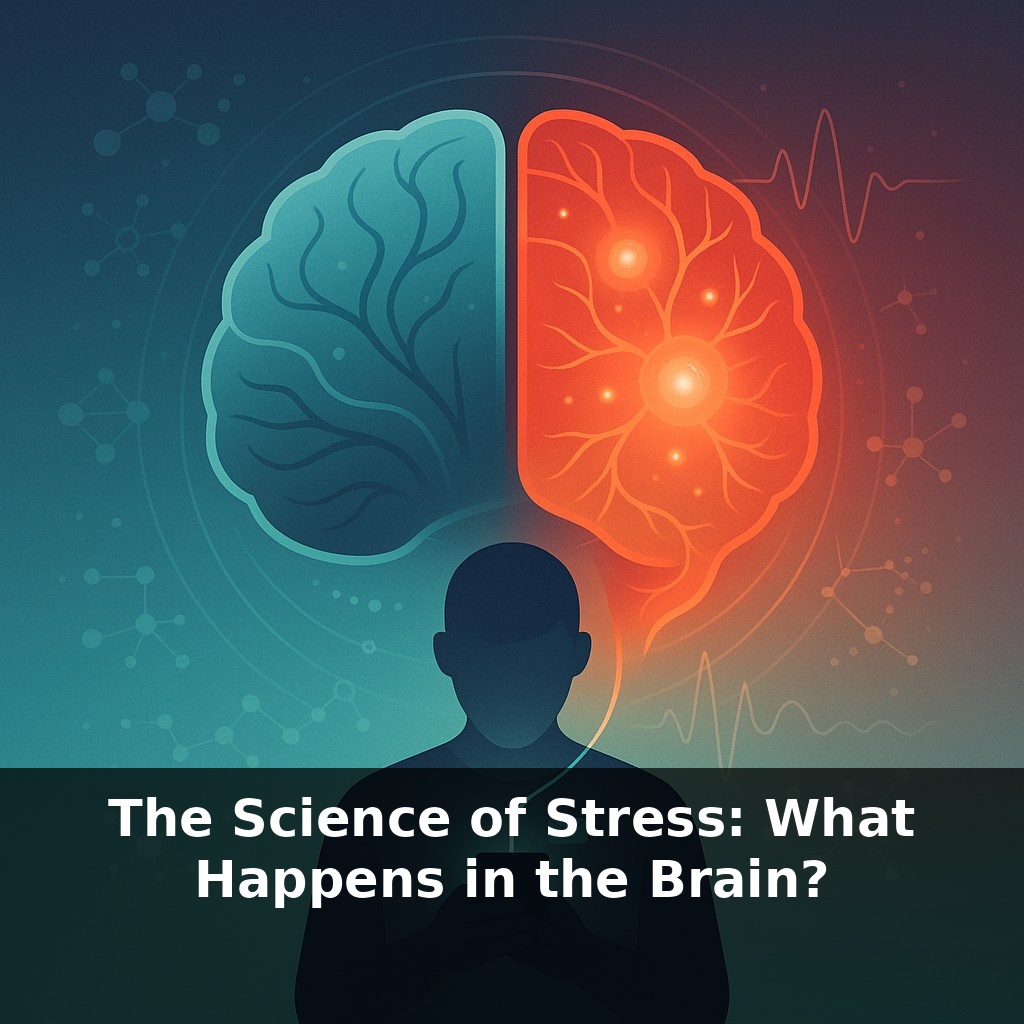
That jolt you feel has a signature: hormones, timing, and specific brain regions all playing their parts with ruthless precision. Stress isn’t just “feeling overwhelmed”; it’s a coordinated brain-body event that unfolds in layers. Within seconds, your body is flooded with signals to speed up your heart, sharpen your senses, and redirect energy from “nice-to-haves” like digestion toward survival systems. Minutes later, a slower, longer-lasting wave quietly changes how you think, remember, and even how your immune system behaves. Over days, weeks, or months, these repeated surges can start leaving footprints in brain structure itself—nudging some circuits to bulk up and others to thin out. That’s why two people can live through similar pressures yet diverge so sharply: one becomes sharper under fire; the other, more scattered, anxious, or exhausted by the same kinds of cues.
Zoom in closer and the picture gets stranger. The same machinery that reacts to an email also recalibrates what your brain treats as “normal.” Under repeated strain, circuits for focus, memory, and self-control can subtly retune so that small hassles feel like major threats. This isn’t about being “weak” or “bad at coping”; it’s about plastic wiring adapting to repeated demands, much like a city reshapes roads around daily traffic jams. Depending on your history, sleep, genes, and even past illnesses, that adaptation can make you steadier under pressure—or keep you stuck on high alert.
A split-second appraisal in the limbic system doesn’t stay local; it kicks off a negotiation with regions that handle context, planning, and memory. One of the earliest to weigh in is the prefrontal cortex (PFC)—the network behind your forehead that helps you prioritize, inhibit impulses, and hold goals in mind. Under a moderate spike, the PFC can actually become more efficient: distracting details are filtered out, and task-relevant information is kept “online” so you can respond quickly and flexibly. That’s why a looming deadline can sometimes make you strangely productive or help a sprinter explode off the blocks at the gun.
But as the response extends from seconds into minutes and beyond, the rules shift. Rising cortisol alters which brain circuits get preferred access to energy and neurotransmitters. The PFC’s fine-grained control begins to give way to older, more reflexive patterns. Complex trade-offs feel harder. You’re more likely to default to habits, black‑and‑white thinking, or snap judgments. This isn’t moral failure; it’s a temporary reconfiguration of what the brain optimizes for: speed and certainty over nuance.
Parallel to this, the hippocampus—the region that tags experiences with “where, when, and in what order”—is quietly recording. Short, contained stress can enhance its ability to stamp in details, which is why you often recall “where you were” during intense moments. Yet with repeated, prolonged activation, the hippocampus becomes more vulnerable. Over months or years, its neurons can lose some of their branching connections, making it harder to contextualize new events or distinguish “then” from “now.” Old alarms can bleed into new situations.
The amygdala, meanwhile, is learning too. Each stressful episode is data about what might be dangerous. With repetition, patterns as subtle as a tone of voice, a time of day, or the layout of a meeting room can become tagged as warning cues. Gradually, the threshold for firing drops. A system built to flag real hazards becomes more liberal with “better safe than sorry.”
You can think of it like a software update rolling out across different modules: one version prioritizes flexible problem‑solving, another prioritizes fast, defensive routines. Which version you’re running at any given moment depends not just on what’s happening, but on what your brain has repeatedly been trained to expect.
Think of your daily routines as “training data” your brain quietly collects. A manager who’s repeatedly grilled in Monday meetings may find their mind tensing up every time the calendar hits 9:59 a.m.—even years later, in a different job. The original trigger is gone, but the pattern linking “Monday + 10 a.m. + conference room” to unease was learned, rehearsed, and stored.
This learning can cut both ways. A surgeon performing complex procedures, a firefighter entering buildings, or a teacher handling chaotic classrooms may, over time, develop circuits that stay clearer under pressure because those contexts are repeatedly paired with effective action, not just alarm. Their brains aren’t tougher by default; they’re differently trained.
Curiously, the same plasticity also shapes what feels “boring” or “too quiet.” If your baseline is constant urgency—tight deadlines, nonstop notifications—then calm can initially feel wrong, like something important must be missing or about to go wrong.
Stress science is quietly moving from “after-the-fact coping” to “early‑warning navigation.” Instead of only noticing overload when you snap at someone, emerging tools could flag subtle shifts in your patterns—like how often you unlock your phone at night or how your walking speed changes on a normal Tuesday. It’s like having a sensitive weather app for your inner climate, nudging you to carry an umbrella—boundary, break, or conversation—before the storm fully forms.
So the real skill isn’t killing stress; it’s learning its “accent” in your own life—how it tweaks your sleep, cravings, or the way small hassles suddenly feel like traffic jams in your head. As research deepens, that self‑awareness becomes less self‑help cliché and more like a user manual: not for a perfectly calm brain, but for one you can steer on purpose.
Before next week, ask yourself: When I notice my heart racing or my jaw tensing, can I pause for 60 seconds and ask, “What exactly triggered my amygdala just now—was it a thought, a notification, or a person?” When I’m in that stressed state, what story is my prefrontal cortex telling me (e.g., “I’m not safe,” “I’ll fail,” “I don’t have time”), and is there a more accurate version I can test in the moment? At least once a day, when I feel my stress spike, can I experiment with 10 slow exhales and then ask, “Did this calm my body even 10%—and what does that teach me about my own stress ‘off switch’?”
From this course
The Stress Conundrum: Mastering the Mental Game
7 episodesUnlock all episodes
Full access to 7 episodes and everything on OwlUp.
Subscribe — $1.99/monthLess than a coffee ☕ · Cancel anytime