Right now, as you listen, your brain is probably juggling more stress signals than your grandparents faced in an entire day. A buzzing phone, a half-read headline, an unfinished email—none feel huge. Here’s the twist: it’s the tiny, constant frictions that silently shape your health.
Modern stress isn’t just “too much to do.” It’s *where* it comes from and *how* it slips into your day without raising its hand. Some triggers are obvious: a tense deadline, a tough conversation, a sudden bill. Others disguise themselves as normal life: a “quick scroll” that turns into bad news, the open-plan office where you hear every keyboard tap, the mental replay of a meeting hours after it ended.
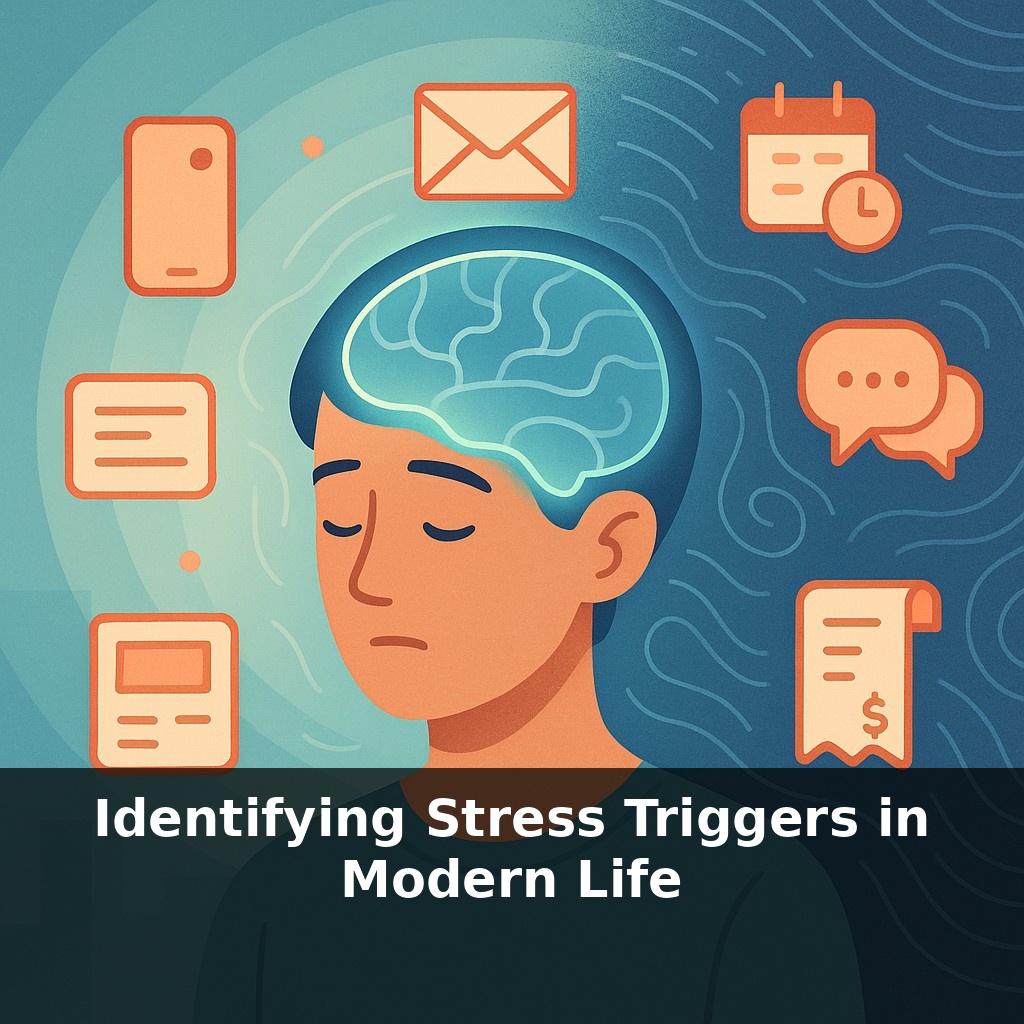
To really understand what’s wearing you down, it helps to sort these triggers into clear buckets. Think in terms of your surroundings, your relationships, your job, your digital habits, and your own thoughts. Suddenly, vague stress becomes a map you can actually read. Patterns start to show up—maybe your stress spikes in noisy spaces, or only after certain kinds of messages. Once you can see those patterns, you’re no longer just reacting; you’re starting to investigate.
Some of the biggest stress drains don’t look emotional at all; they just look “normal.” The office air feels a bit stale, the traffic is a little louder this year, your group chat never really goes quiet. None of these demand a meltdown—they just quietly change the baseline your body runs on. That’s where categories help. When you sort stressors into environmental, social, occupational, digital, and internal, you’re not labeling yourself—you’re labeling the *inputs*. It becomes less about “I’m stressed” and more about “this specific stream is overloading my system today.”
Think of this section as zooming the lens in: instead of looking at “life,” we’re looking at specific channels and what they do to your body over time.
Start with what you *do* for a living. Occupational stress isn’t just “a busy job.” It shows up in how much control you have, how clear your role is, and whether the demands match your resources. A barista rushing through a morning rush with a supportive team experiences that charge very differently from a project manager handed vague tasks, shifting deadlines, and no authority to push back. Research consistently shows that low control plus high demand is especially hard on the cardiovascular system. Over years, that’s part of why chronically stressed workers see that 40–60 % jump in heart disease risk.
Now add the digital layer that sits right on top of work. Those 58 daily phone checks aren’t neutral. Each glance can be a tiny “unknown”: Will this be bad news? A request? A judgment? Even if most pings are harmless, your nervous system prepares for the *possibility* of threat. Thirty of those checks happening during work hours essentially braids your job and your screen into one ongoing stream of micro-alerts.
Then there’s the physical backdrop you rarely name. Noise above 65 dB—a lively café, a busy street, an open-plan office at full hum—has been shown to lift cortisol within minutes. Not enough to make you cover your ears, but enough to nudge your baseline upward. Add harsh lighting, stagnant air, or constant visual clutter, and your body stays slightly braced even when “nothing is wrong.”
Finally, consider what your mind does when nothing specific is demanding attention. The Harvard “Track Your Happiness” data suggests that up to half your waking life is spent in thoughts that wander away from the present task. When that wandering leans toward replaying mistakes, predicting conflict, or mentally checking for danger, your body reacts as if those scenarios are happening now. You can be sitting safely at your desk while your physiology quietly runs a crisis simulation.
Put all of this together and a picture emerges: you don’t need a single dramatic event to feel exhausted. A demanding role with blurry boundaries, layered with frequent phone checks, a noisy workspace, and a brain inclined to rumination can keep your stress response hovering just above idle from morning to night.
A useful way to explore this is to walk through a single, ordinary day and notice how different channels stack.
You wake up already thinking about the presentation you’ll give at 3 p.m. Before you’ve sat up, your mind has projected three possible ways it could go wrong. That’s an internal cognitive trigger, and your body responds as if 3 p.m. is happening now.
On the commute, you scroll through headlines. One story about layoffs at a company like yours, another about a climate disaster on the other side of the world. You lock your phone, but your thoughts keep looping back. That’s digital input seeding fresh internal loops.
At work, your manager drops a “quick” new task with no clear deadline, then rushes to another meeting. You’re not sure how to prioritise, but you know you’ll be judged on the outcome. That’s occupational strain: high responsibility, fuzzy expectations.
By late afternoon, nothing dramatic has happened, yet your shoulders are tight and your focus is scattered. Each channel has been adding a few uncounted grams to the load.
As cities redesign parks as “nervous‑system pit stops” and offices add quiet floors, your daily routes might matter as much as your workout routine. Wearables will likely flag rising tension the way they now flag low steps, nudging you to adjust before overload hits. Some companies are already piloting “focus zones” where alerts, meetings, and even chat tools pause by default—turning stress management from a private struggle into a shared, structural responsibility.
So the real experiment isn’t to “eliminate stress,” but to notice where it quietly enters and exits your day. Over time, you might see that a five‑minute walk, a boundary around one app, or a single honest conversation shifts the whole curve. Not a makeover, just tiny architectural tweaks to how you move, work, and recover—tested, adjusted, then tested again.
To go deeper, here are 3 next steps: (1) Use the free “Stress & Anxiety Companion” or “Wysa” app to log your stress spikes for one week, tagging them specifically as notification overload, social comparison, or work/boundary violations—then review the patterns the app shows you on Sunday. (2) Read the chapter on “Digital Triggers” in Cal Newport’s *Digital Minimalism* and immediately implement one tactic (like batching email or deleting one nonessential social app) for the next 48 hours to see how it changes your stress. (3) Print or download the “Stress Triggers Worksheet” from TherapistAid.com and fill it out with just your top three modern-life triggers (e.g., Slack pings after 6 p.m., doomscrolling before bed, back-to-back Zooms), then post it somewhere visible as your “stress radar” for the week.