Right now, your body might be in a stress state—and you don’t even know it. Heart a little faster, breath a bit shallow, mind half on alert. But here’s the twist: the same surge that fuels a panic spiral can also sharpen your focus… depending on one silent decision your brain makes.
That silent decision is your appraisal: the split-second story your mind tells about what’s happening. Is this load “too much for me” or “a lot, but I can handle it”? That story doesn’t just live in your thoughts—it ripples into your blood pressure, your muscle tension, even how your immune system behaves over the next few hours. Two people can face the same deadline, the same financial hit, the same difficult conversation; one feels pinned, the other feels activated. The difference often isn’t the situation, but the mental model they’re running in the background—like a default filter on a camera, subtly tinting everything you see. In this episode, we’ll zoom in on those invisible filters, unpack how they’re built from past experiences and culture, and explore how deliberately rewriting them can change both your performance and your long-term health.
Think of your stress responses as running on “software” you didn’t exactly install on purpose. Family rules about toughness, school attitudes toward failure, your culture’s stories about success—all of these quietly shaped what “pressure” means to you. Some scripts say, “Stress means I’m not coping,” others say, “Stress means I’m doing something that matters.” Research shows these scripts don’t just color your mood; they can alter hormone release, attention, and even how your blood vessels respond. The crucial shift isn’t to feel less stress, but to relate to it with more skill—and that starts with noticing your current script.
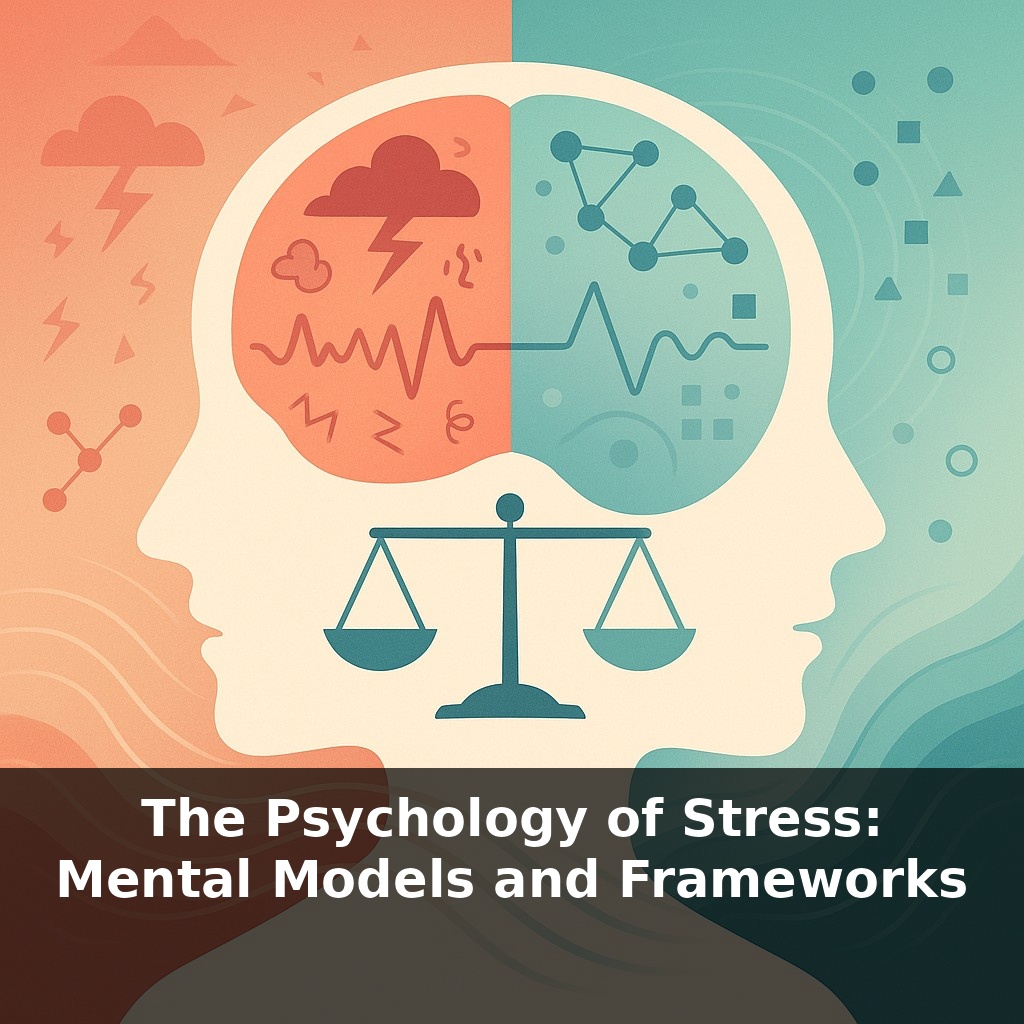
Here’s where the “psychology of stress” becomes very concrete. When a demand hits you—an email from your boss, a notification about your bank account, a partner’s “we need to talk”—your brain runs through a rapid-fire sequence that researchers often break into three parts: demand, resources, and meaning.
First, demand: How big does this situation feel? Is it a small bump or a full-on mountain? Your history matters here. If you’ve been blindsided before, your brain may quietly inflate every bump into a potential avalanche.
Second, resources: Do I have what it takes? Not in some abstract sense, but right now, in this context. Skills, time, allies, tools, even your current energy level all get scanned. Crucially, your belief about your resources is just as influential as the resources themselves. That’s where “stress-is-enhancing” versus “stress-is-debilitating” frameworks start shifting biology: they tilt this resource estimation process.
Third, meaning: What does this demand *signify* about you, your future, your relationships? A critical email might mean “I’m incompetent” to one person and “They care enough to correct this” to another. Same event, totally different downstream chemistry.
Layered on top of this event-level process is your *chronic* stress mindset: your general story about what stress does to people. If you see stress as corrosive, every uptick in pressure gets tagged as danger, amplifying wear and tear. If you see it as a challenging workout for your system, the same uptick becomes a cue to mobilize.
Daily hassles are especially important here. They’re like micro-reps in a training program: traffic, delays, minor conflicts, tech glitches. Each one is a tiny opportunity where your brain practices either “I’m overwhelmed and unsafe” or “This is annoying, but I can marshal a response.” Over weeks and years, those tiny practices accumulate into habitual pathways—well-worn grooves in how your nervous system responds.
The point isn’t to sugarcoat reality or pretend strain is fun. It’s to update your internal “architecture” so that when pressure shows up, more of your cognitive bandwidth stays online, instead of being hijacked by alarm.
Think about two colleagues getting the same last‑minute request from their boss at 4:45 p.m. One’s shoulders lock, thoughts scatter, and the evening feels ruined. The other’s pulse jumps too, but they lean in: “Okay, tight, but let’s see what I can pull off.” The task is identical; the *story* attached to that rush is not.
Here’s where mental frameworks quietly diverge. One person runs a pattern like, “Unexpected = unfair = I’m trapped.” The other runs, “Unexpected = intense = I’ll triage.” Over time, these micro-differences accumulate into very different careers, health profiles, and relationships with pressure.
A helpful way to see this is to treat your reactions like a user interface in a complex app: pop‑up windows of worry, status bars of energy, error messages of self‑criticism. You’re not just clicking mindlessly—you can start to notice which buttons you always hit, which shortcuts you rely on, and whether the interface still fits the life you’re actually living now.
If those “filters” can change outcomes, they become design targets, not background noise. Future tools may treat your day like a live data stream: heart rate, sleep debt, meeting load, even social tension mapped like a weather radar. Instead of just flagging storms, they could suggest micro-adjustments—tweaking preparation, timing, or perspective—much like noise‑cancelling headphones shape sound, not by fleeing noise, but by intelligently reshaping it in real time.
So the next frontier isn’t deleting stress, it’s learning to sculpt it. Think of your day like a soundboard: deadlines, conflicts, hopes all on separate sliders. The art is in mixing—raising challenge without maxing out volume. As you tweak interpretations, you’re not faking calm; you’re training a system that can stay creative even when the tempo spikes.
Try this experiment: For the next three days, whenever you feel stressed, pause and say out loud, “Is this a saber-tooth tiger or an email tiger?” and rate the threat from 1–10 on a sticky note you keep at your desk or in your pocket. If it’s under 7, treat it as a “psychological stressor” and run a 2-minute “safety check” by slowing your breathing (4 seconds in, 6 seconds out) while you deliberately relax your shoulders and jaw. At the end of each day, quickly sort your sticky notes into two piles—“real-world danger” vs. “mind-made spiral”—and notice which pile is bigger and how your body feels after using the safety check.