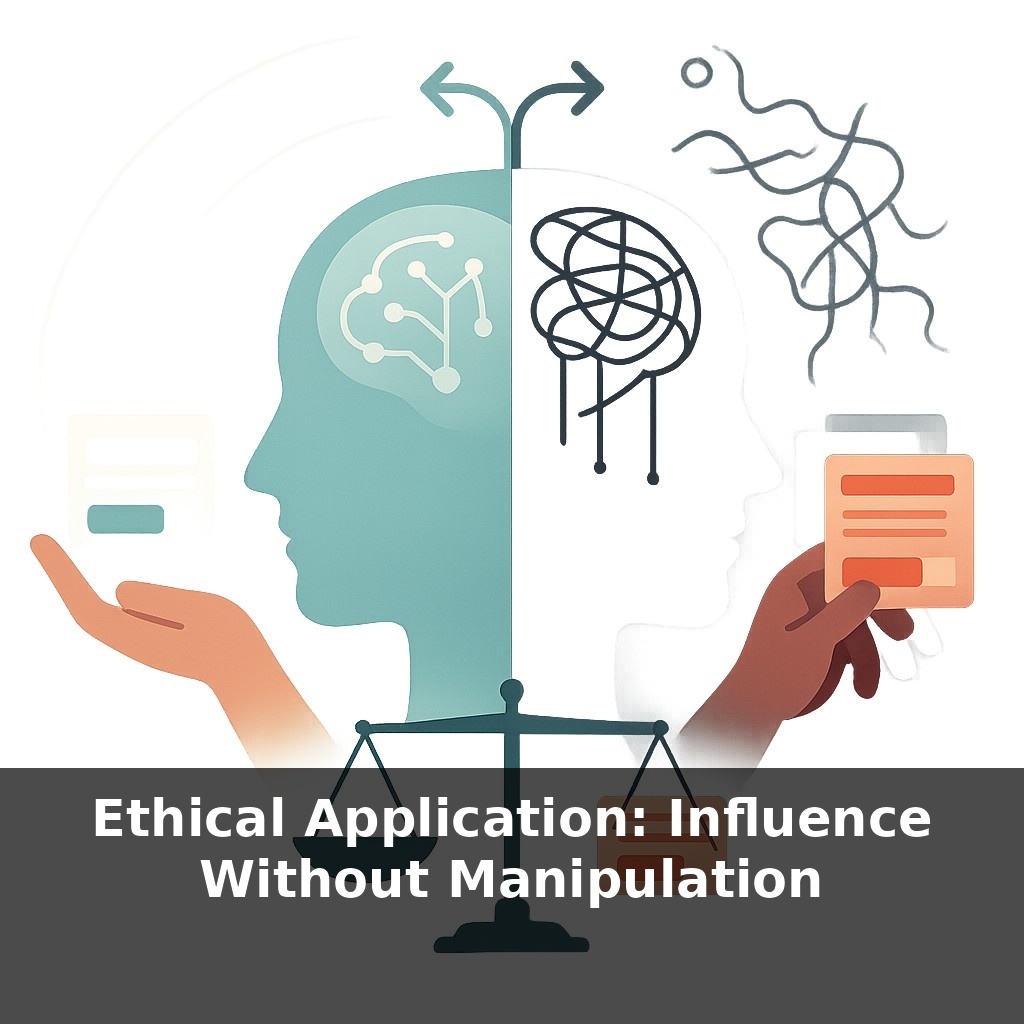
A marketer can boost responses by almost half using the same psychology as a scammer. Same tools, totally different outcomes. You’re scrolling: one ad feels helpful, another feels gross. Here’s the paradox—both are “influencing” you. So what secretly separates influence from manipulation?
Influence without manipulation lives in the small, easy‑to-miss choices: the extra sentence you add to an email, the way you phrase a “limited-time” offer, whether you surface the alternative that makes you less money but might suit the customer better. On a dashboard, two campaigns can look identical—same click-through rate, same revenue—while being ethically miles apart. The difference often shows up later, in trust, complaints, returns, and whether people recommend you or quietly mute you. Data is starting to catch that long tail: transparent reciprocity beats hidden perks, and heavy-handed upsells quietly kill carts. The real question becomes less “Can this nudge work?” and more “Will this still feel fair when the customer realizes what we did?”
Ethical influence gets tricky because most real decisions aren’t cartoonishly good or bad. They live in grey zones: Do you highlight the feature that’s flashier or the one that’s actually more useful? Do you lead with the discount or the long‑term cost? Two teams can look at the same campaign idea and land in opposite places on whether it “feels right.” That’s where small guardrails matter: clear intent, full context, and a bias toward the customer’s long‑term benefit. Think of them as a checklist you run before you hit “publish,” not a legal disclaimer you bolt on afterward.
Influence gets most dangerous at two edges: where attention is scarce, and where data is rich. That’s exactly where psychology-powered tactics live—so the way you use them matters more than the tactics themselves.
Take scarcity. “Only 3 left at this price” can be perfectly fair or deeply misleading depending on what’s behind that number. Ethical scarcity is grounded in real constraints: production runs, time‑bound bonuses, seasonal stock. Unethical scarcity is manufactured tension: fake countdown timers, endlessly extending “last day” sales, or hiding the fact that the product will be available tomorrow at the same price. The tactic looks identical on the surface; the truth under it is not.
Social proof works the same way. “Join 10,000 others” can reassure someone they’re not alone in choosing you. It turns manipulative when you cherry‑pick or distort: unverified reviews, irrelevant stats (“#1 in our category” defined so narrowly that only you qualify), or displaying “X people are viewing this now” based on a script rather than reality. You’re not just nudging; you’re fabricating the nudge.
Framing and personalization raise subtler questions. Framing becomes suspect when you lean on omission: emphasizing monthly costs while burying total commitments, defaulting to the most expensive plan, or hiding downgrade options behind friction. Personalization crosses the line when the user would reasonably say, “I didn’t know you knew that about me,” or, “I wouldn’t have agreed to this if I’d realized how my data was being used.” That line sharpens with vulnerable groups: minors, people in financial distress, or those seeking health advice.
Here’s the practical shortcut: ask, “If a regulator, a journalist, or my customer saw the backend logic and data powering this message, would I still stand by it?” That question forces you to inspect your inputs, not just your outputs.
And the data is blunt: short‑term lifts from aggressive tactics rarely compensate for the long‑term drag of complaints, refunds, and bad word of mouth. Conversion alone is a shallow victory metric if each “yes” quietly seeds future “never again.”
A practical way to see the line is to compare nearby decisions. Two onboarding flows for a budgeting app, for example: in one, the “Start free trial” button sits next to a plain-text link, “Or explore the free version.” Most people still try the trial, but they see a real fork in the road. In the other, the free option exists only after you click a faint “Maybe later,” then decline two pop‑ups. Same business goal; in one case the product invites momentum, in the other it bets on exhaustion.
Or think of a retailer deciding how to present add‑ons. Version A offers a clearly labeled “Recommended bundle” with a short line about who actually benefits. Version B pre‑checks three extras and dims the skip button. The revenue graph may briefly favor B, but support tickets and returns quietly pile up behind it.
Influence tactics are like seasoning in a soup: measured, they reveal what’s already good; dumped in to mask flaws, they signal something you don’t want people to taste.
Legislators are quietly moving from broad “don’t be deceptive” rules toward inspecting your actual flows, defaults, and algorithms. Expect audits that replay your funnels step‑by‑step, asking: “Where did this path get nudged, and why?” Teams that can trace each nudge back to an internal standard—much like doctors charting every dose and symptom—will adapt faster. Others may find that their highest‑converting flows are now their biggest compliance liabilities.
In practice, this means baking reflection into your build process. Before launching a tactic, ask one more question: “Would I feel okay if my closest friend walked through this flow?” That gut check, paired with emerging legal standards, becomes a quiet compass. Your challenge this week: audit a single live journey and mark every nudge you’d be proud to demo onstage.