Right now, more people pop a daily supplement than eat enough vegetables. One person spends a small fortune on bottles promising “cellular rejuvenation.” Another takes nothing and feels fine. Both ask: is skipping supplements risky—or is the real danger believing they’re harmless?
Somewhere between the kitchen cabinet stacked with bottles and the person who proudly takes “nothing at all” is a quieter question: what do your *actual* habits say about whether you need extra help—or should back off? In earlier episodes, we focused on building longevity from your plate outward. Now, we’re zooming in on the gaps that even a thoughtful diet can leave, and the hidden risks that show up when we try to fix everything with a capsule.
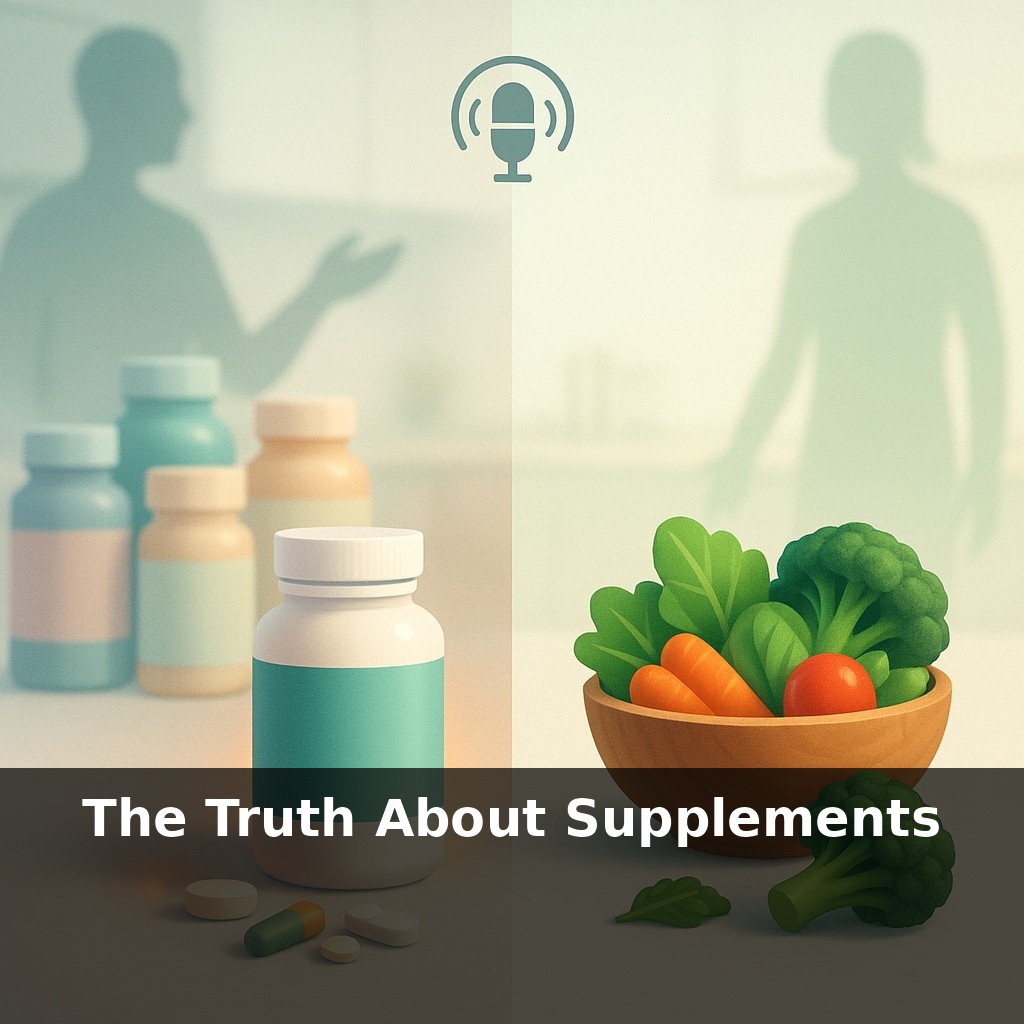
Think of your week: long indoor workdays, sunscreen every time you step outside, maybe limited fish or fortified foods. That routine can silently drain vitamin D or omega-3 stores, even if your meals look decent. On the flip side, layering “energy,” “detox,” and “joint” formulas can stack doses of the same nutrients far beyond what your body can safely use—without any warning label that makes that clear.
Some supplements truly act like safety nets; others are closer to expensive decorations on your shelf. The tricky part is that they all sit in the same-sized bottles, with the same confident claims. A basic multivitamin might cover small cracks in your diet, while a high-dose single nutrient can quietly push you into a danger zone—like stepping over a guardrail in pursuit of a “better” view. And because these products aren’t regulated like prescription drugs, their labels can hint at benefits that the underlying science hasn’t actually confirmed—or has even contradicted.
Here’s where the story gets uncomfortable: when researchers follow large groups of people over time, eating patterns predict longevity far more consistently than what’s in their bathroom cabinet. In fact, data suggest that for most generally healthy adults with reliable access to food, a varied, calorie-adequate diet quietly delivers what they need without extra pills. Yet roughly a third of U.S. adults still add a daily all‑in‑one, and most are confident it’s both safe and helpful.
The reality is lopsided. Some nutrients are genuinely hard to get enough of from food for many people—vitamin D from sunlight‑limited lives is one; long‑chain omega‑3s from fish are another in fish‑poor diets; B12 for those eating no animal products is a third. Here, targeted supplementation can correct a lab‑proven gap or support a clearly defined risk, like elevated cardiovascular danger or documented deficiency. In specific clinical trials, that kind of precision has translated into fewer heart attacks or fractures, but only in the right people, at the right doses.
On the other side are ingredients pushed for “immune resets,” “hormone balance,” or “reverse aging” without solid human data. Some ride on small, early studies or promising findings in mice. Compounds such as NMN and other so‑called geroprotective agents fall into an evolving research space: intriguing, but still experimental. Opting in means accepting that long‑term safety and true benefit in humans aren’t fully mapped.
Dose is another pivot point. Crossing from helpful to harmful can be surprisingly easy with fat‑soluble vitamins, iron, or selenium, especially when multiple products overlap. Liver injury linked to highly concentrated herbal blends and bodybuilding or weight‑loss products is now a recognized pattern in liver clinics. “Natural” on a label doesn’t prevent interactions with blood thinners, blood pressure drugs, or chemotherapy.
So the real question isn’t “Are you pro or anti‑supplement?” but “Where are *your* specific risks, and what does the evidence say about addressing them?”
Think of your current routine the way a financial planner would view your bank statements. Before suggesting new investments, they’d ask: where is the real risk—too little income, too much spending, or money parked in the wrong place? With nutrition, the “income” is your food pattern, the “spending” is how stress, illness, meds, and age draw on your reserves, and the “portfolio” is any pills or powders you’ve added.
A 70‑year‑old who rarely eats fortified grains might discover low B vitamins after a blood panel, while a frequent traveler to high‑pollution cities might talk with a clinician about targeted antioxidants backed by human data, not just marketing copy. Someone recovering from bariatric surgery may truly need lifelong support for iron and calcium, while a generally healthy 45‑year‑old duplicating the same nutrients across “beauty,” “sleep,” and “performance” products is quietly taking on downside with no clear upside. The details of your life—not the label claims—should drive what, if anything, earns a place in your plan.
As testing, wearables, and AI become more accessible, your “pill routine” may start to look less like a grab bag and more like a tailored toolkit. Rather than copying a friend’s regimen, your future choices could adjust like a smart thermostat—subtly shifting with seasons, lab trends, even travel. That also raises new questions: Who controls the data? How will marketing adapt? And will we get wiser about trade‑offs, or simply find more sophisticated ways to chase quick fixes?
Instead of chasing the newest “longevity stack,” focus on the essentials: sleep, movement, real food, and connection, evaluating your actual needs based on your lifestyle and health metrics. The experiment isn’t how much you can add, but how precisely you can choose.
Before next week, ask yourself: 1) “If I had to cut my supplement stash down to just 3, which ones actually have solid evidence behind them and match my real health goals (e.g., sleep, strength, gut health)?” 2) “Looking at the labels of what I’m taking now, do I know the dose, the form (like magnesium glycinate vs oxide), and whether it’s been third‑party tested—or am I mostly trusting marketing claims?” 3) “Where could I reasonably try to get this same benefit from food or lifestyle first (protein, sunlight, sleep, resistance training), and which single supplement would be most worth pausing for 2–4 weeks to see if I notice any real difference?”