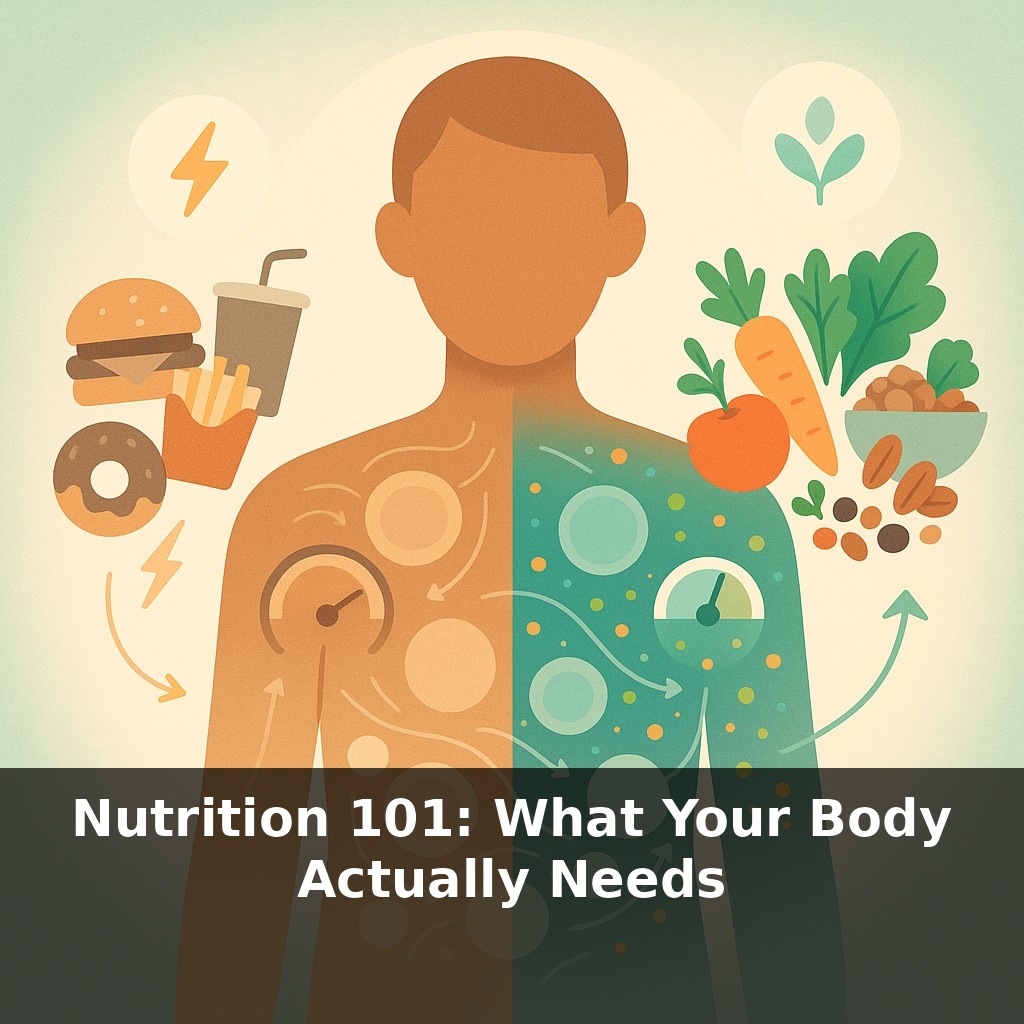
About half of what many people eat in a day gives their body energy but almost no real nourishment. You feel full, but your cells are basically still hungry. In this episode, we’ll explore how your body quietly keeps score—and what it’s actually asking you for.
Here’s where nutrition gets more interesting than “eat your veggies.” Your body isn’t just counting calories; it’s running a constant behind-the-scenes negotiation: How do we divide today’s intake between quick energy, long-term maintenance, repair, and protection? That’s where macronutrients, micronutrients, and water each step into very specific roles. Carbs aren’t just “good” or “bad”; some support steady focus and stable mood, others spike and crash you. Protein isn’t only for gym people; it quietly shapes your hormones, immune system, even how quickly you feel hungry again. Fats aren’t villains or heroes by default—their type and source change how your cells communicate. Then there are vitamins and minerals doing precision work you only notice when something starts to go wrong. In this episode, we’ll unpack what “balanced” actually means for a normal, busy life—not a perfect one.
Most people think “balanced” means hitting some perfect ratio on a plate. In reality, balance shifts with your day, your stress, your hormones, and even how well you slept last night. That’s why the same lunch can leave you energized one day and foggy the next. Your body constantly adjusts: demanding more raw materials after a tough workout, more protective nutrients when you’re fighting a cold, more steady fuel when you’re under pressure at work. A bit like adjusting a painting’s colors as the light changes, you tweak what you eat so the overall picture of your week—not each meal—lands in a healthy range.
When you zoom in on what your body actually needs, three questions matter more than any food rule:
1. Am I getting enough of each *type* of fuel? 2. Is that fuel arriving in a form my body can use steadily? 3. Are the “small but mighty” nutrients showing up often enough?
Start with the big-picture mix. Over a whole day (or even a week), most people feel and function best when roughly half their calories come from carbs, about a quarter from fats, and the rest from protein—within those 45–65 %, 20–35 %, and 10–35 % guideline ranges. But you don’t need a calculator. You can think in rough visuals: at most meals, aim for - ½ your plate from plants rich in carbs and fiber (like beans, intact grains, fruit, vegetables), - ¼ from protein-rich foods, - ¼ from higher-fat or denser carb foods, plus a visible source of healthy fat (like olive oil, nuts, seeds, avocado, fatty fish).
Within that structure, quality does the heavy lifting. Choose carbs that still look something like they did in nature; pick fats that are mostly liquid at room temp; choose proteins that actually required a living thing to grow, not a chemistry lab.
Fiber is your stealth power tool here. Most people are hitting barely half of what their gut and metabolism prefer. A simple way to close that gap: add one clearly fibrous thing per meal—berries at breakfast, beans or lentils at lunch, a vegetable you actually like at dinner. You’re not chasing grams; you’re upgrading textures.
Then there are the essentials your body can’t make: things like omega-3 fats and certain amino acids. You don’t need to memorize them; you need reliable “carriers”: fish or algae-based sources a couple of times a week, a rotation of beans, lentils, soy, nuts, seeds, eggs, or dairy across your days. Diversity covers gaps far better than perfection.
Micronutrients are about patterns, not hero foods. Iron, B vitamins, magnesium, vitamin C—they land in different amounts depending on whether your week leans more on meat or plants, refined snacks or whole foods. One useful lens: how many *colors* and *protein sources* showed up by the end of the day? A beige day (bread, pasta, cheese, chicken) usually means something’s missing. A day with greens, oranges, reds, and a couple of different proteins is quietly protective.
The real skill isn’t sticking to an ideal day; it’s noticing when you’ve drifted—too many low-fiber meals, too little protein earlier in the day, not a single iron-rich food all week—and nudging things back toward balance without starting over.
Think of planning your day of eating more like planning a workday than following a rigid menu. Some “tasks” are high-priority: a solid protein source at breakfast if you usually crash mid-morning, or a fiber-rich lunch if afternoons leave you bloated or sleepy. Others are small but strategic: adding something iron-rich on days you hit a workout, pairing it with vitamin‑C foods so you actually absorb more of it.
Real-life example: Someone who loves takeout noodles at night doesn’t need to give them up. Instead, they might add tofu or shrimp, throw in a frozen veg mix, and swap sugary soda for water or tea. Same comfort, different outcome for their energy and iron status. Or the person who snacks on cookies at 3 p.m. every day could test what happens if they keep the cookie but add a handful of nuts or yogurt—watch how their focus holds up. Like adjusting a medication dose based on lab results, you’re tweaking your food inputs based on how you sleep, digest, and perform—not on abstract rules.
Soon, meeting your body’s needs may feel less like guesswork and more like using a smart map. Wearables and simple blood tests could flag subtle shortfalls before you feel them, nudging you toward tweaks—more leafy greens here, a different breakfast there. Food labels might function like financial dashboards, showing not just “good” or “bad,” but trade‑offs over time. The opportunity—and risk—is outsourcing awareness. The real win is using these tools to sharpen your own judgment, not replace it.
Your body’s needs also change with context: stress, sleep, movement, age, hormones. A perfectly “balanced” Tuesday might fall flat on a night of poor rest or before a big presentation. Think of each meal less as a fixed rule and more as a draft: adjust portions, timing, and textures the way you’d tune an instrument until your everyday performance feels smoother.
Start with this tiny habit: When you pour your morning coffee or tea, add one small source of protein right then—like grabbing a hard‑boiled egg, a slice of turkey, or a spoonful of Greek yogurt. Don’t plan a whole new breakfast, just pair your usual drink with that one protein bite. Do it before you take your first sip, so it becomes a built‑in part of your routine. Over time, you’ll automatically start your day with better blood sugar balance and steadier energy.