Right before your usual mealtime, a “hunger hormone” in your body can spike dramatically—even if you just ate a big lunch an hour earlier. So here’s the puzzle: are you actually hungry… or just trained by the clock, the diet rules, and everyone else’s schedule?
Maybe you grew up hearing, “Finish your plate,” or learned to grab a snack whenever work got stressful—long before you even paused to ask, “Am I actually hungry?” Over time, those messages can get louder than your own body. Now, it might feel like hunger shows up as “I want something” instead of “I need something.” That’s not a personal failure; it’s a training issue. Diet rules, meal plans, fasting windows, and “good” or “bad” food lists all act like background noise, drowning out your internal signals. The good news: research on intuitive and mindful eating shows those signals are not gone, just rusty. With practice, many people can fine‑tune their awareness so that a grumbling stomach, fading focus, or rising irritability become readable, like learning the brushstrokes of a painting you’ve been walking past for years.
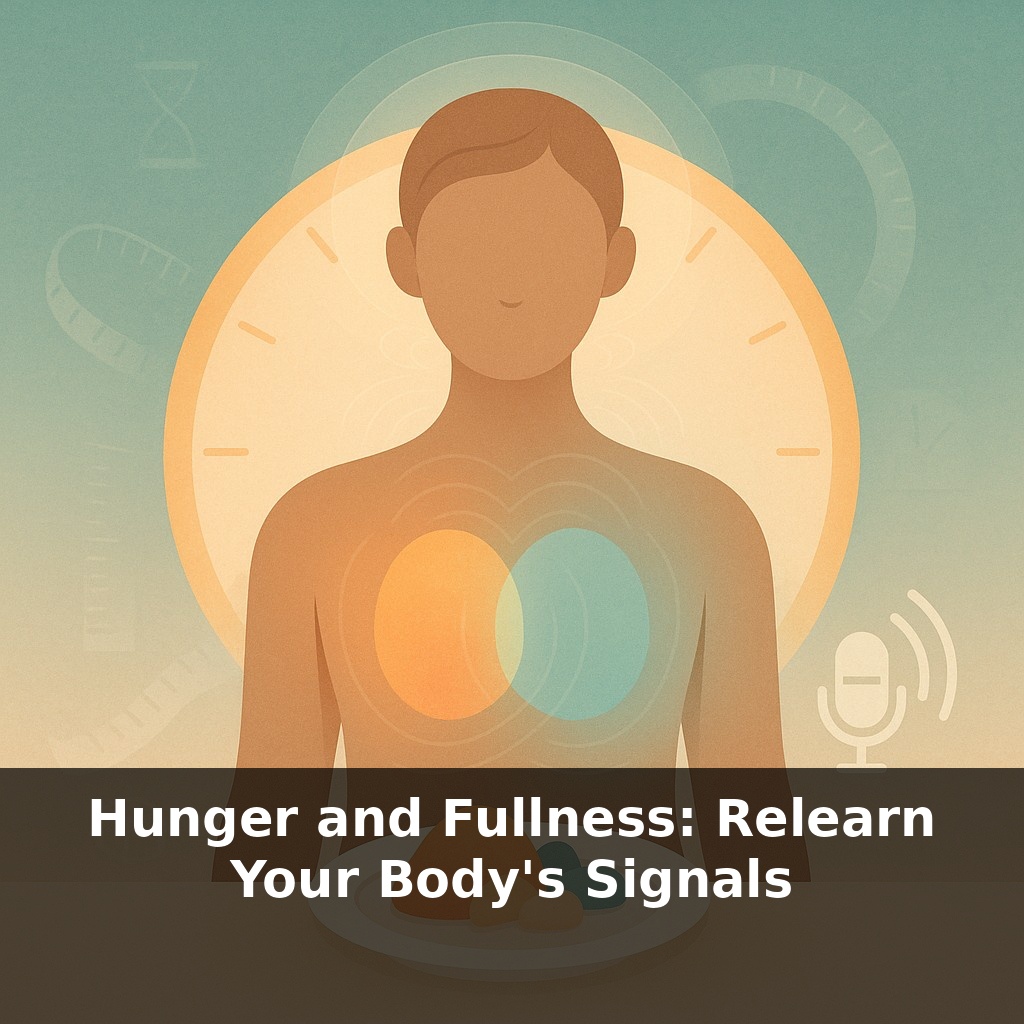
Researchers can actually watch this “signal system” in action. Ghrelin, a key appetite hormone, can rise by about 50% in the hour before your usual meal, almost like your body anticipating a meeting on your calendar. Over years of dieting, skipping meals, or eating by rigid rules, your brain learns to prioritize those schedules over subtle body cues. The result: meals that start too late or end long after you feel vaguely uncomfortable. The shift away from strict diet programs toward holistic wellness reflects a growing recognition that chasing control often backfires—and re‑tuning awareness can be more sustainable.
Think about all the forces that have *retrained* your appetite over the years: school bells, lunch breaks squeezed between meetings, “don’t eat after 7 p.m.,” “just drink water,” “chew gum instead.” Each of those is like a tiny nudge away from noticing what’s happening inside, and toward obeying what’s happening outside.
Biology hasn’t disappeared, though—it’s been adapting. Hormones ramp up before your usual mealtimes, but your brain also learns patterns: “We always snack in front of Netflix,” “We never eat before a workout,” “We clean the kids’ leftovers.” Those patterns can trigger eating even when your body’s need is low, or shut it down when your need is high.
Research on people who step away from rigid rules gives us a useful picture. Across two dozen studies, those who eat more responsively—checking in with their body, allowing all foods, and layering in gentle nutrition—tend to have more stable weights, less emotional distress around food, and fewer disordered‑eating symptoms. In randomized trials, programs that teach this kind of awareness have cut binge‑eating episodes dramatically over a few months, suggesting that “loss of control” eating isn’t a willpower problem so much as a signal‑mismatch problem.
Here’s where it gets nuanced: relearning your signals doesn’t guarantee weight loss, and it isn’t about chasing a particular number. Some people lose weight, some maintain, some gain a little after years of suppression. The consistent benefits show up more in metabolic markers, mood, and food sanity: less obsessing, fewer extremes, more ease.
A helpful way to look at this is like a medical specialist reviewing a patient’s chart. Each sensation—stomach emptiness, lightheadedness, craving for something warm, boredom, anxiety—is one data point. None of them, on their own, gives the full diagnosis. But when you line them up and review them without judgment, patterns emerge: “I mistake stress spikes for hunger,” or “I wait so long to eat that I blow past comfortable fullness at night.”
That curious, investigative mindset is the foundation. Instead of asking, “Is this the right food?” you begin asking, “What is my body telling me, and how can I respond in a way that leaves me feeling better in an hour than I do right now?”
Consider a few “case studies.”
Case 1: Late‑night fridge patrol. You’re standing in the light of the refrigerator, not particularly empty, just wired after scrolling. Instead of grabbing the usual snack, you pause: “What would actually help me feel more settled?” Maybe it’s herbal tea, stretching, or finally going to bed. If you still want food after that check‑in, you eat—but now it’s a response, not a reflex.
Case 2: Mid‑afternoon crash. You notice your focus blurring and patience thinning. Yesterday you powered through with coffee. Today you ask, “Did I eat enough earlier? Was there protein, or only quick carbs?” You choose a snack that supports the next few hours, then watch how your energy responds.
Case 3: Social eating. At a work lunch, you’d usually mirror everyone else. This time you slow down halfway, glance at how your body feels, and decide whether another few bites will leave you comfortable or sluggish—then act on *that* data, not group pressure.
As tech and culture catch up, your body’s cues may soon be only one “voice” in a small committee of inputs. A wearable might flag a blood-sugar dip, while a school lesson once taught you how to pause and check in before reacting. Food companies are already watching what keeps people satisfied longer, like an investor tracking which stocks deliver steady returns, not flashy spikes—shifting products toward foods that quietly support focus, mood, and staying power.
As food culture slowly shifts, you get to run a personal “pilot study” on yourself: testing which meals act like steady background music and which feel more like a loud commercial. Your challenge this week: once a day, pause mid‑meal and ask, “How do I want to feel in two hours?” Let that question quietly shape your next few bites.