Tonight, millions of busy people will spend more time deciding what to eat than actually cooking. One parent is scrolling delivery apps, another is staring into the fridge, both exhausted. Yet some households cut this chaos in half—with one simple weekly routine.
People who plan meals at least three days ahead are 28% less likely to be overweight. That’s not willpower—that’s architecture. Instead of fighting cravings at 6 p.m., they quietly removed dozens of tiny decisions long before dinner ever started.
So why do most of us still wing it?
Because “meal planning” sounds like a Sunday spreadsheet, not a lifesaver. It feels rigid, perfectionist, and completely unrealistic when your week is already packed. But what actually works for busy people isn’t a color‑coded plan; it’s a few light-touch systems that run in the background, like gentle autopilot.
Think: a short list of go‑to dinners you rotate, one or two ingredients you always batch‑cook, and a grocery habit that almost runs itself. Instead of planning every bite, you’re just setting up guardrails. In this episode, we’ll turn that idea into something you can start this week—even if you hate planning.
Here’s the twist most people miss: the goal isn’t to predict exactly what you’ll eat on Thursday at 7:15 p.m.—it’s to decide *less* when you’re tired and hungry. Think of it more like setting up a few “default answers” than scripting your whole week. That’s why research finds huge wins from even tiny moves: pre‑choosing three dinners, batch‑cooking a single protein, or using a grocery list template. We’re not chasing perfection here; we’re shrinking the gap between “I’m starving” and “There’s something decent ready,” so the easy choice and the healthy choice become the same thing.
Most people think the magic lives in the food itself—some perfect recipe, some magical “Sunday prep.” In reality, the leverage is in *where* you decide and *when* you decide.
Start by shrinking your “decision zone.” That’s the chaotic 4–7 p.m. window when cravings are loud, kids are hungry, and your brain is fried. You want as few forks in the road as possible here. Research on decision fatigue shows that every extra choice—scrolling recipes, debating takeout, hunting for missing ingredients—nudges you toward the path of least resistance, which is rarely the one that matches your long‑term goals.
So rather than asking, “What should we eat this week?” zoom in on two more precise questions: - “Which parts of dinner always slow me down?” - “Which parts fail when I’m tired?”
For some people, it’s chopping. For others, it’s dishes. For many, it’s simply *deciding*. Your system should target *your* bottleneck, not some idealized version of how a “healthy” person cooks.
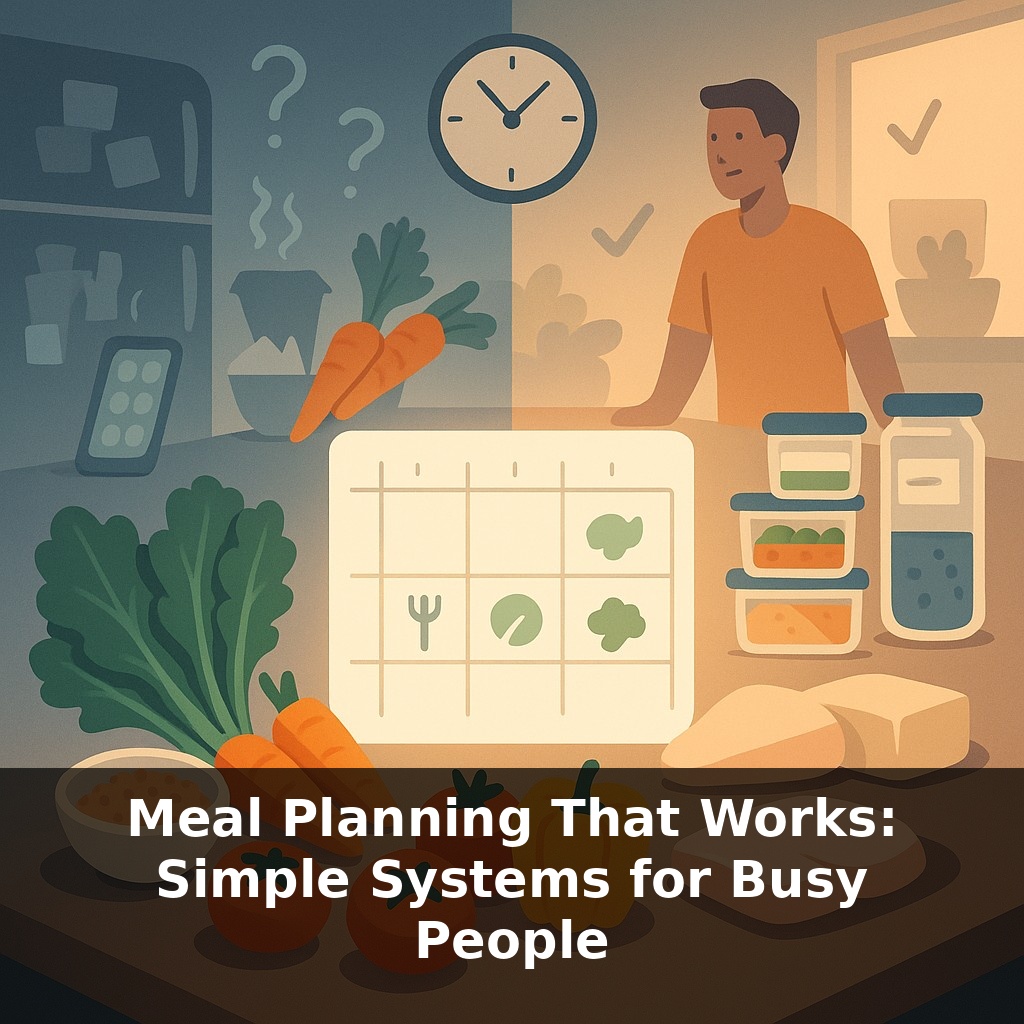
This is where simple patterns help. Theme nights are one example—not a rigid calendar, but a loose rhythm. Maybe Tuesdays are “something in a tortilla,” Thursdays are “oven + sheet pan,” Fridays are “DIY snack plates.” Within each theme, you still have freedom: quesadillas or tacos, salmon or chicken, hummus or cheese. The category is fixed; the details stay flexible. You’ve reduced decisions without feeling boxed in.
Another powerful pattern is “component cooking.” Instead of full meals, you prep a few mix‑and‑match building blocks—like a pot of grains, washed salad greens, a sauce, cut vegetables. Think of it like keeping basic art supplies on hand: you’re not painting the same picture every night; you just don’t have to start from a blank canvas. This approach also keeps food from feeling like a lineup of leftovers, because you assemble plates fresh: today it’s a warm grain bowl, tomorrow it’s a big salad, the next day it’s a quick stir‑fry.
Technology can quietly reinforce these patterns. A saved grocery list for your “usuals,” a recurring calendar reminder to check what you already have before shopping, or a note on your fridge with three backup 10‑minute meals you can always throw together from pantry staples—these small moves mean you’re rarely starting from zero. Over time, your kitchen stops being a daily puzzle and starts feeling more like a familiar route you can walk on autopilot, even after a long day.
A real example: one software engineer I worked with was constantly blowing his food budget on delivery. Instead of redesigning his whole week, he picked a single “anchor dinner” on Mondays: roast something in the oven while answering late‑day emails. He’d throw extra vegetables on the same tray, season them once, and be done. That one habit quietly supplied sides for two more nights and cut his delivery orders in half within a month.
Another client, a nurse with rotating shifts, built a tiny “Plan B shelf” in her pantry: shelf‑stable soups, microwavable grains, and a couple of jarred sauces she actually liked. On nights when everything fell apart, dinner became opening two things and heating them. No guilt about “failing” the plan—just a softer landing that still looked like real food.
Think of these like low‑tech safety nets: small, predictable structures that catch you when the week doesn’t go how you hoped, so your eating doesn’t have to crash with it.
As these small systems spread beyond dinner, they can quietly reshape your whole environment. Office fridges stocked with prepared basics, school apps that suggest simple family menus, even neighborhood “prep clubs” where friends swap one extra tray of food—these all multiply your time. AI tools may soon nudge you like a gentle financial advisor: “You’re low on energy and veggies—want me to line up three 15‑minute options and order what’s missing?”
Over time, your kitchen becomes less a battlefield and more a studio: you walk in, pull out familiar tools, and sketch dinner without overthinking every line. You’ll still have messy weeks and blank canvases, but now you’ve got sketches to fall back on. The experiment isn’t “Can I be perfect?” It’s “How easy can I make the next decent choice?”
Start with this tiny habit: When you put your coffee mug on the counter in the morning, open your fridge and pick **one** protein you’ll use for dinner (like chicken thighs, tofu, or eggs) and place it on the front shelf. Then, grab your phone and type just **one** dinner idea using that protein into your notes app (for example: “taco bowls with chicken” or “tofu stir-fry with frozen veggies”). If you’re packing lunches, toss **one** grab-and-go item (like Greek yogurt or a cheese stick) into a “lunch basket” in your fridge so it’s easy to see. That’s it—one protein, one dinner idea, one easy lunch add-on.