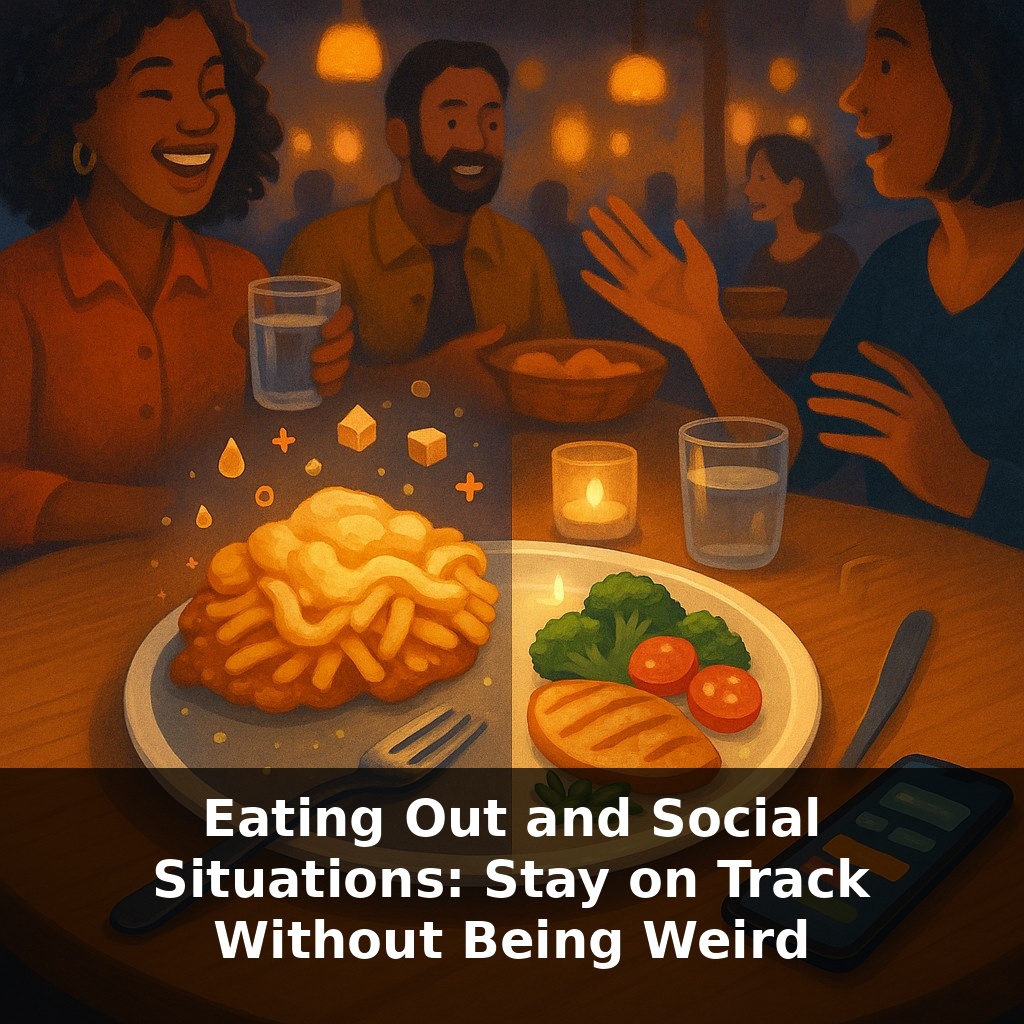
You can eat out regularly and still improve your health. Most restaurant meals quietly pack more than a full day’s worth of “extras.” You’re laughing with friends, telling stories… and in the background, your plate is quietly doubling what you meant to eat today.
That “normal” night out? It often starts long before you sit down. A group text appears: “Dinner Friday?” Someone drops a link to the restaurant. This is your first quiet decision point. People who glance at the menu in advance end up choosing options with about 160 fewer calories on average—not because they’re dieting, but because they’re not rushed, hungry, and distracted by conversation.
Then come the micro-moments that matter more than willpower: where you sit, what you order first, how many times the breadbasket passes by your hand. Research shows that simply sitting farther from shared dishes can significantly cut how much you eat, even when you’re not “trying.” The goal isn’t to be the difficult friend with special rules. It’s to build small, near-invisible habits that let you enjoy the night and still wake up feeling on track.
In social settings, the script is already written for you: split appetizers, “just one drink,” automatic refills, shared desserts “for the table.” Those defaults quietly push most people toward the 1,200‑calorie entrée plus another 500–800 calories in sides, drinks, and dessert. You don’t need to fight the script; you just need to edit it. Subtle moves work best: ordering first so others unconsciously match your lighter choice, asking for sauces on the side (often trimming 60–100 calories), or suggesting one shared dessert instead of four, which can cut your sugar hit by about 18 grams without saying “I’m being good.”
Most people focus on “what” to order; the real advantage comes from *how* you structure the meal. Think in three quiet moves: anchor, balance, and buffer.
**1. Anchor your meal with one clear choice**
Before you look at the menu, decide your priority:
- “Tonight my anchor is protein.” - “Tonight my anchor is vegetables.” - “Tonight my anchor is the social experience, so food stays simple.”
Then match the menu to that anchor:
- Protein anchor: aim for ~25–40 g protein (e.g., grilled fish, chicken, tofu, lean steak). That’s usually a palm‑to‑palm‑and‑a‑half portion, not a plate‑spanning slab. - Vegetable anchor: look for at least 2 cups total across the meal. A basic side of broccoli (≈½–1 cup) plus a mixed vegetable side or salad can get you near that.
Deciding this *before* you scan the options makes high‑calorie “surprises” less tempting.
**2. Balance the plate without announcing it**
Use a simple visual split that doesn’t require special requests:
- Roughly ½ plate vegetables - ¼ plate protein - ¼ plate starch
You can get close by combining standard items: an 8‑oz steak + fries might run ~1,000–1,200 kcal. Shift to a 5‑oz steak (≈350 kcal), roasted potatoes (≈200 kcal), and a vegetable side (≈80 kcal), and you’ve quietly trimmed 400–600 kcal while adding fiber and volume that help you feel full.
Watch “hidden heavies” that look small but add up fast: - Creamy sauces: ~100–150 kcal per 2 Tbsp - Cheese: ~110 kcal per 1 oz - Nuts: ~170 kcal per ¼ cup
Choosing *one* of these instead of all three keeps flavor without doubling the meal.
**3. Build buffers into the social flow**
You don’t have to opt out of anything; you just shape the pace:
- Start with water and drink ~1 glass before alcohol. That alone can cut one extra drink (~120–200 kcal). - If you want an appetizer and dessert, aim for mini‑portions of both: split an appetizer (saving ~150–300 kcal) and share dessert (often dropping another ~200–300 kcal compared with ordering your own).
One subtle medical parallel: clinicians adjust *dose* rather than banning a medication. You’re doing the same with rich foods—lowering the “dose” while keeping the experience.
These moves keep you present at the table, not doing math in your head, while nudging the total meal closer to the amount your body actually needs.
Skip the “light” section and work inside normal choices. Example: at a burger place, you can quietly trade a 1,200‑kcal combo for ~700 kcal without looking fussy. Order a single patty (~250 kcal), skip cheese (‑110), add extra lettuce/tomato/onion (~10), choose a side salad instead of fries (salad with vinaigrette on the side ≈120 vs. fries ≈350–400), and drink water or diet instead of a 16‑oz soda (0–5 vs. ~200). Same restaurant, same vibe, ~500 fewer calories.
At a family‑style dinner, serve yourself once using “two‑fist” portions: one fist of protein (~3–4 oz meat or tofu ≈150–250 kcal), one fist of starch (~150–200 kcal), two fists of vegetables (~80–120 kcal). That plate often lands around 400–600 kcal. Go back only for vegetables or salad and you stay closer to a day’s needs without announcing any rules.
Buffets? Start by walking the full line, then choose exactly 3 items. Pre‑deciding that limit naturally shrinks intake, even if each pick is rich.
AI will quietly tilt the playing field in your favor. Expect QR‑code menus to offer “balanced plate” presets tuned to your height, weight, and goals, trimming 200–400 kcal per meal without you hunting options. Chain restaurants may show nutri‑scores beside prices, nudging orders toward items with more fiber or protein. Group tabs could highlight “shareable” portions, normalizing split entrées. Over a year, these small automations can redirect tens of thousands of calories toward better choices.
Treat this like skill practice, not perfection. Two nights out weekly at 400 kcal “saved” each is 800 kcal/week—over a month, that’s >3,000 kcal, roughly the effort of running 30 miles. Your challenge this week: at one meal out, change just *one* thing—swap a side, share a dish, or skip one drink—and notice how little the social vibe actually changes.