Right now, millions of people are “on a diet” and also secretly eating the foods their plan forbids. In other words: they’re breaking the rules just to stay sane. So here’s the real question—what if the problem isn’t your willpower, but the rules themselves?
A strange thing happens when you try to “eat perfectly”: your brain quietly starts planning its rebellion. You promise yourself “no sugar this week,” and suddenly the office donuts you usually ignore feel louder than your inbox. That tension between how you want to eat and how you actually eat isn’t a personal flaw—it’s a sign you might be using an all‑or‑nothing strategy in a world that doesn’t work that way.
Social lives, birthdays, late‑night drive‑thrus, and stressful Tuesdays don’t pause just because you decided to “be good.” Real life keeps throwing curveballs, and rigid plans snap under that pressure. What tends to last is a structure that bends without breaking: clear enough to guide you, loose enough to let you be human. That’s where the 80/20 approach comes in—not as another strict plan, but as a way to give your eating a backbone and still leave room to breathe.
Instead of asking “Is this food good or bad?” the 80/20 mindset nudges you to ask, “How does this choice fit into my bigger pattern?” That shift matters, because most of us don’t blow our health goals with a single dessert; we drift off course through dozens of small, automatic decisions—extra nibbles while cooking, mindless snacks at the computer, social eating that blurs into every day. To make 80/20 work in real life, you don’t need perfection; you need a loose map of your usual week, so you can decide on purpose where the “everyday” meals go and where the “worth it” moments live.
Here’s the twist: flexible structure isn’t just “nicer,” it’s measurably more effective. In that 2015 study of 1,900 adults, people who practiced flexible restraint—noticing portions, planning some treats, adjusting when life happened—had BMIs about 10 % lower than those clinging to strict rules. Same basic goal, radically different mindset.
Think of 80/20 as zooming out from single foods and zooming in on patterns over time. Instead of obsessing about Tuesday night’s dessert, you’re asking, “Across this week, where do my choices naturally cluster?” That question matters, because research on flexible dieting consistently finds lower binge‑eating, less guilt, and more consistency—exactly the conditions where change sticks.
In practical terms, 80/20 gives you levers you can actually pull:
- You can organize it by calories (like 400 discretionary calories in a 2,000‑calorie day). - Or by meals (for example, 17–18 meals this week mostly nutrient‑dense, 3–4 more relaxed). - Or by occasions (most routine days dialed in, some planned looser moments).
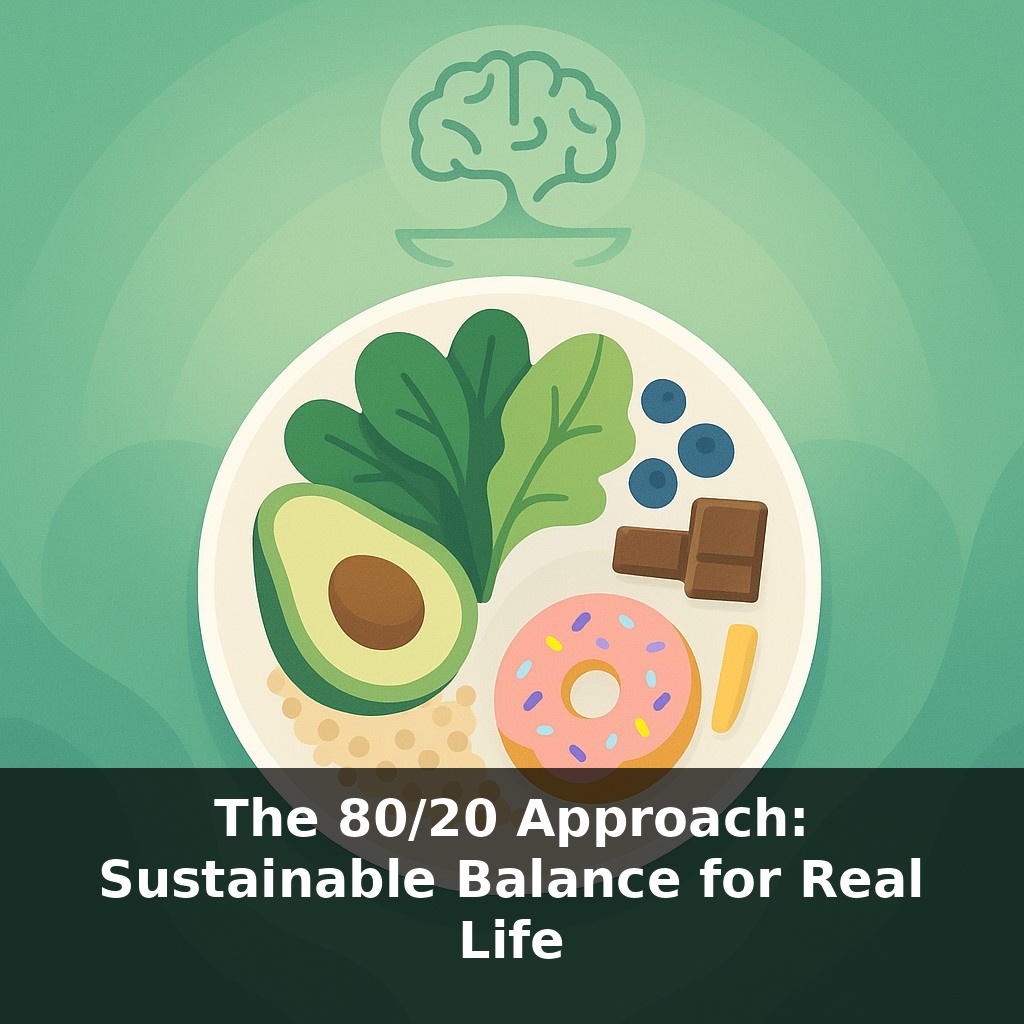
None of these require obsessively weighing every bite. Many people do well with simple visuals—asking, “Does about 4 out of 5 of what’s on my plate grow, run, swim, or come directly from a plant or animal?” and letting the remaining space cover sauces, sweets, and social foods.
Culture has already moved this way. Millions of #8020diet posts show people pairing salads with burgers, or lifting weights and still eating dessert. Programs like Noom use similar traffic‑light systems and still see solid average weight loss. The common thread isn’t perfection; it’s having a clear “most of the time” pattern plus explicit room for enjoyment.
The subtle magic is psychological. When you know there’s a built‑in place for the birthday cake, the cake stops feeling like a rebellion. It’s just part of the plan. That reduces the “I’ve blown it, so why stop now?” spiral and makes it easier to return to your usual pattern the very next meal.
Your challenge this week: choose one lever—calories, meals, or occasions—and sketch your personal 80 and 20 for just the next 3 days. Don’t try to change anything yet; simply notice where your real life already fits, and where it pushes back.
Think about a random Tuesday: you grab toast and coffee on autopilot, speed through lunch at your desk, then say yes to takeout because the day went sideways. Nothing dramatic, but that kind of day can feel “off” without you knowing why. This is where 80/20 can quietly sharpen your awareness.
Concrete example: someone working from home decides their “80” includes simple defaults—Greek yogurt or eggs for breakfast, some kind of vegetable at lunch, and a protein they enjoy at dinner. Their “20” isn’t a free‑for‑all; it’s one evening snack they actually look forward to, plus one flexible meal for the week where they don’t second‑guess the menu. They’re not chasing perfection, just giving their usual rhythm a clearer shape.
Your challenge this week: once a day, pause before eating and ask, “Is this more of an ‘anchor’ choice or a ‘treat’ choice for me?” No judgment, no changes required. By day seven, scan back and notice when treats feel satisfying—and when they’re just filling space.
As tech gets smarter, that “20” may stop being a vague guess and start behaving like a live dashboard. Devices could flag when your sleep, stress, or blood‑sugar trends suggest tightening things up—or when you’ve earned more leeway. Think less food diary, more GPS: you set the destination, and your flex range reroutes in real time around travel, deadlines, and holidays, nudging you back on course without demanding a perfectly straight line.
Think of this as tinkering, not testing yourself. You’ll keep adjusting the mix as seasons, schedules, and priorities shift—more like updating a playlist than carving commandments in stone. Some weeks the “hits” repeat; others you’ll add new tracks. That ongoing remix is where ease, enjoyment, and better health quietly start to overlap.
Here’s your challenge this week: Pick one area of your life that always slides to the “all-or-nothing” extreme (like workouts, nighttime snacking, or scrolling before bed) and set a clear 80/20 rule for it today—e.g., “Four weeknights I’ll cook a simple protein + veggie dinner at home, and one night I’ll order takeout guilt-free.” Put that 80% guideline on your fridge or in your notes app, and every night for the next 7 days, quickly mark whether you were in your 80% or enjoying your 20% (no gray area, just one or the other). At the end of the week, count how many days you hit your 80% and decide one tiny tweak to make that rule feel even easier next week.