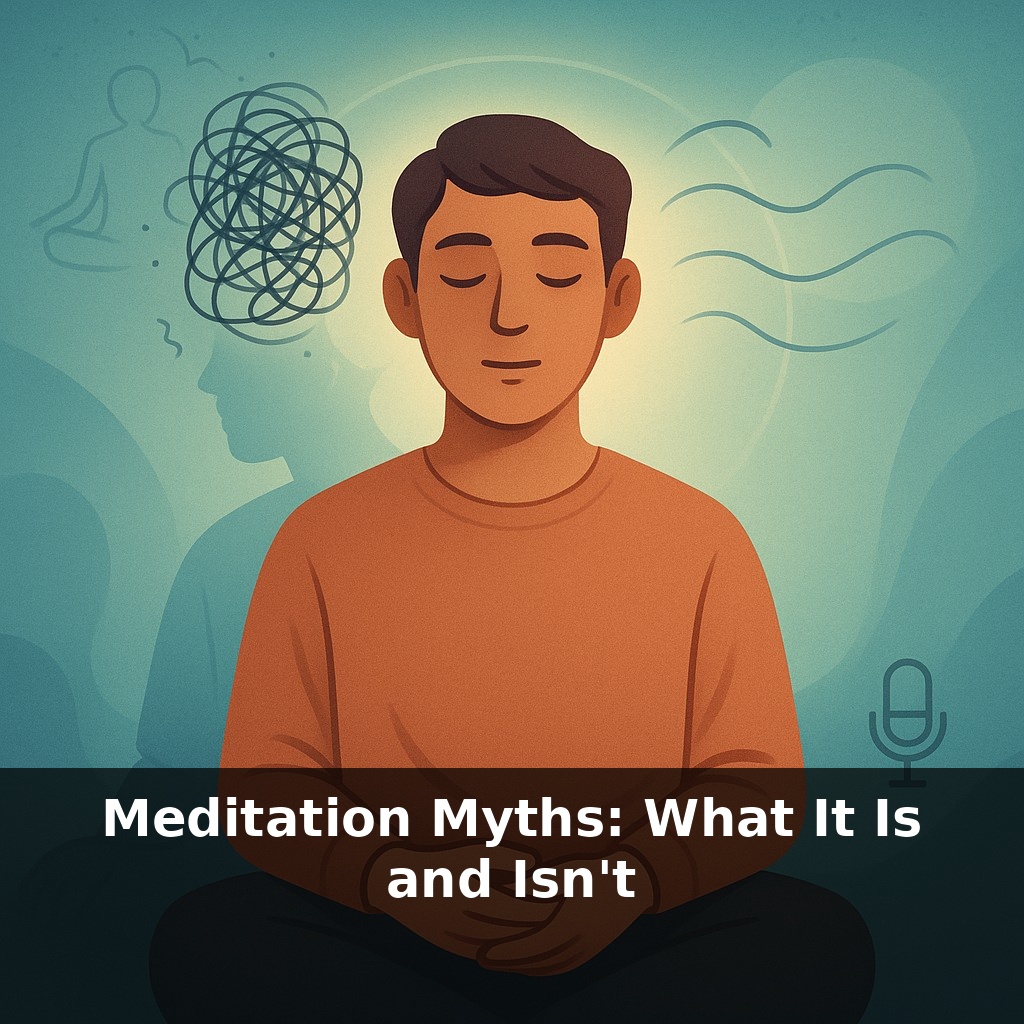
Meditation Myths: What It Is and Isn't
📝 Transcript
Meditation is now the most-used “alternative” health habit in the U.S.—yet many people quietly quit after a few tries, convinced they’re doing it wrong. You sit down, your thoughts race, your leg falls asleep, and you think: “So this is supposed to make me calmer… how?”
In this episode, we’re going to clear out the mental clutter around what meditation is *supposed* to look like. Because a lot of people aren’t quitting a practice—they’re quitting a caricature. You know the one: perfectly still, forever serene, never distracted, sitting on a cushion that somehow doesn’t make your feet fall asleep.
Meanwhile, in the real world, meditation has quietly gone mainstream in places you might not expect. National surveys now show more U.S. adults use it than yoga or chiropractic care. Companies like Aetna offer it not as a perk for “spiritual types,” but as a tool for reducing employee stress and sharpening focus. The U.S. military has tested it to help soldiers keep their heads clear under pressure.
So if you’ve thought, “My mind’s too busy for this,” you’re exactly who this episode is for. We’ll separate myths from what science actually shows—and what that means for *your* daily life.
Here’s the twist: a lot of the pressure you feel around “doing meditation right” doesn’t come from the practice itself—it comes from the stories wrapped around it. Social media loves the pristine, candle-lit version; real practice often looks more like closing your eyes for three minutes in a parked car between errands. In this episode, we’ll unpack how those polished images quietly shape your expectations, and why they’re so different from how high-performing workplaces and even the military actually use these tools in messy, real-life conditions. That gap between image and reality is where most people get stuck—and where you can get free.
Here’s where the myths quietly sneak in.
If you’ve ever thought, “I can’t stop thinking, so I can’t meditate,” you’re bumping into the most stubborn one: that success = a blank mind. In actual practice, thoughts popping up are not a sign of failure; they’re the raw material. The “rep” is noticing you’ve wandered and gently coming back—to the breath, the body, a sound, a phrase. That moment of returning is where the brain networks for attention and emotional regulation get exercised.
Another sticky myth: you need a special setup. A cushion, incense, total silence, 30–60 uninterrupted minutes. Helpful if you like them, but not required. Most research-backed programs train attention in very ordinary postures: sitting in a chair, walking down a hallway, even standing in line. What matters is the quality of awareness, not the aesthetics of the scene.
Then there’s the “instant zen” story. A few people do feel noticeably calmer right away, but for many, the first sessions feel…louder. You finally pause, and suddenly every worry and to‑do item shows up. That’s not new stress being created; it’s old noise becoming visible. With a bit of consistency, people usually report something subtler than bliss: they’re less yanked around by the same triggers, recover faster after setbacks, and catch spirals earlier.
The religion myth also loses steam when you look at how these skills are taught in hospitals and clinics. The focus isn’t on belief; it’s on training attention and awareness in specific, repeatable ways, then measuring outcomes like pain scores, mood, or sleep. You don’t have to adopt a worldview to notice you’re clenching your jaw less or ruminating a bit less before bed.
One more quiet misconception: that only “calm, disciplined” people can do this. In reality, the folks who feel the most scattered, stressed, or skeptical often have the most room for noticeable change. The bar to start is low: a few minutes, a simple anchor, and a willingness to be with your experience exactly as it is—busy mind included.
You’re not trying to become a different kind of person on the cushion; you’re learning a different way of relating to the person who’s already there.
Think of how you’d approach learning a new language. You don’t start by giving a TED Talk in flawless Spanish; you start by butchering “¿Dónde está el baño?” at a café, then gradually getting less awkward. Meditation practice is similar in its *feel*: clumsy, then slightly less clumsy, then occasionally fluent.
Take one real-world pattern people notice: they still get irritated in traffic, but they catch the first surge of anger sooner—right as the horn-hand twitches—instead of three minutes into a fantasy argument. Or a parent still feels drained at bedtime, but now pauses for three breaths before snapping, which sometimes is just enough to choose a softer tone.
In office settings, some teams experiment with 60‑second “reset pauses” before tense meetings. No incense, just eyes down, a shared breath, then business. Over a month, people report fewer side conversations afterward and less rehashing conflicts at night—a practical, observable shift, not a personality transplant.
As tools evolve, the practice may look less like a solo habit and more like a guided lab for your own nervous system. Subtle shifts in heart rate or breath could flag early overload the way smoke detectors flag kitchen mishaps—before burnout sets off an alarm. Schools and clinics might fold in ultra-brief practices between classes or appointments, normalizing “mental pit stops” the way handwashing was normalized: quick, routine, and quietly protective in the background of daily life.
So instead of chasing a flawless session, you’re really learning tiny course corrections—like nudging a steering wheel a few degrees rather than slamming on the brakes. Over time, those subtle shifts can reroute whole days: a tense email answered more thoughtfully, a late night worry cut short, a difficult talk softened by one conscious breath before you speak.
Before next week, ask yourself: 1. “When I think ‘meditation means emptying my mind,’ what actually happens in my body—do I tense up, get impatient, or feel like I’m failing—and what if I treated those reactions as part of meditation instead of proof I’m bad at it?” 2. “If I gave myself just five minutes a day to sit, follow my breath, and let thoughts come and go (without fixing or judging them), what would I be most curious to notice: my breathing, my fidgeting, my self-talk, or something else?” 3. “In what specific, everyday moment—like waiting for coffee to brew, sitting in my car before going inside, or winding down before bed—could I experiment with this more realistic version of meditation and see how it actually feels, instead of how I think it’s ‘supposed’ to feel?”
From this course
Meditation Made Simple: Calm Your Mind in Minutes
7 episodesUnlock all episodes
Full access to 7 episodes and everything on OwlUp.
Subscribe — $1.99/monthLess than a coffee ☕ · Cancel anytime