Right now, your body knows you’re stressed before your mind does. On a tense day, your jaw tightens in a meeting, your shoulders creep up during emails, your stomach knots in traffic—and you don’t notice until you’re exhausted. Today’s practice flips that pattern on its head.
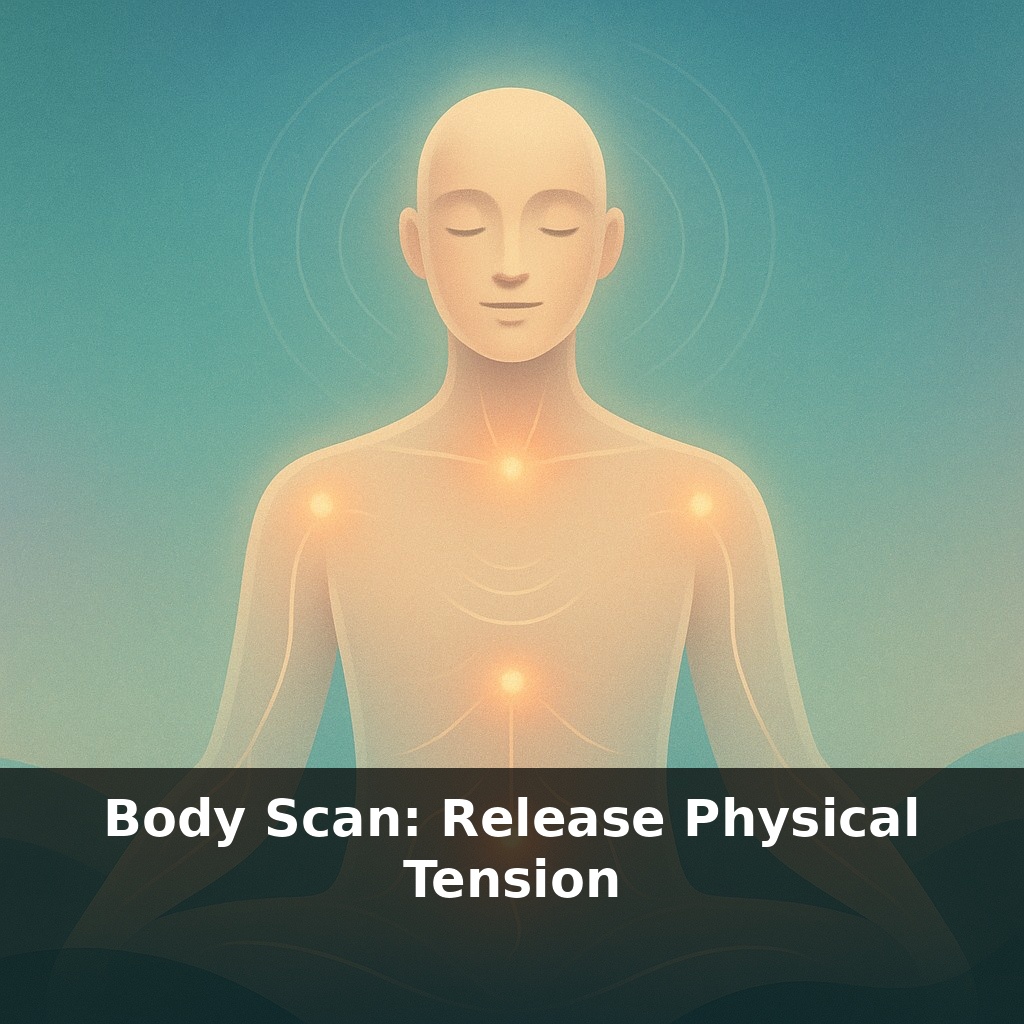
A lot of people try to relax by attacking tension at the surface—stretching a stiff neck, rubbing the temples, scrolling for a “quick break.” It helps for a moment, then the tightness creeps back in new places, like a stress version of whack-a-mole. The body scan takes a different route: instead of fighting tension, you learn to *notice* it with such clarity that your nervous system starts to stand down on its own. This isn’t positive thinking or forcing calm; it’s training the brain networks that sense your internal state, the same ones that guide balance, heartbeat, and breathing. Over time, that training adds up in very real ways: lower blood pressure, less pain, better sleep. In this episode, you’ll practice moving attention through the body in a steady, methodical way, like a careful chef checking each burner on the stove before turning the kitchen down to low.
Most people don’t realize how *fast* their internal state can shift. In one study, just eight weeks of daily body scans nudged down blood pressure—without changing diet or workouts. That’s because you’re not only noticing tension; you’re quietly retraining how your system reacts to pressure throughout the day. You might still get stuck in traffic or open an intense email, but your body learns a new script: notice, soften, reset. Think of this practice as tuning an instrument before you play—subtle adjustments that change the sound of the whole day. In a moment, you’ll try a short version you can actually finish.
Here’s what you’re actually doing during a body scan: you’re training three specific skills that most of us never learned on purpose—precision, permission, and pacing.
**Precision** is *where* you place attention. Instead of a vague “I feel bad,” you practice noticing, “My left shoulder is slightly higher than my right,” or, “There’s a pulsing behind my right eye.” Research using brain scans finds that this kind of detailed noticing lights up regions involved in interoception—the brain’s map of what’s happening inside you. At first it can feel oddly effortful, like learning to taste subtle flavors in food. With repetition, the “resolution” of your inner picture quietly improves.
**Permission** is *how* you relate to what you find. Most people either brace against discomfort (“This tightness has to stop”) or disappear into distraction. In a body scan, you experiment with a third option: “This is here; I’ll let it be exactly as it is for a few breaths.” You’re not trying to like the sensations, and you’re not trying to change them. You’re practicing a stance of curious allowance. Paradoxically, this non-fighting attitude is often what allows grip-like tensions to start to loosen on their own.
**Pacing** is the *speed* of attention. If you rush, your mind skips ahead and you miss half your body. If you go too slowly, you get bored and drift off. The sweet spot is a steady, unhurried sweep—lingering just long enough to actually register sensation, then moving on. Think of that slow, even sweep as similar to a weather front crossing a region: it doesn’t hover in one town all day, and it doesn’t sprint so fast that nothing changes; it moves steadily, bringing different conditions as it passes.
As you practice this triad—precision, permission, pacing—you’ll likely notice side effects outside of formal practice. You catch yourself clenching your teeth in a difficult conversation and ease your jaw a notch. You spot a flutter of unease before a meeting and take three fuller breaths. Over time, these micro-adjustments accumulate into a quieter baseline. Not perfectly calm, not magically serene—just a body that spends less time stuck on high alert and more time able to shift gears when you need it to.
Think about a few real-world moments where this kind of precise, permission-based attention quietly changes the script.
You’re in a long video call. Instead of powering through, you notice your throat feels dry and your chest a bit compressed. Without making a big deal of it, you lower your shoulders, sip water, and angle your screen so you’re not craning your neck. The meeting is the same, but your baseline through it is softer.
Or you’re an athlete cooling down after a run. During a deliberate sweep of attention, you catch a subtle hitch in your right hip. It’s not pain yet, just a *tug*. Because you caught it early, you stretch differently, adjust tomorrow’s mileage, and probably prevent an injury that would have sidelined you weeks later.
On a tough day with kids, you pause for thirty seconds in the bathroom. You scan quickly from face to feet and spot a buzzing behind the eyes and a fist-like hand. You loosen your fingers, look at a fixed point, and breathe a little more deeply—enough to respond, not snap.
As this practice spreads beyond apps and clinics, expect it to slip into places you wouldn’t normally label “meditation.” A nurse might use a 20‑second scan between patients the way a chef does a quick station check; pilots, surgeons, or coders could run micro‑scans before complex tasks as a standard safety step. Schools may teach kids to sweep their bodies before tests, not to relax, but to notice early overload—like reading a traffic light before it turns red—so they can pause before things boil over.
Your challenge this week: once a day, pause for just one minute and quietly sweep attention from head to toe. Afterward, jot a single word about what you found—“wired,” “foggy,” “loose.” By week’s end, you’ll have a tiny map of how your inner weather shifts, and a simple way to decide when to push, when to coast, and when to fully rest.