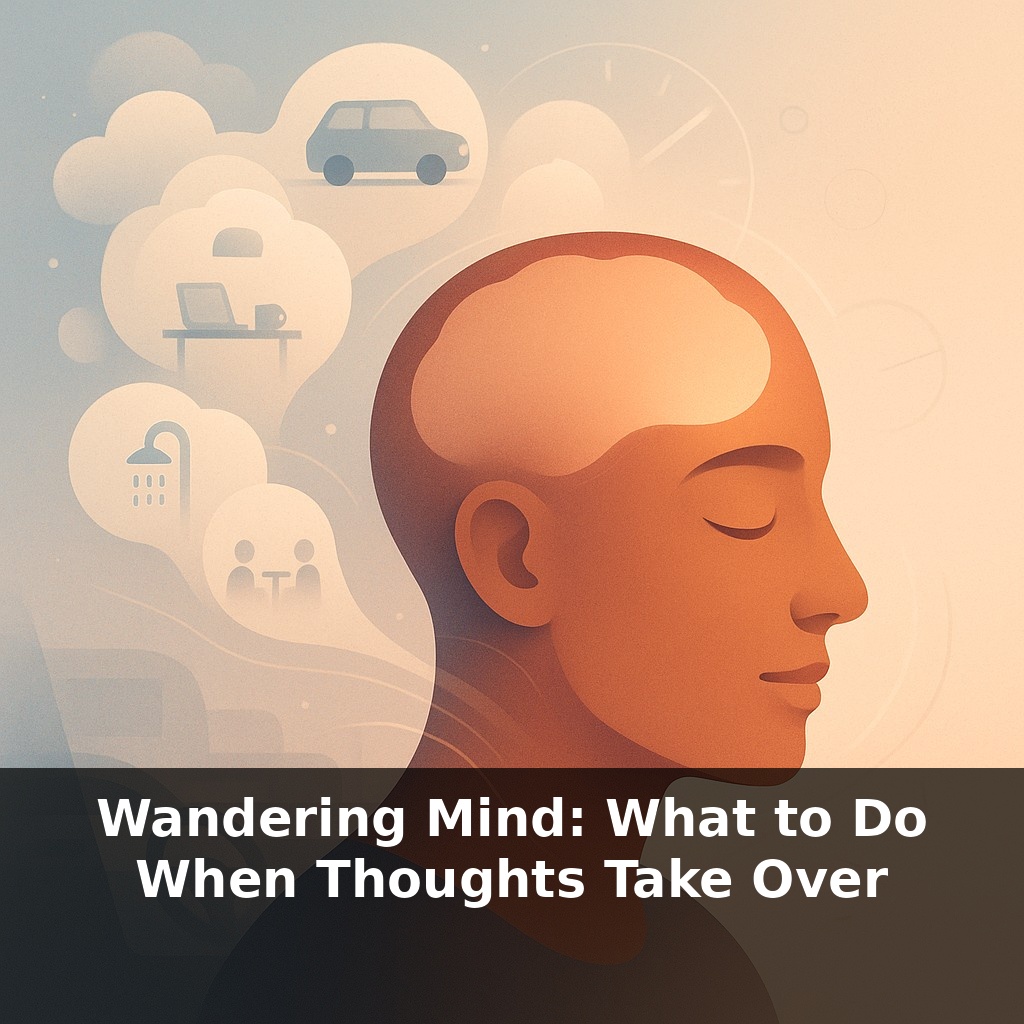
Right now, your brain may be off-script. Studies suggest our thoughts stray from what we’re doing about half the time—often without us noticing. You might be driving, showering, or in a meeting… and suddenly realize you missed the last few minutes of your own life.
Most of us only notice our thoughts have taken over when something snaps us back: the traffic light turns green, someone says our name, the oven beeps. Until that moment, it can feel like the mind quietly “stole” a chunk of time and filled it with reruns, worries, or half-finished to‑do lists.
In meditation, this can be even more obvious. You sit down with a simple intention—follow the breath, listen to sounds—and within seconds you’re reworking a conversation, solving work problems, or planning dinner. It’s easy to conclude: “I’m bad at this. My mind is too busy.”
But here’s the shift we’re making in this episode: the problem isn’t that thoughts appear; it’s that we don’t notice when they’ve taken the wheel. Once you can see that moment more clearly, you have options—and that’s where real practice begins.
Here’s the twist: the very moment you catch your mind drifting is not a mistake in practice—it *is* the practice. That tiny flash of “oh, I’m gone” is your brain’s monitoring system coming online, like a quiet internal notification ping. Neuroscientists call this capacity “meta-awareness,” and it’s trainable. Each time you recognize you’ve been pulled into a storyline, you’re strengthening this system. Over time, it’s like adjusting a lens: what used to blur together—thoughts, emotions, reactions—starts to separate, giving you just enough space to choose your next move.
When thoughts take over, most people instinctively do one of two things: fight them (“stop thinking, focus!”) or follow them (“I’ll just finish this one mental conversation…”). Both keep you in the same loop: reacting to whatever pops up next.
A different option is to treat the moment you “wake up” inside a thought as a fork in the road. You don’t have to like what’s happening in your head to work with it; you just need a simple script for what to do *next*.
Think of three basic moves:
1. **Gentle refocus** This is the simplest: you notice you’re gone, and you redirect. No commentary, no scolding. The “gentle” part is not about being nice—it’s about being efficient. Harsh self‑talk (“ugh, again”) adds more mental noise and keeps you entangled with the thought stream. A light touch is quicker: *“Thinking. Back to X.”*
2. **Label and let be** Sometimes the content is sticky—worry about a health test, a tense email, a relationship issue. In those moments, a quick label helps you see the category rather than the story: - “Planning” - “Remembering” - “Judging” - “Worrying” This doesn’t fix the issue. It just marks it, like a mental Post‑it, and then you return to your anchor. You’re quietly teaching your brain: *I can acknowledge this without disappearing into it.*
3. **Open monitoring** On days when thoughts are especially loud, continuously refocusing can feel like bailing water from a leaky boat. Instead of narrowing, you can deliberately widen. For a few minutes, you allow sounds, body sensations, and thoughts to come and go in awareness, without picking a favorite. When a thought appears, you notice its arrival, its flavor (fast, slow, intense, faint), and its passing, the way a clinician might observe a symptom: curious, but not immediately intervening.
Here’s the key shift underneath all three moves: you’re updating your relationship to thoughts from “commands to obey” to “events to observe.” A thought like “You’re failing at this” used to be a verdict; now it’s another mental event that rises, peaks, and fades. Over time, this quiet downgrade of authority is what makes even persistent patterns—self‑criticism, catastrophizing, endless rehearsing—feel less like a cage and more like background noise you can choose how to respond to.
You can see this most clearly in everyday moments. You’re halfway through brushing your teeth and notice you’ve been replaying a comment from your boss. That instant of “caught in the act” is like flipping on a light in a messy room: nothing’s cleaned up yet, but you can finally see where things are. From there, you might quietly note, “Ah, work stuff,” feel your feet on the floor, and finish brushing without needing to solve anything.
Or you’re lying awake at 2 a.m., mind racing through worst‑case scenarios. Instead of arguing with the worries or trying to force sleep, you mentally tag what’s here—“future,” “fear,” “fixing”—and gently redirect to the sensation of the pillow, the weight of your body. You’ll drift off when you do; the immediate win is that you’ve stopped taking every midnight thought as urgent truth. Gradually, this kind of response becomes your default in hard conversations, in traffic, even in conflict: less auto‑pilot, more choice.
As tools and workplaces adapt, this skill may quietly reshape daily life. Apps could flag mental detours like a smart watch flags irregular heartbeats, nudging you back before you’ve sunk an hour into doom‑scrolling. Classrooms might weave in short pauses so kids learn to spot mental spirals alongside times tables. There’s promise and risk: the same techniques that help you suffer less could also be tuned to keep you grinding longer. The open question: who decides what your attention is *for*?
Your challenge this week: each day, pick one routine task—washing dishes, showering, commuting—and quietly mark *one* moment when you realize you’ve been “somewhere else.” No judgment, just a mental note and a gentle return. Over days, you may notice it feels less like wrestling with your head and more like adjusting a radio dial until the signal comes back.