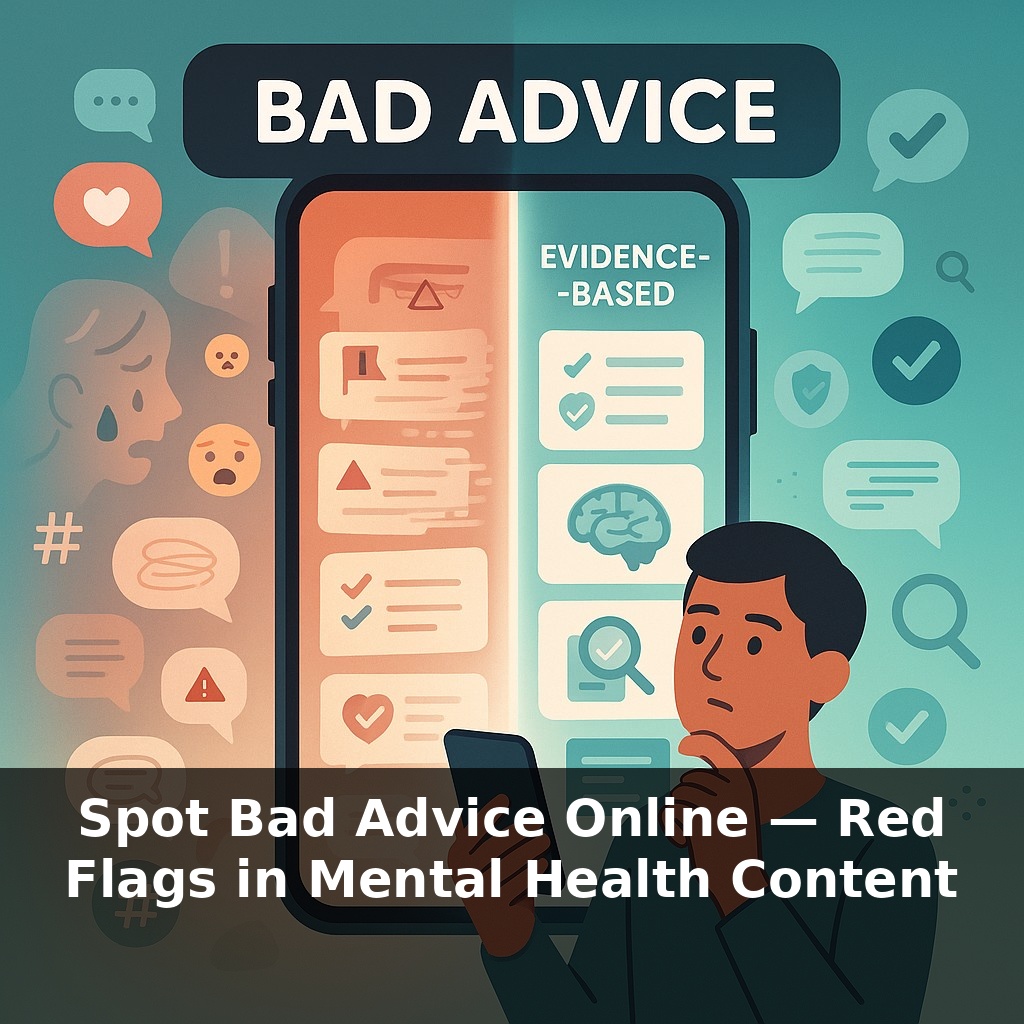
One of the most‑watched topics on social media is mental health, yet a lot of the “advice” spreading fastest is flat‑out wrong. A creator cries on camera, shares a three‑step “fix,” and thousands comment, “This saved my life,” even though nothing was actually tested or checked.
Over 100 billion views sit under the #mentalhealth hashtag on TikTok alone, yet a 2022 study found only about a third of top depression videos cited any science at all. That gap between what feels true and what’s actually backed by evidence is where things get risky. In earlier episodes, we focused on getting solid help from therapists and doctors; now we zoom out to the wild ecosystem your For You page drops you into every day. Posts can sound comforting and still be misleading—like a beautifully decorated cake that’s underbaked in the middle. Some creators are trained clinicians; others are guessing based on their own story, or quietly steering you toward a product link. This episode is about sharpening your internal “BS filter” so you can keep the helpful ideas, ditch the rest, and avoid advice that quietly pulls you away from real support.
On social feeds, it’s easy to mistake *relatable* for *reliable*. A creator’s story might mirror yours so closely that their words feel like a custom-fit jacket—never mind that the stitching hasn’t been stress‑tested. Algorithms boost what grips emotion, not what passes a safety inspection, so the posts that rise to the top are often the most dramatic, simplified, or neatly packaged. That doesn’t make them useless, but it does mean you’re browsing a highlight reel, not a treatment manual. In this episode, we’ll zoom in on practical red flags so you can scroll like a curious researcher, not a passive patient in a waiting room.
Start with the simplest check: *Who’s actually talking to you?* Click through to their profile and look for real‑world anchors—licenses (psychologist, psychiatrist, LCSW, LPC), workplaces, or links to clinics or universities. “Mental health advocate,” “coach,” or “healer” isn’t automatically bad, but those labels don’t tell you what training, if any, keeps their content grounded. When credentials are vague and the bio is mostly discount codes, treat bold claims as marketing, not medicine.
Next, listen for how they talk about information. Do they mention research, guidelines (like WHO, APA, NHS), or say, “Here’s what we *think* based on current studies”? Or is everything “proven,” “guaranteed,” and “suppressed by big pharma”? It’s fine if a short video can’t cite every paper, but you should be able to click a link or search a term they give and actually find something beyond another influencer repeating the same line.
Motive shows up in pacing. Notice when a post spends 10 seconds on your pain and 40 seconds on “the one product I trust” or a paid course. Education‑first creators usually give you usable ideas even if you never buy anything: questions to ask a doctor, language to explain symptoms, options to explore. Sales‑first content makes you feel stuck or doomed *unless* you follow, subscribe, or purchase.
Pay close attention to how they handle complexity. Real mental‑health info has “it depends” baked in—different bodies, cultures, histories, and diagnoses change the picture. Red flags pop up when you hear “this works for *everyone*,” “therapy is a scam,” or “meds always make you worse.” Universal rules are comforting because they simplify hard choices, but your brain and life are not a single-ingredient recipe.
Safety might be the biggest filter. Be wary of anyone who tells you to stop medication suddenly, hide symptoms from a clinician, replace prescribed care with a supplement or breathing hack, or ride out suicidal thoughts alone. WHO’s focus on suicide misinformation is a reminder: careless content doesn’t just waste time; it can cost lives.
One useful mental shortcut: when a post hits you hard—rage, hope, or panic—pause before sharing or acting. Strong emotion is your cue to slow down, zoom out, and run a quick scan of source, evidence, motive, extremes, and safety.
Scroll past a post that insists, “Therapy is useless, all you need is X”? That’s a perfect moment to test your checklist in the wild. Picture three common characters on your feed: the “trauma coach” promising a one-week nervous-system reset, the psychiatry resident breaking down side‑effects in plain language, and the lifestyle influencer swearing a mushroom drink replaced her antidepressant.
Run SOURCE first: who can you actually look up beyond this platform? Then EVIDENCE: do they point you to a guideline, a book, even keywords you can search later, or just personal vibes? MOTIVE shows when one of them keeps circling back to a discount code. EXTREMES jump out in captions like “never” and “always.” For SAFETY, notice whose tips you’d feel okay a 14‑year‑old following unsupervised.
Checking posts this way is like adjusting a camera lens in bad weather: you can’t stop the storm of content, but you can keep your view just sharp enough not to walk off a cliff.
In a few years, your feed may look less like a random scroll and more like a busy airport: verified “flights” (licensed experts), sketchy pop‑ups, and AI “holograms” confidently pointing in all directions at once. Labels, credibility badges, and warning screens will help, but they’ll never catch everything. The mindset shift: treat your scroll like weather—changing, sometimes severe. Your job isn’t to control the storm, but to carry the right gear and know when to seek shelter offline.
Treat each post like a song on the radio: some are catchy noise, a few are worth replaying, and not every lyric belongs in your life. Saving the solid ones, muting repeat offenders, and checking big claims offline over time creates a kind of “playlist hygiene” so your daily scroll supports you instead of slowly knocking you off key.
Before next week, ask yourself: 1) “The last time I saved or shared a mental health post, what specific evidence did the creator give (beyond ‘it worked for me’), and would I trust that same level of evidence from someone talking about my physical health?” 2) “When I see bold claims like ‘this one trick heals trauma’ or ‘therapists don’t want you to know this,’ what would I learn if I paused for 2 minutes to quickly Google the creator’s credentials and check whether reputable organizations say something similar?” 3) “Looking at my feed today, which 1–2 accounts consistently make me feel scared, broken, or dependent on their content to ‘fix’ myself—and what would it be like to mute them for a week and replace that screen time with a source I know is grounded in actual research (like a licensed clinic, university, or professional association)?”