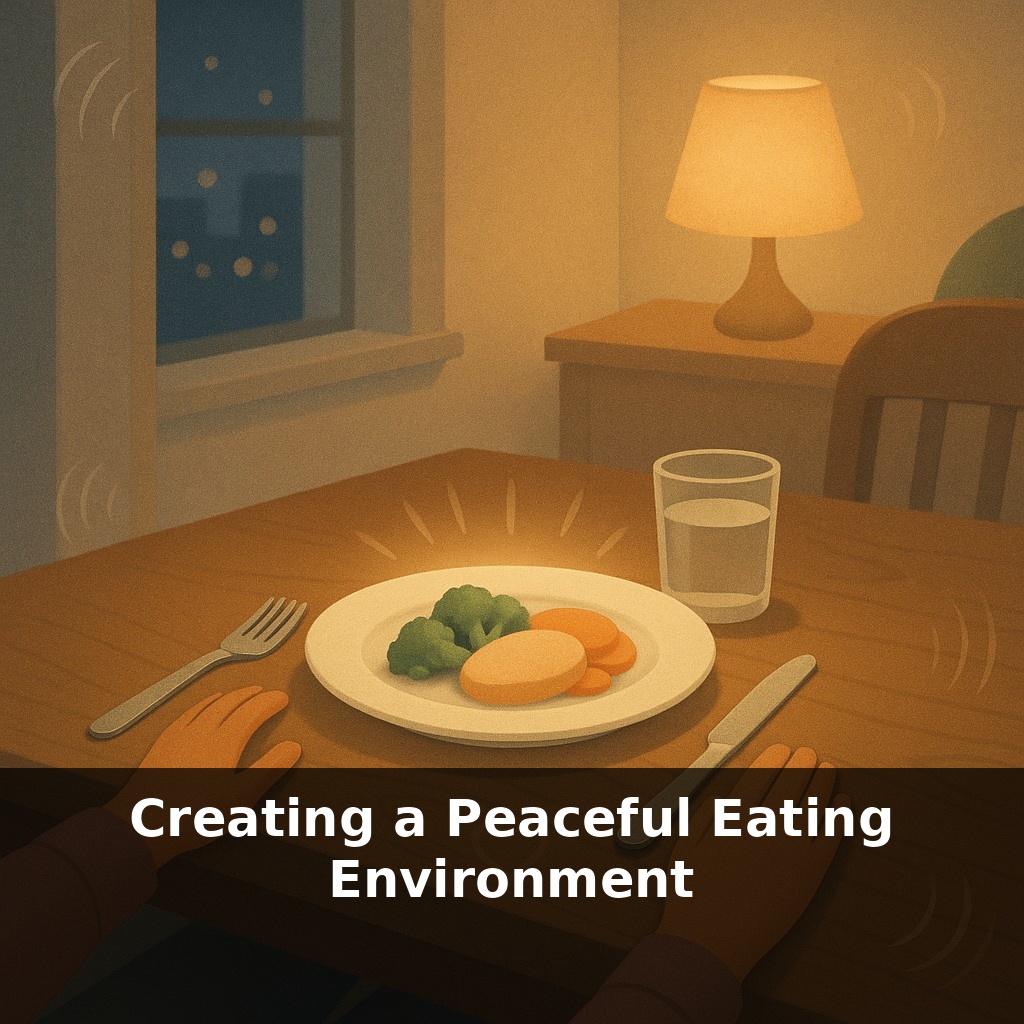
You can change how your body digests food without changing a single ingredient on your plate. Imagine transforming a noisy, rushed meal into one with softer light, less noise, and a brief pause before the first bite. Such subtle shifts can make remarkable differences.
That shift you just imagined—less noise, softer light, a small pause—does more than “feel nicer.” Research shows it can change how clearly you sense your own hunger and fullness signals, almost like turning up the resolution on a blurry image. A peaceful eating environment doesn’t mean fancy decor or silence; it means choosing cues that help your body stay present to the meal instead of bracing against stress.
Here’s where it gets interesting: your brain integrates dozens of small details at the table—sounds, scents, colors, even clutter—to decide whether this is a moment to rush or to settle. Over time, those repeated signals can become habits: fork speed, bite size, how often you check in with your stomach instead of your screen. By adjusting the “default settings” around your meals, you’re not just changing ambience—you’re quietly retraining what “normal eating” feels like.
Think of your meals as “software updates” for your nervous system: every lunch at your desk, every late-night snack by the TV quietly installs a new default. Over time, your body starts predicting how a meal will feel before the first bite—rushed or spacious, tense or settling—and prepares accordingly. That prediction shapes your pace, your portions, even how satisfying the meal seems afterward. The good news is you don’t need a perfect schedule or a separate dining room to shift this. Small, repeatable cues—where you sit, what you see, how you begin—can steadily rewrite that code in your favor.
Most people try to fix eating by changing the food. Yet a growing stack of studies shows that *how the room behaves* can shift what and how much you eat almost as strongly as the menu itself. That means you can keep the same pasta, the same takeout, the same leftovers—and still change the outcome by changing the “climate” around the plate.
Start with sensory load. Your brain has limited bandwidth; if it’s processing emails, notifications, and a loud TV, it has less capacity to notice subtle body cues. In those conditions, portions creep up, bites get larger, and meals blur together. This is where controlled lighting, sound, and scent come in—not as decor, but as tools for reducing noise in the system so your internal signals don’t have to shout.
Light is one of the quiet levers. Bright, cold, “office” lighting is associated with speed and task mode; warmer, softer light tends to slow movements and invite lingering. Even a single lamp or dimmed overhead light at home can mark the shift from “working” to “eating,” telling your brain this is a different kind of moment.
Sound matters in a similar way. Fast, high-tempo background noise nudges you to match its pace; calmer soundscapes or gentle, slow-tempo music help extend the gaps between bites. This doesn’t require silence—just fewer competing voices. Think of it as turning down the “frame rate” of the meal so each bite becomes a distinct event instead of part of a continuous stream.
Scent works as a primer. Strong, unrelated smells (cleaning products, scented candles) can pull attention away from the plate, while mild, food-adjacent aromas (herbs, citrus, a pot of tea) keep the sensory focus coherent. When what you smell and what you eat line up, it’s easier to register subtle shifts in satisfaction.
Then there’s visual order. A consistently cluttered table keeps your brain in monitoring mode—where is everything, what might tip over, what needs to be moved? Clearing just enough space for plate, glass, and utensils acts like a visual boundary: this area is for eating, not working, scrolling, or sorting mail.
Layered together, these details become a kind of architectural plan for your meals. You’re not chasing perfection; you’re setting up a default layout that makes slower, more attentive eating require less willpower and more simple follow-through.
A practical way to see this in action is to run tiny “A/B tests” with your own meals. One evening, keep your usual setup but add just one tweak: clear everything from the table except what you need for eating. Notice not only your pace, but how often your attention drifts. Another day, keep the clutter but silence notifications for the length of the meal. You’re not judging, just comparing the “data” of your experience.
You can also create zones, the way many people do for work: maybe a specific chair is only for meals, or a small tray becomes your mobile “table” that appears only when it’s time to eat. Over a few days, your body starts to associate that setup with a particular rhythm.
Your challenge this week: pick *one* environmental lever—sound, light, or visual order—and standardize it for five meals. After each, briefly rate (1–5) how settled you felt and how easy it was to stop. By the fifth meal, look for subtle trends.
A quiet meal today may be rehearsal for how cities, offices, and homes will “think” about eating tomorrow. As buildings get smarter, your kitchen could act like a gentle coach—lights shifting, noise softening, even your watch suggesting a short pause before the first bite. Restaurants might compete less on portion size and more on calm. Like upgrading from a noisy, laggy laptop to a smooth-running system, the goal isn’t fancy features, but fewer glitches between you and your body’s cues.
Over time, the details you’re shaping at the table can ripple outward: you may find yourself slowing in other places too—sipping coffee instead of gulping it, pausing before late‑night snacks, noticing stress spikes sooner. Like updating the “settings” on your day, each calm meal becomes a quiet vote for a life that doesn’t rush past your own signals.
To go deeper, here are 3 next steps:
1. Pick one meal today and try the “peaceful plate setup” from the episode: set your table (no phones, no TV), put food onto a plate instead of eating from containers, and use the free Peaceful Eating Checklist from The Body Image Upgrade (or a similar mindful eating checklist you find online) to guide you through that meal. 2. Tonight, listen to a 10-minute mindful eating meditation (search for “Mindful Eating Meditation – The Mindful Movement” on YouTube or use the “Mindful Eating” practice in the free Insight Timer app) while you eat a snack, and focus only on your senses like the host described—texture, temperature, and flavor. 3. Choose one external “eating trigger” you struggle with (like tension at the dinner table or rushing lunch at your desk) and read the chapter on creating calm mealtimes in “Intuitive Eating” by Tribole & Resch or “Savor” by Thich Nhat Hanh, then change just that one situation tomorrow—maybe by eating lunch away from your computer or starting dinner with a 60-second family “quiet pause” like the episode suggested.