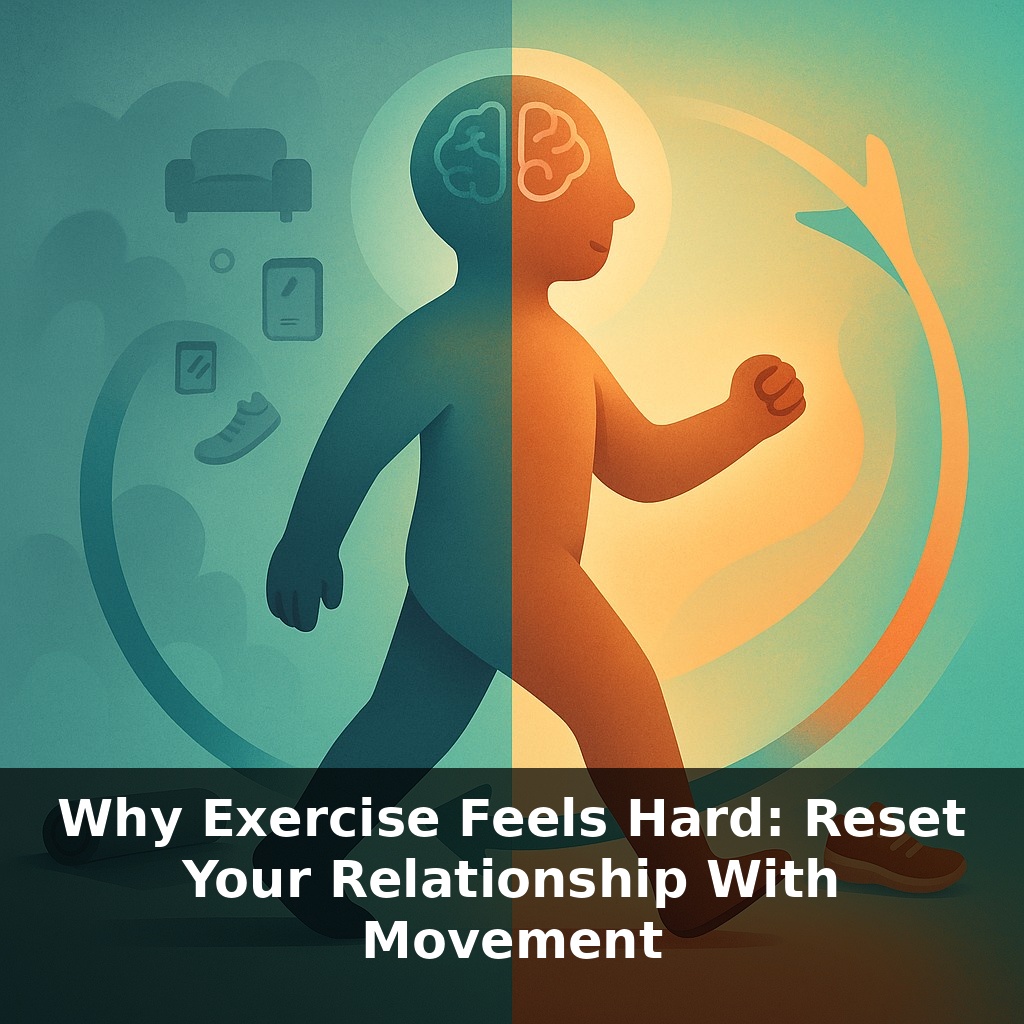
Why Exercise Feels Hard: Reset Your Relationship With Movement
📝 Transcript
Right now, your brain is quietly running a cost–benefit analysis on exercise—and it’s biased against you. You can feel exhausted just thinking about a workout… then strangely fine once you actually move. Why does the “before” feel so awful, while the “after” feels so good?
Your brain’s bias doesn’t just shape whether you work out—it quietly dictates *what* kind of movement you even consider “valid.” Years of gym-class shame, “no pain, no gain” culture, and fitness influencers sprinting on screens can train you to believe that unless you’re drenched in sweat or collapsing on the floor, it “doesn’t count.” So a walk after dinner? Stretching while you watch a show? Dancing in your kitchen? Your mind might tag those as “nice, but not real exercise” and quietly file them away as optional. This is a problem, because your body doesn’t share those rules. Physiologically, it happily responds to small, pleasant bouts of movement, sprinkling in better blood flow, lower stress hormones, and tiny mood boosts. The conflict isn’t between you and exercise—it’s between your lived experience and a story you were handed about what movement is supposed to look like.
Part of the problem is that your nervous system keeps detailed “movement memories.” It remembers the mile run you were forced to do, the time you were picked last, the workout that left you so sore you couldn’t sit down. Those memories get bundled with emotions—embarrassment, pressure, boredom—and stored as a kind of “movement profile.” When a chance to move appears, your brain quickly scans that profile and issues a forecast: *This will suck.* Not because it’s true right now, but because that’s what the file says. Updating that file—gently, repeatedly—is how movement starts to feel different.
Here’s the sneaky part: your brain isn’t just pulling scary movement memories from the past—it’s also running predictions about the *future*, and those predictions are systematically distorted.
Three big glitches tend to show up.
First, **overestimating how bad it will feel.** Studies find people reliably predict workouts will be more uncomfortable, more tiring, and more awkward than they actually turn out to be. That’s called affective forecasting error. Your brain highlights every possible downside—sweat, breathlessness, logistics—and largely ignores the likely upsides: pride, relief, clearer thinking, maybe even a bit of fun. So the “ugh” you feel before moving is often a reaction to an exaggerated forecast, not to reality.
Second, **discounting future benefits.** Your brain is wired to care more about what happens in the next hour than what happens in the next decade. Avoiding mild effort right now feels more compelling than lowering your risk of disease later—even though you *know* the long-term stakes are huge. But not all benefits are decades away. There are near-term payoffs your brain does respond to: better sleep tonight, a calmer nervous system this afternoon, being less snappy with people you care about. When movement is linked to those immediate, tangible wins, it stops feeling like a vague investment and more like a useful tool.
Third, **associating movement with obligation instead of choice.** When exercise feels like something you “should” do, it activates the same resistance you might feel toward an overflowing inbox. But when movement is chosen—*how* you move, *where*, *with whom*, and *for what* emotional reason—it starts to plug into the brain’s reward systems. You’re not chasing gold stars; you’re hunting for experiences your nervous system actually likes: music, nature, mastery, play, social connection, or even just a slice of quiet.
Think of it like updating medical records: old notes say “exercise = threat,” but every small, tolerable bout of movement that ends with “huh, that wasn’t so bad” is a new entry in the chart. Over time, enough of those entries shift the overall diagnosis from “avoid” to “maybe,” then from “maybe” to “I kind of miss it when I don’t.”
Think about how your brain treats different types of movement during a single day. You might scroll your phone for 30 minutes without hesitation, but balk at a 10‑minute walk as “too much.” That’s not laziness; it’s your prediction system mislabeling one action as cozy and the other as costly. A practical way to update that label is to run tiny “experiments” that contradict the old file.
For example: set a timer for 5 minutes and put on one song while you tidy, sway, or pace during a call. When the timer goes off, *pause* and quickly rate two things from 1–10: “How bad was that, really?” and “How do I feel right now compared to before?” You’re not judging yourself; you’re collecting data. Over a week, those numbers often reveal a pattern: anticipation stays high, but actual discomfort drops, and mood inches up.
This is your nervous system learning, through repeated, low‑stakes proof, that movement can be brief, flexible, and sometimes quietly rewarding—not a test you pass or fail.
In the next decade, your “I should work out” list may quietly turn into background systems that move with you. Think less bootcamp, more autopilot: shoes that suggest a calming route when your stress spikes, office layouts that nudge short walking loops, group chats that turn shared step streaks into low‑key rituals. Like a well‑designed museum, the environment does the curating, and you just follow the path that feels most interesting in the moment.
So instead of waiting to “feel like” exercising, treat movement as a series of tiny, curious check‑ins with your body—more like tasting samples than committing to a full meal. Some will be bland, some surprisingly good, and your job is just to notice. Over time, those small, neutral experiments can snowball into a rhythm that feels chosen, not forced.
To go deeper, here are 3 next steps: (1) Take the free “Movement, Mindset & Motivation” quiz on Jessica’s website to pinpoint *why* exercise feels so hard for you, then screenshot your results and pick one “green-light” activity she suggests to try for 10 minutes today. (2) Listen to the episode of the *Maintenance Phase* podcast on “The Fitness Myth” to unlearn perfectionist, all-or-nothing workout rules, and jot down 3 “rule-breaking” movement options (like dancing in your kitchen, walking while voice-texting a friend, or stretching during Netflix) that actually sound doable this week. (3) Grab a copy of Kelly McGonigal’s *The Joy of Movement* and use the first chapter as a prompt to build a 3-song “feel-better, not fitter” playlist; as soon as you finish the chapter, hit play and let yourself move however you want for the length of those three songs—no tracking, no goals, just noticing how your body feels.
From this course
Start Exercising (Finally): Fitness for Beginners
7 episodesUnlock all episodes
Full access to 7 episodes and everything on OwlUp.
Subscribe — $1.99/monthLess than a coffee ☕ · Cancel anytime