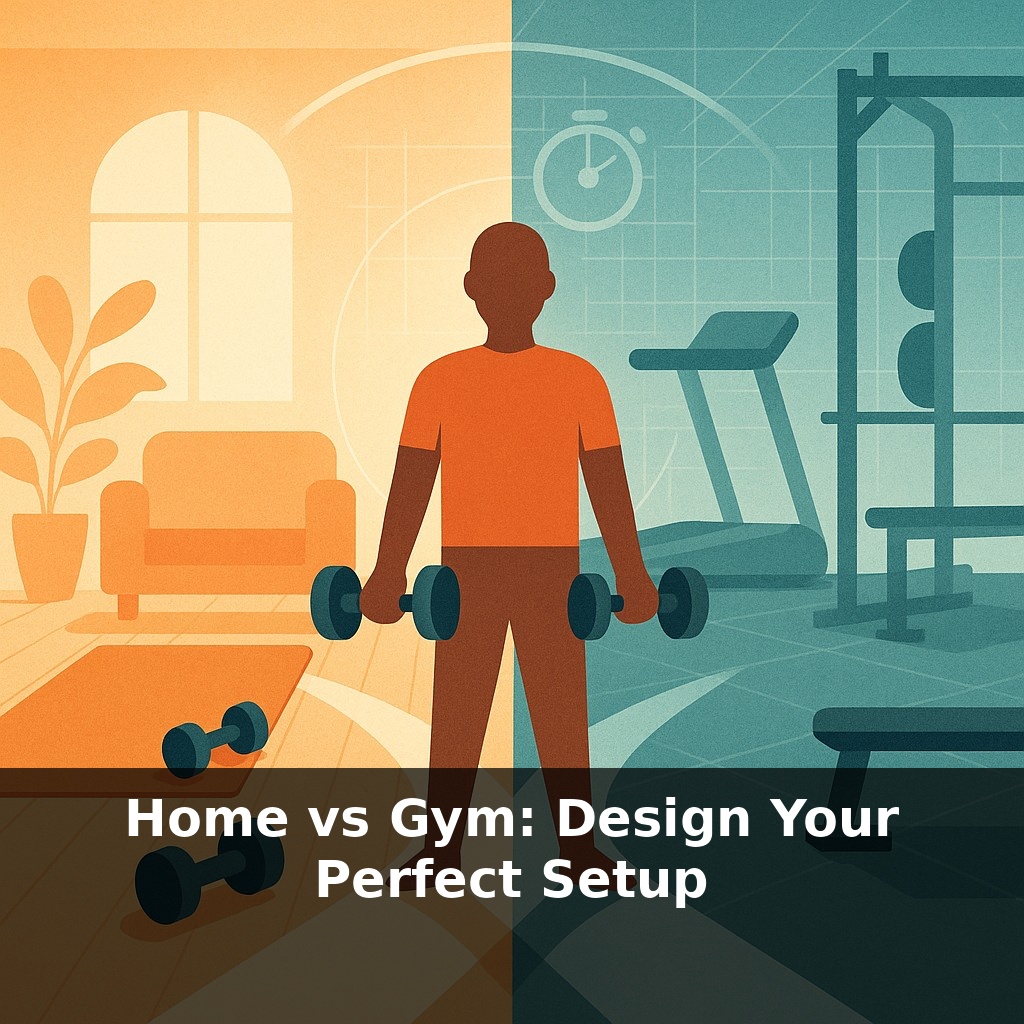
Right now, someone is driving 20 minutes to a gym… to walk on a treadmill. Meanwhile, their neighbor is getting fitter in a tiny living room with a single pair of dumbbells. Same goal, totally different paths. The strange part? Both might be wasting effort—and for opposite reasons.
Some people treat this like a moral question: “Real” training happens at the gym; home workouts are a compromise. Others flip it: gyms are “for posers,” and the living room mat is where the disciplined train. Both views miss the real issue: you’re not choosing a side in a culture war, you’re choosing an environment that quietly shapes your daily decisions. Think of two friends: one keeps a guitar on a stand in the living room and practices every day; the other keeps a better guitar in a case under the bed and “means to” play. The difference isn’t the instrument—it’s the friction between intention and action, and whether your setup makes showing up feel like default or like a project you have to psych yourself up for.
So the real question isn’t “home vs gym,” it’s: where do you actually *show up* when life gets messy—late meetings, tired evenings, bad weather, kids’ homework chaos? That’s the battlefield where routines live or die. For some, a gym’s noise and energy act like a green light: once they swipe in, they’re locked in. For others, that same trip feels like a wall. Meanwhile, a few small, well‑chosen tools at home can turn stray 20‑minute pockets into real training—or into laundry‑folding time if the space feels cluttered, distracting, or optional.
Here’s where most people go wrong: they choose “home” or “gym” the way they choose a team in a rivalry, not the way they’d design a tool that has to work on a chaotic Tuesday night.
Start with three brutally practical questions:
1. **What training do you actually need?** Hypertrophy, basic strength, cardio health, mobility, or some mix? - Heavy barbell strength or powerlifting: you’ll probably need access to a rack, plates, and safe spotting options at least some of the time. - General muscle, fat loss, feeling better: adjustable dumbbells, bands, and floor space can cover a surprising amount. - Cardio: brisk walking or running outdoors often beats paying to stand in line for a single row of treadmills.
2. **Where does your day *naturally* have space?** Scan your calendar, not your ideals. - If your evenings collapse, a gym that’s “on the way” to work or school might beat the fantasy of a pristine 7 p.m. home session that never happens. - If you’re on kid-duty or on call, 20–30 minute “micro‑sessions” at home may win over 90‑minute trips that require perfect scheduling.
3. **What derails you most often?** - If you’re easily distracted by chores or screens, four walls and a squat rack might be worth the membership. - If crowds, waiting for equipment, or commute stress drain you, a simple home corner can preserve the willpower you actually have.
Now layer cost and psychology on top: - A low‑cost gym you never visit is more expensive than a modest home kit you touch four days a week. - But a slightly pricier, well‑located gym that you *consistently* use can beat a high‑end smart device that turns into an awkward statue in your living room.
From there, think modular instead of all‑or‑nothing. You might lift twice per week at a gym for heavy work, then fill the gaps with short home sessions for mobility, core, or conditioning. Over time, you can shift that mix as your schedule, confidence, and preferences change—like slowly rebalancing an investment portfolio as your life situation evolves.
Your “perfect” setup isn’t what looks impressive in photos. It’s the combination of places, tools, and times you can repeat so often that progress becomes almost boringly reliable.
Think of three people designing their own “blended” setup.
Alex works downtown, passes a gym right next to the train. Twice a week, they duck in for 40 focused minutes of heavier lifting, no phone, no multitasking. At home, there’s a single kettlebell in the hallway; any night that doesn’t hit the gym becomes a 15‑minute kettlebell + pushup session before dinner. No big decisions, just default options tied to places they already pass through.
Jordan hates crowds and drives a lot. They cancel the distant, fancy gym and build a minimalist garage zone: mat, adjustable dumbbells, a pull‑up bar. But every Saturday, they buy a day pass to a better‑equipped facility to practice a few lifts that feel safer with more space and platforms.
Sam leans on social energy: a small group class twice a week, then a living‑room “maintenance kit” for travel days—bands, a jump rope, a yoga block—so missed classes don’t spiral into skipped weeks.
A few years from now, your “where do I work out?” decision might feel less like choosing a place and more like tuning a dial. Your watch notices your sleep tanked, and nudges you toward a short, quiet home session instead of that intense class you booked. Your gym app could unlock a nearby park rig when you’re traveling, the way bank cards tap into partner ATMs. Think less in terms of membership vs. equipment, more in terms of a flexible network that adapts as your life shifts.
Your “right answer” may change: busy season at work, a new baby, a move across town. Treat your training locations like tabs in a browser—you can close, reopen, and rearrange them as life shifts. The win isn’t loyalty to home or gym; it’s learning to remix both so there’s almost always *some* path of least resistance waiting for you.
Try this experiment: for the next 7 days, split your training so you do all your compound lifts (like squats, bench, pull-ups/lat pulldown) at the gym and all your accessories (like dumbbell curls, band work, core, and mobility) at home. Before you start, rate yourself from 1–10 on energy, convenience, and consistency expectations for each setup. At the end of the week, look at your actual behavior: How many sessions did you complete in each place, how hard did you push (RPE), and which felt easier to start? Based on what you actually did—not what you hoped—decide whether your “default” training base should be home or gym and lock that in for the next month.