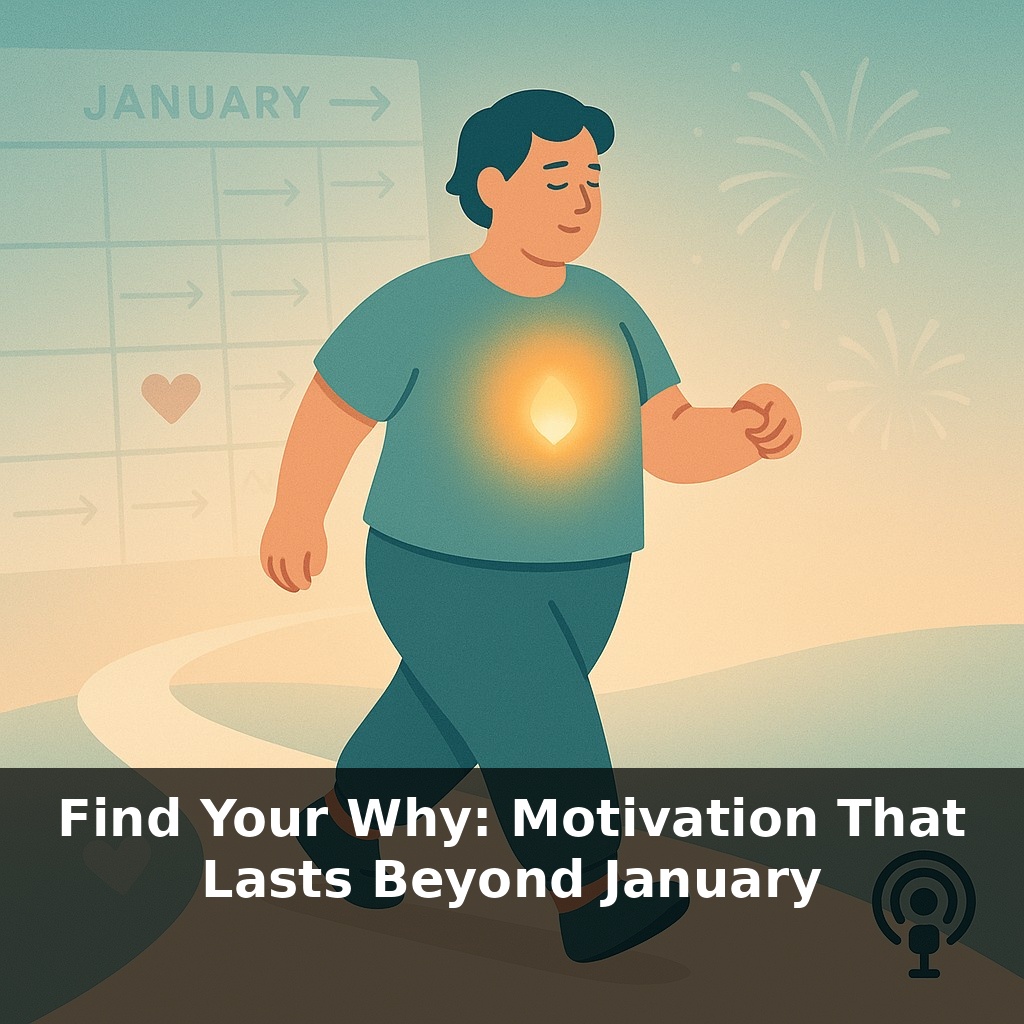
About 8 out of 10 New Year fitness resolutions quietly die before Valentine’s Day. But here’s the twist: many of those people didn’t lose motivation—they just chased the wrong reason. In this episode, we’ll explore why the ‘why’ behind your workout matters more than the workout itself.
So if the usual “New Year, new me” fuel runs out fast, what actually lasts? Research in motivation science points to a quieter, sturdier engine: the reasons that make today feel better, not just your body smaller someday. Think less “I should burn calories” and more “this walk helps me stop replaying work emails in my head” or “that strength session lets me pick up my kid without my back complaining.”
Psychologists call this shift toward inner reasons “autonomous motivation,” and it behaves more like a savings account than a lottery ticket: small, regular deposits eventually change what feels normal. Instead of forcing workouts onto your life like an awkward meeting, movement starts to feel like a part of how you cope, focus, and even connect with people you care about.
In this episode, we’ll uncover how to find that kind of motivation—and how to practice it, even when January is long gone.
Think about the last time you actually *looked forward* to moving your body. Odds are, it wasn’t a random treadmill grind—it was a hike with a friend, dancing in your kitchen, or a walk that cleared your head after a long day. That’s the territory we’re heading into now: not “how do I force myself to work out,” but “where in my real life does movement already feel like a win?” We’ll connect dots between your values, your stress patterns, and your daily routines, so exercise turns into something that supports your life instead of competing with it.
Think of this next step as switching from “I should move more” to “I’m a detective studying what actually pulls me off the couch.” Instead of forcing a plan, we’re gathering evidence about what already works for you—even in tiny, easily overlooked ways.
Start with your *good* days, not your “ideal” ones. On days you feel even 10% better than average—less frazzled, a bit more patient, slightly more confident—what kind of movement, if any, shows up? Maybe you took the stairs without thinking, wandered while on a phone call, or stretched your neck between meetings. These crumbs matter, because they show you where movement fits without a fight.
Next, zoom in on *moments*, not workouts. Five-minute pockets count: walking to clear your head before a hard conversation, doing squats while the kettle boils, pacing while voice-texting a friend. When movement piggybacks on something you already care about—connection, calm, focus—it stops needing its own giant block on the calendar.
Research backs this up: people stick with activities that feel like extensions of who they are. So ask, “Where do I already feel most like myself?” Is it when you’re joking with coworkers, getting lost in a podcast, or being outdoors? Each answer points to a different experiment: lunchtime walks with a colleague, evening walks with audiobooks, weekend park circuits with family.
Environment is another quiet lever. If your shoes are buried in a closet and your living room screams “collapse here,” you’re fighting upstream. Small tweaks—a yoga mat that lives by the couch, dumbbells near the desk, a coat hook by the door with your walking gear—act like visual invitations. The easier it is to start, the less heroic you have to be.
Finally, consider your social world. Who around you views movement as normal, not extreme? A neighbor who walks nightly, a coworker who stretches between calls, a friend who loves casual bike rides—these are the people who can turn your experiments into shared rituals instead of lonely tasks.
Think about three very different people.
First, there’s Maya, who started a “10,000 steps” plan and quit in three weeks. When she looked closer, she realized steps meant nothing to her—but showing up clear-headed for her therapy clients did. She began taking 7‑minute “reset walks” between sessions, not to hit a number, but to feel present. The steps became a side-effect, not the point.
Then there’s Luis, who swore he’d finally “get shredded.” His progress stalled—until he noticed his real smile showed up after pickup soccer with coworkers. He stopped chasing a six-pack and committed to never saying no to a game if he was free. Two years later, his health markers improved more from those standing weekly games than from any short-lived program.
Finally, picture Anika, an artist. She treats her week like a canvas: each short walk, stretch, or bike ride is a brushstroke that changes the overall mood. She’s not chasing perfection, just layering tiny choices that make the whole picture feel more like her.
Soon, your “why” might be built into the tools you already use. Fitness platforms could feel less like drill sergeants and more like therapists with calendars, nudging you toward choices that fit your real life. Picture an app noticing you slept badly and offering a gentle walk instead of a punishing workout, or your insurance rewarding evenings you spend active with friends the way banks reward consistent savings—small bonuses that add up quietly over time. Your everyday choices become data that programs learn from, then tailor back to you.
So instead of asking, “How long will I keep this up?” try, “What tiny action today deserves a repeat performance tomorrow?” Let your body’s feedback be your coach: more ease, better sleep, a calmer brain are like green lights on a dashboard. Follow the signals that brighten your day, and consistency stops being a promise and starts becoming a side-effect.
Try this experiment: For the next 7 days, every time you do the habit you “think” you want (like going to the gym, cooking at home, or working on that side project), say out loud: “I’m doing this because I want ______,” and fill in the *real* reason (e.g., “to have the energy to play with my kids after work” or “to feel proud when I present at the next team meeting”). After each session, quickly rate on a scale of 1–10 how motivated you feel to repeat it tomorrow *because of that reason*, not the habit itself. By the end of the week, circle the 1–2 reasons that consistently gave you the highest motivation scores—those are your true “whys.” Next week, keep the same habits but put your chosen why *in front* of them (say it before you start), and see if your consistency or resistance level changes.