Most people who exercise still miss one crucial move—and it’s not running faster or lifting heavier. In one scenario, your heart is strong but your muscles can’t keep up; in another, you’re powerful but winded on the stairs. Which body are *you* secretly building?
Here’s the twist: your body doesn’t log workouts the way your fitness app does. It doesn’t care that Monday was “leg day” and Wednesday was “cardio day.” It tracks whether, over time, you can move more easily, recover faster, and stay healthier with less effort. That’s where most plans quietly fall apart—they obsess over *sessions* instead of what those sessions are slowly building in the background: endurance you can rely on and strength you can actually use.
Think about the last time life surprised you—a friend’s last‑minute move, a sprint for a train, an unusually long workday on your feet. Those moments reveal your real program, whether or not you meant to design it that way. In this episode, we’ll zoom out from individual workouts and look at how to shape weeks and months so your everyday life starts feeling lighter, not just your gym log heavier.
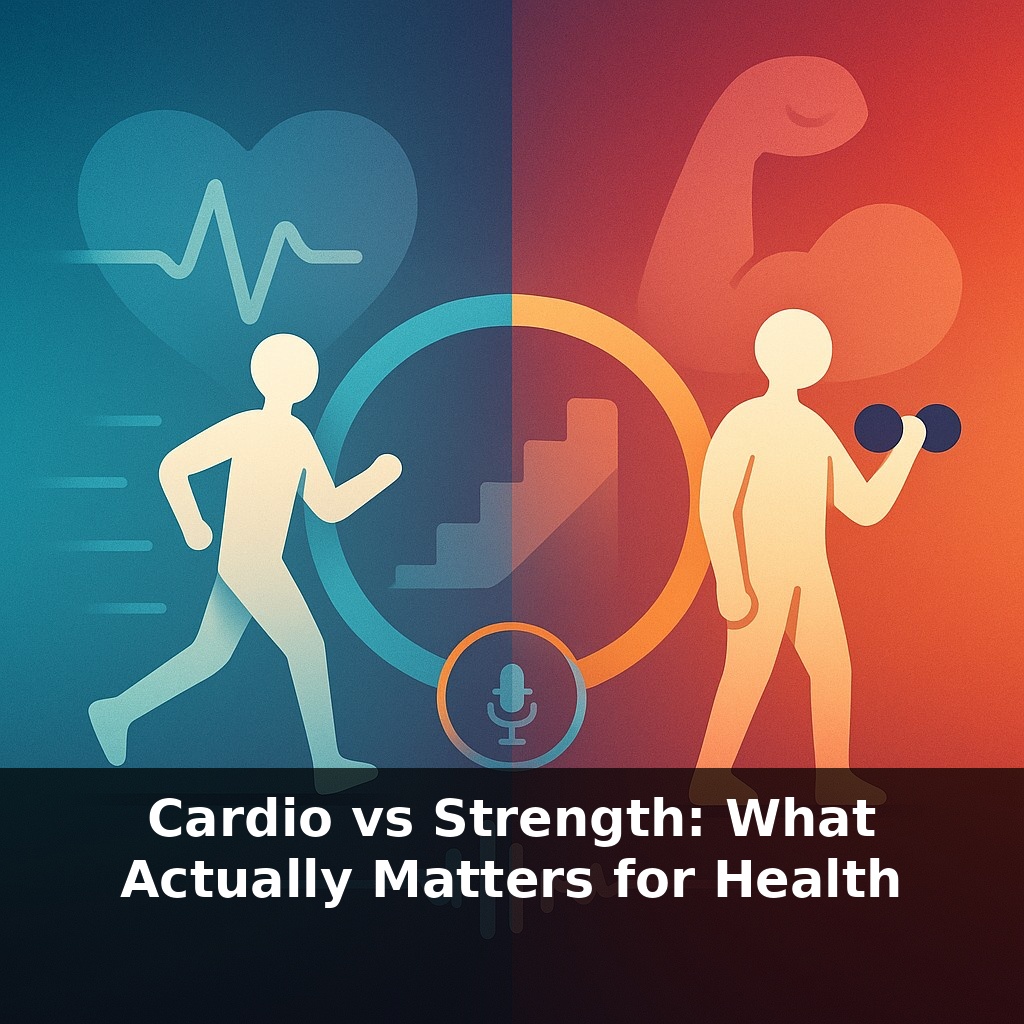
Here’s where cardio vs strength really stops being a theory debate and starts showing up in your blood work, your joints, and your mood. Cardio leans hard on your heart, lungs, and blood vessels; strength leans on your muscles, bones, and nervous system. Your body quietly “votes” after every week: are you better at moving longer, or better at resisting load—or both? Over months, that vote shows up as how easily you keep up with kids, how stable you feel on stairs, how often you get winded, and how confident you are picking up something heavier than you meant to.
Here’s where the trade‑offs get interesting. When you mostly move in long, steady efforts—brisk walks, easy runs, cycling—you’re teaching your body to become a fuel‑efficiency expert. Over weeks, it quietly upgrades how well you use oxygen, ferry fats and carbs to working tissues, and clear waste so you can keep going. That’s why even modest improvements in VO₂ max show up later as fewer cardiac events and a lower chance of “I’m fine” suddenly turning into a hospital visit.
Shift the dial toward heavier, slower work—squats, presses, pull‑ups, rows—and the upgrades look different. Instead of just going longer, you’re upgrading how much force you can produce, how quickly you can call on it, and how well joints stay aligned while you do it. This is what decides whether a misstep on a curb becomes an awkward stumble or a broken wrist, and whether you can still get out of low chairs easily in your 70s.
The magic isn’t in choosing a side; it’s in how the two types of stress talk to each other. Push your breathing hard a few times a week and you increase the “ceiling” for how much work your body can handle in total. Build more muscle and stronger connective tissue, and you raise the “floor”—the minimum capability you walk around with all day. A higher ceiling plus a higher floor means a bigger safe zone for everything else in your life: sleep, mood, focus, even how resilient you are to bad food or stressful weeks.
Think of it like a basic medical toolkit: one part is about keeping vital systems robust enough that problems show up later and milder; the other is about giving you the physical “equipment” to handle whatever still gets through. Neglect either side and small issues become big ones faster.
In day‑to‑day terms, that might mean your “easy pace” walk gradually becomes faster at the same effort, while the grocery bags that once felt heavy start registering as “no big deal.” The real win isn’t just burning more calories; it’s that your normal life tasks slide further and further into the “effortless” zone, leaving you more energy—both physical and mental—for the parts of life that actually matter to you.
Think of your week like a budget: you only get so many “effort dollars,” and how you spend them changes what your body quietly invests in. Put almost everything into long, steady movement and you’ll probably cruise through step counts but stall when a suitcase needs heaving into an overhead bin. Spend it all on heavy lifts and you might own the weight room, yet feel oddly spent after a day of errands.
Concrete example: Person A does 5 brisk walks a week, no lifting. They glide through a 5K charity event, but their back complains during a weekend of cleaning and rearranging furniture. Person B lifts 3 days a week, no focused movement between. They can carry every grocery bag in one trip, but a short hike with hills feels like punishment.
Now zoom in on you: which scenario feels uncomfortably familiar, even if the details differ? If your calendar is full of only one “flavor” of effort, your body is quietly majoring in that and minoring in everything else. That’s fine—until life gives you an exam in the subject you’ve been skipping.
Skipping focused movement now might quietly reshape your future options more than you think. As lifespans stretch, the real gap won’t be “who lives longer,” but “who can still do what they care about.” The choices you make this year nudge that curve. Consistent, mixed training acts like compound interest on your physical independence: small deposits today can mean carrying grandkids, traveling light, or simply climbing stairs tomorrow without needing to negotiate with your body first.
Over the next few months, notice where life still feels “heavy”: maybe it’s a long day in the garden, a city weekend on foot, or hauling suitcases through a station. Use those friction points like trail markers, nudging you toward the mix of movement that makes ordinary days feel more like cruising on a bike path than grinding up a gravel hill.
Try this experiment: For the next 10 days, alternate between a “cardio day” and a “strength day” and score your energy, mood, and sleep each morning from 1–10. On cardio days, do 25 minutes of continuous zone 2 work (easy jog, brisk walk uphill, or cycling where you can still hold a conversation). On strength days, do 3 sets each of goblet squats, pushups (incline if needed), and dumbbell rows, choosing a weight where the last 2 reps feel challenging but doable. At the end of 10 days, compare your scores and notice which type of training leaves you feeling better overall—and use that to adjust your weekly routine going forward.