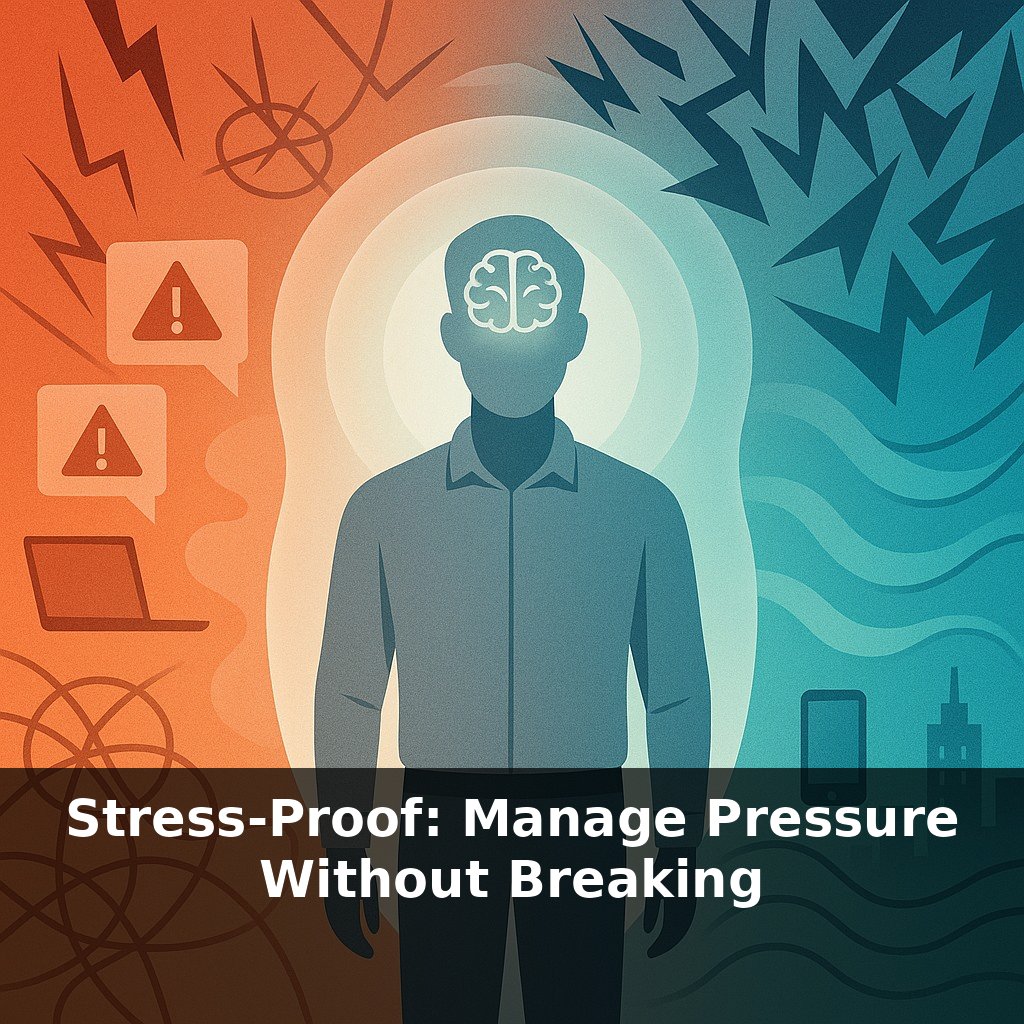
About half the people who say they’re “good under pressure” already show early wear and tear in their bodies. You push through deadlines, family drama, bad sleep… and it works—until it doesn’t. This episode asks: how do you train now so stress doesn’t own your future?
Resilience isn’t about “toughing it out”; it’s about how efficiently your body and brain reset after stress. That reset is trainable. In one study, 12 weeks of regular aerobic exercise boosted baseline heart-rate variability by up to 25 %, a sign the nervous system is recovering faster, not just enduring more. Eight weeks of mindfulness training at one large insurer cut medical visits by over a third, suggesting daily stress didn’t translate into as many health problems.
In this episode, we shift from putting out fires to rewiring the system that keeps starting them. You’ll see how small, repeatable inputs—like 150 minutes of weekly exercise, a consistent sleep window, and brief cognitive “reset” drills—can lower inflammatory markers, stabilize cortisol, and strengthen the brain circuits that help you stay steady under load. Think of this as your blueprint for stress-proofing the next 10–20 years, not just surviving this quarter.
Most people underestimate how fast chronic pressure can reshape their biology. In one University of Chicago study, cutting sleep below 6 hours for just a week raised cortisol by 21 % and C‑reactive protein by 30 %—shifts more typical of aging several years. The upside: the same systems that degrade can be rebuilt. Regular aerobic training has lifted baseline HRV by 10–25 % in only 12 weeks, and strong social networks are linked to a 50 % greater chance of living past 70. In this section, you’ll turn those numbers into a concrete, weekly “resilience stack” that steadily lowers your long‑term health risk.
Up to this point, we’ve focused on why a “resilience stack” matters. Now we’ll translate that into specific, trackable targets you can actually hit in a normal week—without turning your life into a biohacking project.
Think in three layers: body, mind, and connection.
Body first. If 150 minutes of moderate exercise per week feels abstract, break it into 5 blocks of 30 minutes. Three can be brisk walking (enough that talking is possible but singing is not), and two can be slightly harder sessions—cycling, jogging, rowing, or stairs. Aim for at least one session that nudges you into short, 30–60 second bursts where your breathing noticeably deepens, repeated 6–8 times with easy recovery. People following similar “polarized” weeks often see resting heart rate drop by 3–5 beats per minute in 2–3 months, a sign their baseline load is lower.
Next, guardrails for sleep. Instead of chasing a perfect 8 hours, set a fixed “sleep window” of 7.5–9 hours that’s consistent within 30 minutes every day, including weekends. For example, 11:00 p.m.–6:30 a.m. If you currently average 6 hours, move by 15 minutes per week, not an hour overnight. In clinical programs, even a 45‑minute extension over a month has been linked to measurable improvements in reaction time and error rates on cognitive tests—practical proof that your brain is resetting more fully.
For the mind layer, use brief, repeatable drills. One simple protocol: twice per day, run a 2‑minute “physiological sigh” session (double inhale through the nose, long exhale through the mouth, repeated 8–10 times), followed by 60 seconds of deliberately labeling what you’re feeling in one word. Participants using similar micro‑practices have shown reductions of 15–20 % in self‑reported tension scores within 4 weeks, even under unchanged workloads.
Finally, connection. Don’t aim to “be more social”; schedule one 20–30 minute, device‑free interaction at least three times per week: a walk with a colleague, a call with a friend, dinner without phones. Longitudinal data suggest that adding even one regular confidant—someone you can be honest with—can cut the odds of future depressive episodes by roughly a third.
None of this requires a retreat or a radical lifestyle overhaul. You’re building small, repeatable patterns that, over months, quietly reshape how your system carries and clears pressure.
A practical way to test this “resilience stack” is to treat it like a 4‑week pilot program with clear metrics. For exercise, pick a baseline you can measure without gadgets: time to comfortably walk 1 km. If it takes you 12 minutes now, aim for 10–11 minutes by week 4 using the 5‑session plan. For sleep, track “groggy mornings” on a 0–3 scale. If you log 15 days at level 2–3 in a month, your first target is to bring that under 10 simply by tightening your sleep window.
For mental resets, choose one recurring trigger—say, your 9 a.m. inbox check—and pair it with a 3‑minute protocol (2 minutes of breathing, 1 minute of labeling). If your average perceived tension around that task is 7/10, see if you can bring it to 5/10 by the end of the month.
To harden the social layer, identify exactly 2–3 people you’ll invest in. Schedule 12 device‑free conversations in 4 weeks—roughly three per week—and note after each one: energy up, down, or neutral. Keep the people and patterns that reliably move the needle up.
Within five years, most phones and watches will quietly learn your personal “overload signature”: maybe your breathing shifts by 3–4 breaths per minute or your typing speed drops 15 %. Systems already detect this with >80 % accuracy in pilots. Use that trend to your advantage. Your challenge this week: pick ONE existing metric—steps, sleep, or focus time—and decide a clear “yellow zone” threshold where you’ll automatically switch to a 3–minute reset, no debate.
Use your “yellow zone” as a training cue, not a failure. Each time you run your 3‑minute reset, you’re adding one rep to the system you want for age 60, not just surviving age 35. Over a year, even 3 resets per workday equals ~750 short sessions—enough repetition to make calmer responses under pressure your new default, not the exception.
Start with this tiny habit: When you first touch your phone in the morning, pause and take **one slow breath** while silently saying, “Body, you’re safe right now.” Right after that breath, gently **relax your shoulders for just three seconds** to tell your nervous system it can stand down. In the evening, when you turn off a light for the night, **name one small stress your body handled today** (“That traffic jam,” “That awkward meeting”) and say, “And I’m still here.” Do this daily; you’re quietly training your stress response to reset instead of stay stuck on high alert.