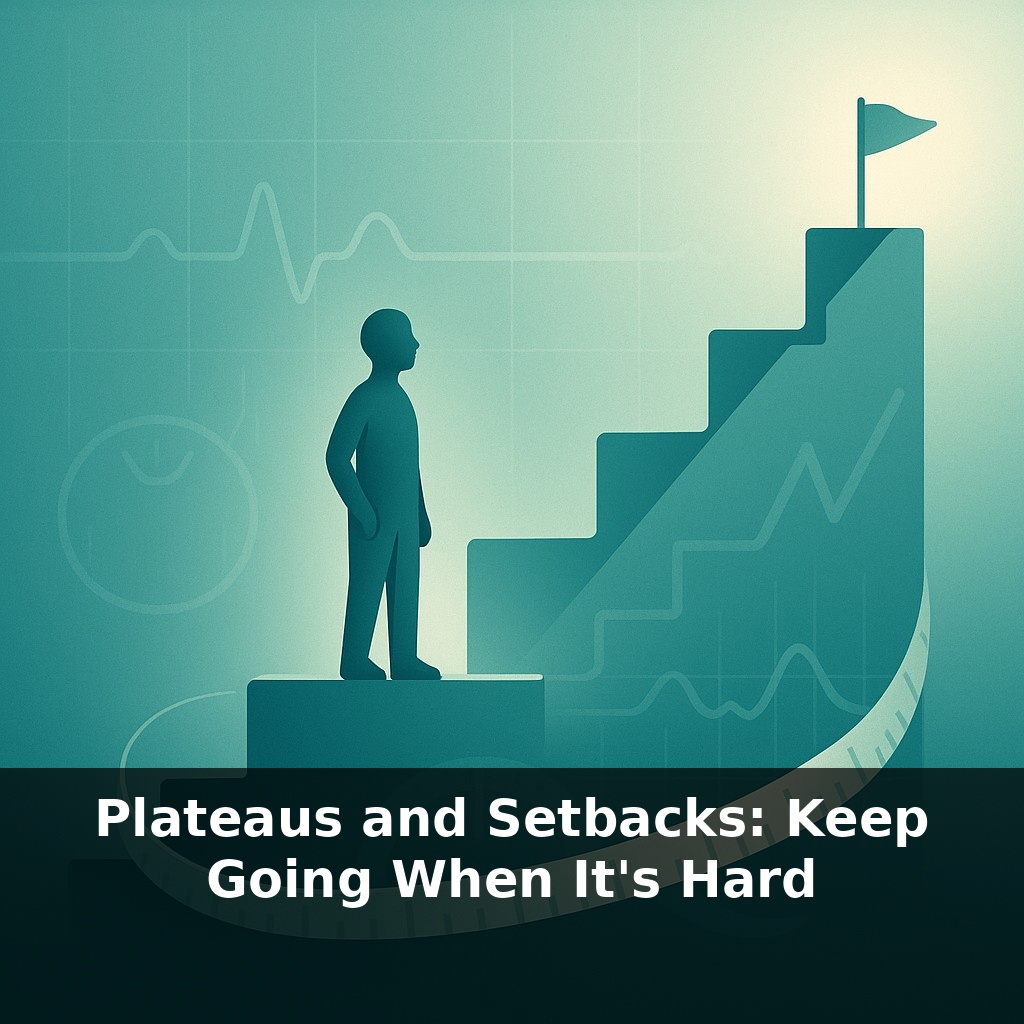
“Your body is designed to fight weight loss. After the first few weeks, it quietly burns fewer calories and cranks up your hunger. So here’s the twist: when your progress suddenly flatlines, it might mean your biology is working perfectly—not that you’re doing anything wrong.”
About 80% of people who lose weight gain most of it back within five years. That sounds discouraging—until you notice the missing detail: the other 20% don’t succeed because everything went smoothly; they succeed because they learned how to keep going when it didn’t.
This is where plateaus and setbacks come in. Not as villains, but as checkpoints. A plateau can show you that your current routine has done its job and now needs upgrading. A setback can highlight hidden triggers—stress, social pressure, sleep, old habits—that were always there, just waiting for a tough week.
Think of this phase less like “I blew it” and more like “I’ve reached the part of the hike where the trail gets steeper and the map finally matters.” Now we’re going to zoom in on that map: what to do, what to expect, and how to keep moving when progress slows or even reverses.
Some of what feels like “stuck” or “slipping” is actually your body and brain updating their settings. Hormones nudge you to eat more. Old reward pathways light up when you’re stressed or tired. Your schedule shifts, your social life pulls, and suddenly the routine that felt natural last month feels awkward and fragile. Instead of treating this as a verdict on your willpower, we’re going to treat it like feedback: data you can use. In this episode, we’ll turn those vague “why is this so hard?” moments into specific knobs you can adjust—food, movement, mindset, and environment—one small dial at a time.
About 15%—that’s how much your resting burn typically drops after losing just 10% of your body weight. Add in moving a bit less without noticing and getting more efficient at your workouts, and the “same” plan quietly becomes a smaller deficit or no deficit at all. That’s why a plateau often shows up not as a dramatic event, but as a slow fade: your clothes stop changing, the scale hovers, your energy dips, and your brain whispers, “Why bother?”
This is where precision beats drama.
Instead of slashing more calories or doubling your cardio, think in terms of small, testable adjustments. One option is a “maintenance phase”: a few weeks where you deliberately hold your current weight, eating slightly more while tightening skills—consistent meal timing, basic tracking, strength training form, sleep. Research shows this kind of pause can ease some of the metabolic pressure and make the next loss phase more productive.
Strength work deserves special attention. Lifting 2–3 times per week helps you keep muscle, which cushions some of that drop in daily burn. The goal isn’t to become a powerlifter; it’s to give your body a reason to hang onto the tissue that keeps your engine from shrinking more than it has to.
Setbacks require a different lens. Instead of asking, “How do I undo the damage?” ask, “What made the old pattern the easiest option in that moment?” Was it late-night work, weekends with friends, travel, conflict, boredom? Those aren’t character flaws; they’re contexts. When you name the context, you can design friction: fewer default snacks in reach, simpler meals ready to reheat, boundaries around bedtime, a go-to “good enough” order at your favorite restaurant.
Here’s where self-monitoring quietly shines. People who track at least a few days per week aren’t just more diligent; they spot patterns earlier. The logging isn’t punishment—it’s a flashlight. It shows you that Thursday nights are your danger zone or that skipped lunches lead to overeating later. Then you adjust one lever at a time.
Your challenge this week: run a 7‑day “stall or slip” experiment. Each day, quickly note just three things: how you slept, your stress level (1–10), and the *one* moment you felt closest to giving up—or actually veered off plan. No judgment, no calorie math, just context. At the end of the week, look for repeats: same time of day, same place, same people, same emotion.
Once you spot a pattern, design a tiny counter‑move you can test next week. For example:
- If late-night scrolling pairs with snacking, charge your phone in another room and keep a book or puzzle by the bed. - If work stress sends you to the drive‑thru, pre‑decide a “better, not perfect” order and save it in your notes. - If weekend socializing blows up your structure, add a consistent anchor—like a protein‑heavy breakfast and a 10‑minute walk before events.
Treat this like a curious scientist, not a judge. The goal isn’t a flawless week; it’s to discover your most common friction points and install one small support where it counts most.
Think of this phase like adjusting a complex medication regimen: the dose that worked at first may need fine‑tuning as your “labs” (sleep, mood, routines) change. A doctor doesn’t throw out the whole treatment; they tweak timing, amount, and combinations, then recheck.
Let’s translate that to real life. Say Sunday nights always end with overeating. Instead of vowing to “be good,” you might prescribe yourself a pre‑emptive, higher‑protein dinner and a 10‑minute walk while a show plays on your phone. If travel derails you, your “dose change” could be swapping one airport pastry for a yogurt and building a rule: every hotel stay gets a stocked mini‑fridge with at least two easy options.
Your tools can be just as practical: a sticky note on the pantry that says “pause and pour water first,” a recurring calendar reminder titled “10‑minute reset,” or a friend you text a single word—“wobble”—when you’re close to bailing on your plan. None of these erase hard days, but together they shift the odds, turning each plateau or setback into another round of intelligent adjustment instead of another reason to quit.
Soon, “keep going when it’s hard” may come with backup you don’t have yet. New meds like GLP‑1/GIP agonists can quiet some of the body’s pushback, while wearables and glucose sensors may flag stalling patterns before you notice them—like a weather app warning of a storm so you grab an umbrella early. AI coaches could nudge tiny course-corrections, and more walkable cities might mean your default day helps you out, even when your motivation doesn’t.
Progress, then, is less a straight path and more like tending a small garden: some weeks you prune, some weeks you just keep things alive. What matters is staying engaged with the process. When a tough stretch hits, you’re not starting from zero; you’re returning with better tools, clearer patterns, and proof you can outlast the rough patches.
Start with this tiny habit: When you notice yourself thinking “Nothing’s working” or “I’m stuck,” pause and say out loud, “I’m in a plateau, not a dead end.” Then, open the notes app on your phone and type exactly one sentence describing *one* thing you did today that moves you 1% closer to your goal (like “I sent that email,” “I did 5 minutes of practice,” or “I showed up even though I was tired”). If you truly did nothing, type: “Today’s win: I’m still in the game.”