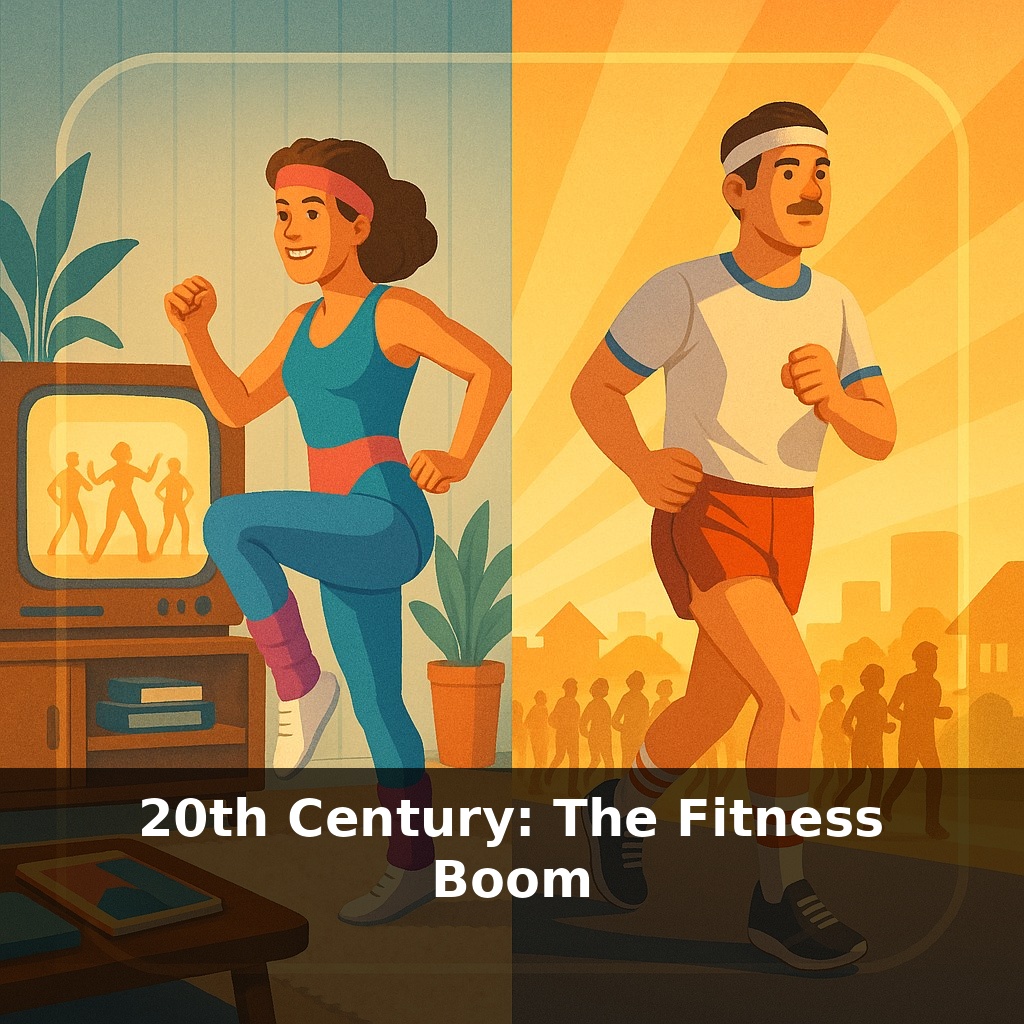
By the late 1900s, more Americans were paying monthly fees to sweat on purpose than to rent movie tapes. In one living room, a mom in leg warmers kicks along with a TV workout; down the street, a dad laces up cheap running shoes to jog with thousands of new fitness fans.
By the 1970s and 80s, movement wasn’t just something you did; it was something you *joined*. A paperback could send you outside to jog, a glossy magazine cover could sell you a new ideal of how a “healthy” body should look, and a plastic card on your keychain could unlock a fluorescent-lit room full of machines promising transformation.
Doctors had started sounding alarms about sitting all day, but it was pop culture that turned concern into a craze. Music pumped from boom boxes, bright leotards filled TV screens, and suddenly entire neighborhoods seemed to be in motion—following choreographed steps, counting reps, logging miles.
The new twist? You didn’t have to compete or perform for a crowd. You only had to show up: in your living room, on a sidewalk, or under the mirrored ceiling of a strip‑mall studio, where sweat became a kind of social currency.
Cardio research and heart‑disease charts weren’t exactly beach reading, but they quietly rewired public expectations. A checkup could now come with a prescription to move more, the way a mechanic recommends an oil change. At the same time, post‑war paychecks and shorter workweeks carved out evenings and weekends that didn’t exist for earlier generations. Those spare hours became fertile ground for new habits: a neighbor invited you to a jogging group, a coworker mentioned a lunchtime class, a magazine column nudged you to log your miles like balancing a checkbook.
Seventeen million plastic bricks of magnetized tape sat in living rooms and dorms by the mid‑1980s, all stamped with the same name: Jane Fonda. That number wasn’t just a sales record; it was proof that the center of gravity was shifting from stadiums and school fields to carpets and coffee tables. You no longer needed a coach, a team, or even a schedule—you needed a VCR and enough floor space to lie down.
Behind that living‑room revolution, a few big forces were speeding things up. Scientists were publishing dense papers on oxygen uptake and heart disease, but entrepreneurs translated those graphs into glossy promises. Dr. Kenneth Cooper’s bestseller didn’t just list mile times; it handed readers clear targets and a sense of control. Readers didn’t meet him in a lab—they met him on page 73 with a simple table telling them where they stood and how to improve.
Gyms, once the domain of boxers and serious lifters, realized there was an untapped crowd that was curious but intimidated. Nautilus machines arrived like user‑friendly interfaces: numbered settings, fixed paths, padded seats. Instead of learning barbell technique from a grizzled regular, a newcomer could follow a circuit that quietly imposed order—ten repetitions here, move to station two, then three. It felt more like navigating an office copier than handling industrial steel.
Meanwhile, shoe companies and apparel brands discovered that identity could be stitched and glued as much as trained. The same neighborhood that wore running shoes to actually jog started wearing them to the mall, blurring the line between fan and participant. Music videos and magazine ads pulled celebrity bodies into everyday comparison, turning a private choice about how you spent an hour into a visible statement about who you were.
Mass media stitched these strands together. Morning shows demoed new routines, late‑night infomercials sold contraptions that promised shortcuts, and every channel seemed to feature someone sweating under bright lights. The message was less “be an athlete” and more “opt in”—to a class, a tape, a club key tag, a mailing list promising the next big thing. Bit by bit, the default evening at home started to compete with an invitation to follow along with strangers who felt oddly familiar.
Step into a 1980s strip‑mall studio: fluorescent lights hum, a wall of mirrors doubles every person, and the instructor calls first‑timers by name. That room worked like a tiny laboratory for behavior change. Lights, music, and timing were engineered so you didn’t have to negotiate with yourself; once class started, you were carried along by the playlist and the crowd.
Down the block, a big‑box gym quietly ran its own experiment. Rows of treadmills faced TVs, not windows, so you’d anchor the effort to a favorite show instead of the clock. Staff scheduled peak “after work” classes like prime‑time programming, knowing that if it felt like missing an episode, you’d come back.
Even the checkout aisle got involved. Magazines promised “30 days to a stronger you,” bundling calendars, before‑and‑after stories, and glossy gear ads into a single package. It wasn’t just selling a plan; it was selling a future snapshot of yourself you could almost flip to.
Seventeen million Fonda tapes foreshadowed a world where guidance lives in your pocket instead of your VCR. The next wave may treat your daily data stream like a weather report: streaks of sitting, bursts of effort, stress “storms” moving in. Insurance plans could reward “streaks” like loyalty programs, while cities redesign streets the way malls once redesigned interiors. Your phone might negotiate with your calendar, slipping in micro‑sessions the way email inserts notifications—quietly, persistently, until they feel inevitable.
Now the question is less “*whether* you do something” and more “*who* gets to shape what you do next.” Tech firms, city planners, and even employers are quietly writing the next chapter—deciding whether your day feels like a maze of escalators or a park path with frequent benches, small nudges woven into routes you already travel.
Try this experiment: For the next 7 days, train like a “mini 1970s–80s fitness boomer” and log how you feel before and after each session. Do one classic Jack LaLanne–style calisthenics circuit (push-ups, sit-ups, jumping jacks, bodyweight squats) for 10–15 minutes in the morning, then an “aerobics era” session in the afternoon or evening—pick a basic step aerobics or Jane Fonda–style video on YouTube and follow along for 20 minutes. Notice which style leaves you more energized vs. drained, and how your mood, sleep, and motivation shift over the week. At the end, decide which era’s style you want to keep as your “default” workout vibe for the next month.