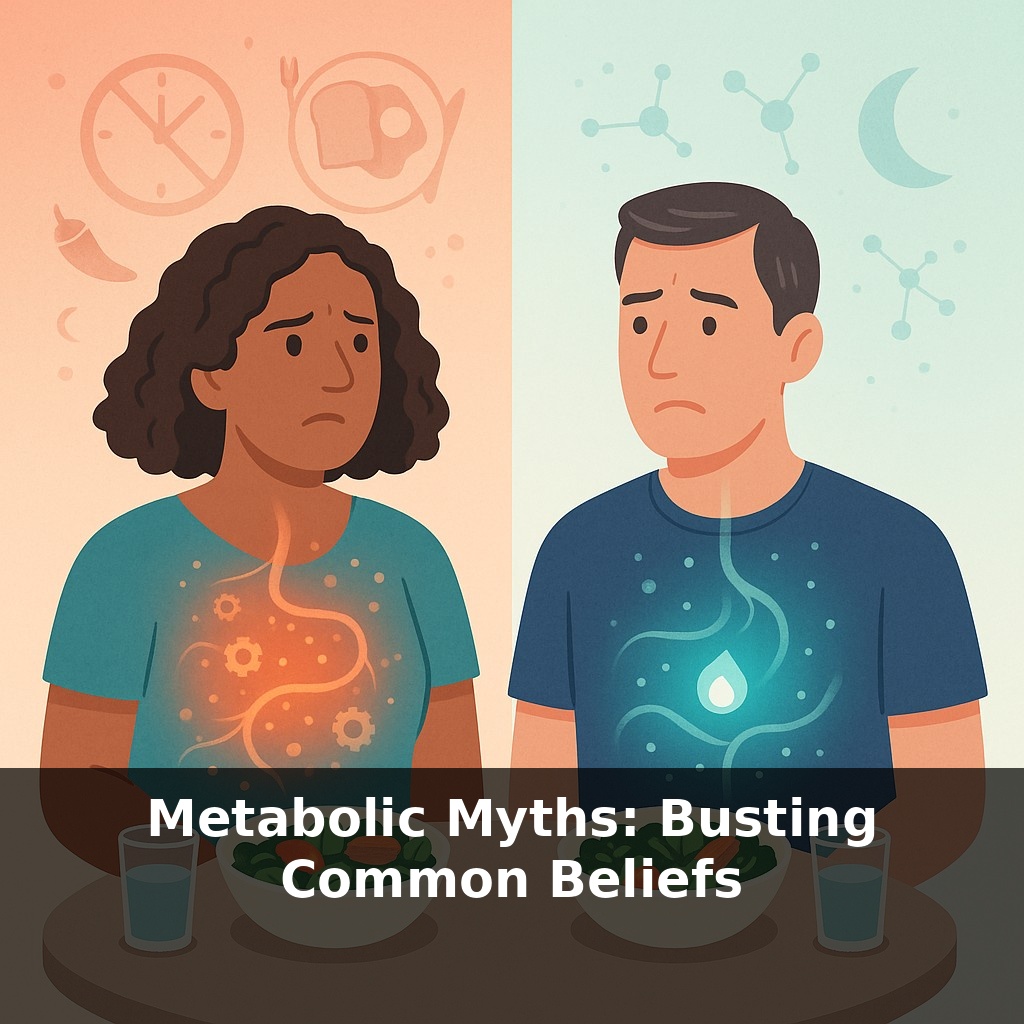
Your metabolism today isn’t drastically slower than it was in your twenties—most of the change comes decades later. So why do so many people feel “broken” by midlife? Picture two friends eating the same lunch, one gaining weight, one not. What’s really going on under the hood?
Here’s the twist: most of what the internet blames for your “slow metabolism” barely moves the needle. Skipped breakfast? Late-night snack? That spicy “fat-burning” dinner? In studies, these barely register compared to things you almost never see in bold headlines: how much you move without thinking, how much muscle you carry, and how your body quietly adjusts after big weight changes.
This is where the myths get sneaky. They sound scientific—“starvation mode,” “metabolic switch,” “hormone reset”—but usually take small, real effects and blow them up into magic fixes or doomsday stories. Instead of asking “What ruined my metabolism?” a more useful question is “Which levers do I actually control, and how strong are they?”
In this episode, we’ll zoom in on those levers, separate signal from noise, and show you what truly changes your daily burn—and what truly doesn’t.
To make sense of the noise, we need a clearer map of what actually drives daily energy use. Researchers usually split it into three big pieces: the calories it takes just to keep you alive at rest, the extra burn from digesting food, and everything you spend on movement—from planned workouts to fidgeting in a meeting. Most viral advice focuses on tiny tweaks to one piece, then promises life-changing results. In reality, the most meaningful shifts come from slow, often boring changes in these three areas that quietly add up over months, not from dramatic “metabolic hacks” in a single week.
Here’s where the numbers cut through the noise.
First, that “my metabolism died at 30” story doesn’t match large population studies. When researchers measure energy use in thousands of people from childhood to old age, they find it stays remarkably stable from about 20 to 60, once you account for body size and composition. The noticeable drift starts later: after 60, the average decline is about 0.7 % per year. That’s slow erosion, not a cliff.
So why do the thirties and forties feel so different? Two big, quiet shifts: loss of muscle and changes in how you move through the day. Muscle is metabolically “expensive” tissue. Add 1 kg and you burn maybe 10–15 extra kcal per day doing nothing at all. That’s not a license to “eat anything,” but add 3–4 kg over time and you’ve built yourself an extra snack’s worth of daily wiggle room—every day, for as long as you keep that muscle.
Movement is even more powerful. Non-exercise activity—the stairs you take, the walking you skip, how much you stand, fidget, carry things—can differ by hundreds of calories per day between people of the same size. That’s the piece most “slow metabolism” complaints are actually pointing at, without realizing it. Two office workers can have nearly identical resting needs but radically different totals by 8 p.m. simply because one paces on calls and the other sits still.
What about the popular “boosters”? Caffeine can nudge your burn up 3–11 %, but only for a couple of hours, and the bump is small in absolute terms—maybe a few dozen calories for a typical dose. “Fat-burning foods” mostly lean on the thermic effect of food: protein costs more energy to process (roughly 20–30 % of its calories) than carbs or fats. That’s useful when planning meals, but again, we’re tweaking the margins, not rewriting the rules.
Even after big weight loss, when people see some metabolic adaptation, the downshift is usually in the 5–15 % range of total daily expenditure. Annoying? Yes. Catastrophic? No. It means maintenance calories might be a bit lower than a simple calculator predicts—not that your body has stopped responding to effort.
Your challenge this week: pick one “lever” you can test in real life. Either (1) add one short, daily movement habit that doesn’t feel like a workout—like a 10-minute walk after lunch—or (2) add 20–30 g of protein to one meal. Keep everything else as steady as you reasonably can. At the end of 7 days, note any changes in appetite, energy, or how your clothes fit—not because a week will transform you, but to feel how small, repeatable choices beat dramatic “metabolic hacks.”
Think of your metabolism like a software system receiving periodic updates, not a gadget with a single on/off turbo button. Real people’s stories often reflect this. A beginner who lifts twice a week for a year might add a few kilos of lean mass and notice they can maintain their weight on an extra slice of bread or a small latte most days—not a cheat-day binge. Someone who switches from driving to cycling for short commutes doesn’t feel a “metabolic reset”; they just slowly outgrow a belt notch in the right direction over months.
You can see the flip side when a step tracker reveals how a “busy” work-from-home day barely cracks 3,000 steps. Nothing is broken; the code is just running fewer tasks than you thought. Elite endurance athletes provide an extreme contrast: they often burn double a typical adult’s daily energy, not because of hacks, but because their “background processes” (training volume, recovery, long-term adaptation) are dialed up for years. The principle scales down: small, consistent inputs, compounded, beat dramatic overhauls almost every time.
Here’s where this gets exciting. As wearable sensors, at-home blood tests, and continuous glucose monitors improve, your “metabolic profile” could look less like a single number and more like a detailed training log. Nutrition plans may start to resemble software updates: small patches pushed regularly based on how your body actually responds in real time. Your challenge this week: note one situation where data—not guesses—could change the way you eat, train, or recover.
So instead of hunting for a hidden “fix,” you’re really learning a long game: small shifts, tested and repeated, gradually rewrite your body’s default settings. Over months, patterns emerge—how sleep, stress, and training days change your hunger or progress. Let curiosity lead here; treat each week like a new lab trial, not a verdict on your willpower.
Try this experiment: For the next 10 days, keep your total calories the same but swap 30–40% of your usual carbs (like pasta, bread, juice, snacks) for protein-rich foods (eggs, Greek yogurt, chicken, tofu, cottage cheese) at each meal. Don’t change your exercise routine at all. Each day at the same time (for example, right when you wake up and right before bed), rate your hunger on a 1–10 scale and note whether you feel more or less “energy crashes” after meals. At the end of the 10 days, compare how often you felt truly hungry, how stable your energy felt, and whether your cravings went up or down—this will show you how much protein and food quality (not “a broken metabolism”) affect how your body feels.