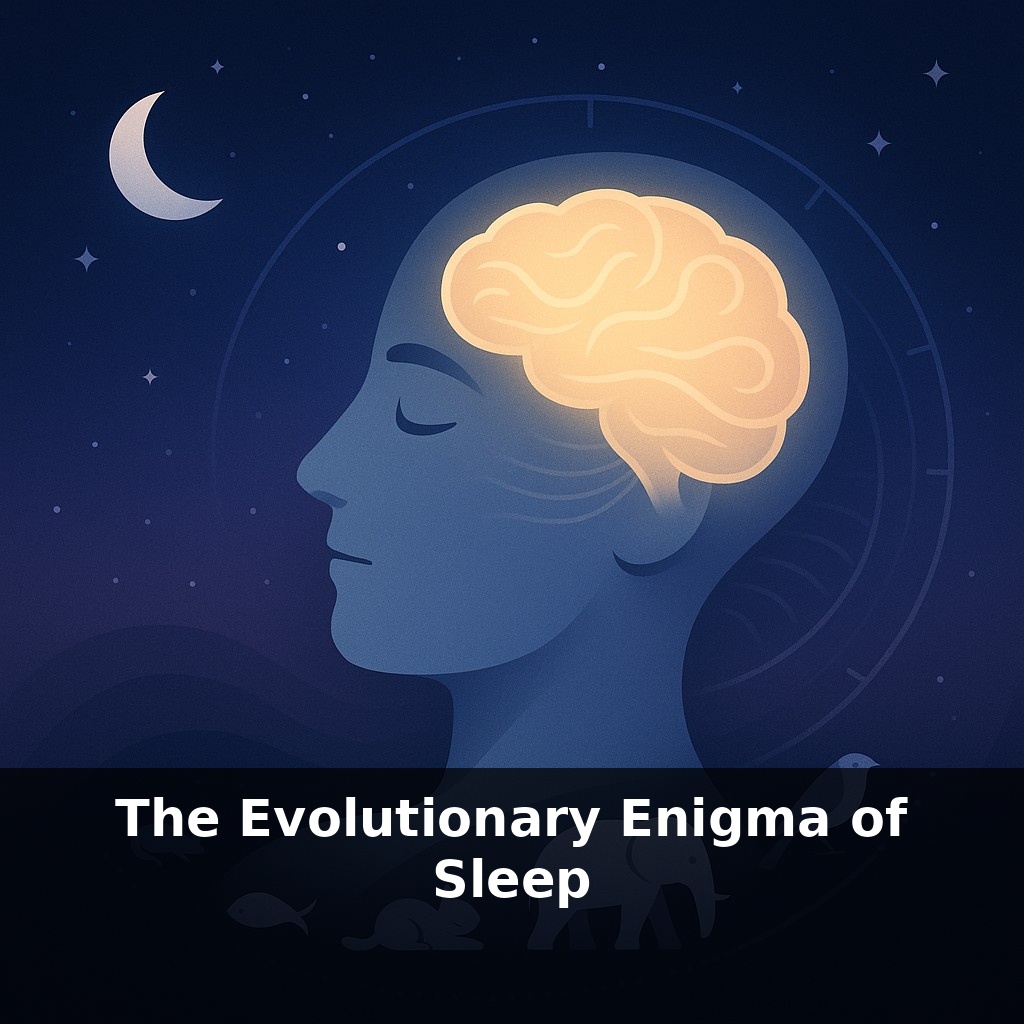
The Evolutionary Enigma of Sleep
📝 Transcript
Right now, as you’re listening, whole species across the planet are deliberately going “offline,” lying motionless while predators roam and food goes uncollected. Why would evolution keep a habit so dangerous that, in lab rats, skipping it entirely is actually fatal?
If abandoning the waking world is so costly, the obvious question becomes: what payoff is big enough to justify it? Across the animal kingdom, the details of sleep look wildly different. Wild African elephants nap for barely two hours; certain birds sleep with half a brain at a time while still gliding; tiny fruit flies take brief dozes that still follow precise internal rules. Yet underneath these quirks, researchers keep finding the same pattern: when sleep is cut short or fragmented, things quietly start to break. Cells don’t recover as well from wear and tear, memories blur at the edges, and reaction times slow like a browser with too many tabs open. Even more strangely, when sleep is missed, many brains “push back,” forcing deeper or longer rest later, as if repaying a critical biological debt rather than indulging in optional downtime.
Across evolution, species have solved the “sleep problem” in wildly creative ways instead of deleting it. Dolphins let one brain hemisphere rest while the other stands guard. Migrating birds grab tiny sleep fragments mid-flight. Desert animals shift most of their rest to the safest, coolest hours. These aren’t signs that sleep is optional; they’re workarounds that protect a process the brain refuses to give up. It’s as if nature kept rewriting the schedule rather than canceling the show, suggesting that whatever happens during those hours is more fundamental than how, when, or where it’s squeezed in.
Across species, the clues to *why* sleep persists come from what quietly improves when it’s protected—and what unravels when it’s disturbed in very specific ways.
Shift just the **timing** of rest, for instance, and internal clocks fall out of sync. In humans, rotating night shifts don’t merely feel unpleasant; they’re linked to higher rates of metabolic disease, mood disorders and even certain cancers. Similar clock misalignment in animals scrambles hormone pulses, body temperature rhythms and feeding patterns, even if total rest time is held constant. That suggests evolution hasn’t only preserved rest itself, but also the choreography of *when* it happens relative to light, temperature and social activity.
Change the **type** of sleep, and different systems start to fail. When researchers selectively cut down REM-rich phases in animals, emotional responses grow exaggerated and learning that depends on flexible thinking falters, even if other rest periods are spared. Trim deeper, slow-wave phases instead, and you see disproportionate hits to physical recovery and basic alertness. Each “flavor” of rest seems to specialize: some stages quietly tune circuits for remembering, others reset stress chemistry or restore sensitivity to future rewards.
Then there’s what’s happening at the microscopic level. During certain stages, patterns of brain activity replay recent experiences in compressed bursts, strengthening or weakening particular connections. Other phases seem to enforce a kind of “budget cut” on overactive links, keeping neural traffic from turning into gridlock after a long, stimulus-heavy day. Even the fluid bathing the brain changes its flow while we’re offline, helping sweep out byproducts that accumulate during wakefulness.
Body-wide processes join in. Immune cells alter their patrol routes and signaling, which may be why vaccines are more effective when given before adequate rest. Energy use shifts gears; tissues temporarily prioritize repair over performance. Across all these layers, rest doesn’t look like a single switch the brain flips, but a rotating sequence of specialized tasks that are too disruptive to run at full volume while navigating predators, rivals and potential mates. Evolution, instead of finding a way around this constraint, appears to have doubled down—refining an intricate nightly routine that quietly keeps complex life viable.
A striking clue comes from animals that bend the “rules” without breaking them. Wild African elephants, for example, average barely two hours of rest, often skipping it entirely on nights when they travel long distances. Yet they don’t simply run on empty: on safer days, they enter deeper phases and pack more recovery into shorter windows, like a company compressing critical updates into a brief, carefully timed outage. Fruit flies show a similar pattern on a tiny scale. When researchers keep them active with mild stimulation, their later rest grows more intense and focused, and specific learning tasks recover first—as if their brains triage which “tickets” in the repair queue get resolved fastest. Even in humans, short-sleeping individuals who stay healthy tend to show unusually efficient transitions between sleep stages. The recurring theme is not “how long did you rest?” but “did the system protect the right operations, in the right order, often enough to stay stable?”
Rats dying in weeks without rest and elephants thriving on two hours hint at a deeper puzzle: how long could we safely shrink our own nights if we knew exactly which neural “jobs” mattered most for health? Your challenge this week: notice when your sharpest ideas or nastiest moods appear—after solid rest or after cutting corners. Treat it as a personal experiment in mental “interest rates,” where small nightly deficits quietly accumulate into costly long-term loans.
So the puzzle isn’t just *why* we shut down, but how precisely each brain has tuned that shutdown to its niche. Your nights are part of that long experiment. Think of each decent stretch of rest as a small deposit into a long-term project; you rarely see instant results, but over months the “account balance” quietly shapes what you can learn, risk, and recover from.
Try this experiment: For the next 3 nights, delay your usual bedtime by 90 minutes but keep your wake-up time fixed, and notice how your sleep pressure (that strong “need to sleep” feeling) builds and how quickly you fall asleep once you finally get into bed. On night 4, go to bed at your *normal* time again and see if you fall asleep faster and sleep more deeply, as your brain “defends” its sleep need like the podcast described. During the day after each night, casually rate your alertness (e.g., “foggy,” “okay,” or “sharp”) every few hours and see how even mild sleep restriction changes your daytime functioning. This little self-deprivation/recovery cycle lets you feel firsthand why evolution worked so hard to protect sleep.
From this course
The Mysteries of Sleep Unveiled
5 episodesUnlock all episodes
Full access to 5 episodes and everything on OwlUp.
Subscribe — $1.99/monthLess than a coffee ☕ · Cancel anytime